

It was a late afternoon at the end of the year, but the small roads leading to the red pomelo orchards in Tan Lac commune were unusually quiet. On both sides of the road, the orchards were ablaze with red pomelos, a mix of large and small fruits lying both on branches and under the trees. There were no sounds of harvesters, no trucks waiting to load the fruit, only the faint scent of ripe pomelos in the air, evoking a feeling of both abundance and melancholy.
"This year, the red pomelos from Tan Lac are practically being given away for free," said Mr. Bui Van Quynh, head of Chong Vach hamlet, Tan Lac commune, gesturing towards his pomelo orchard. His voice lowered. The entire hamlet has nearly a hundred hectares of red pomelo trees, but this season, not many pomelos have sold, and even those that have sold are fetching very low prices. Some households still have ripe red pomelos left on the trees, falling to the ground without a single buyer inquiring.
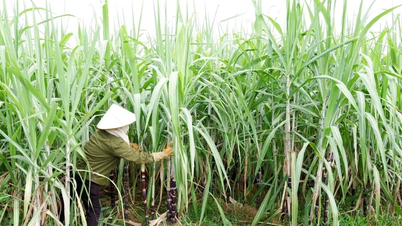
Mr. Quynh's family has been involved with red pomelo cultivation for many years. Last year, his orchard had nearly 100 red pomelo trees ready for harvest. However, the price of pomelos dropped sharply and repeatedly, meaning the money from selling the fruit wasn't enough to cover the maintenance costs. From last year to this year, he decided to cut down most of the trees, keeping only a few for his own consumption. The remaining land is now used to grow sugarcane. "Cutting them down is heartbreaking, but if we don't, we'll lose even more money, and the revenue won't even cover the expenses," Mr. Quynh sighed.

The pomelo orchards used to be the pride of the people of Tan Lac commune.
The story of Mr. Quynh's family is not unique. In the village, many households have had to hire people to cut down their pomelo trees to sell as firewood, some even cutting down entire orchards. The pomelo trees, once their main source of income, now lie stumps, sap still oozing from the saw marks, a testament to an unavoidable decision.
The price of Tan Lac red pomelos at the beginning of January 2026 was mentioned by locals with figures that shocked and saddened anyone who heard them. Small pomelos, sold in loads of 40-50 fruits, sometimes only fetched 15,000-20,000 VND per load, which works out to less than 500 VND per fruit. Larger fruits only fetched slightly more, around 1,000 VND per fruit at the orchard. Some days, traders offered such low prices that farmers didn't even want to harvest them, letting the ripe pomelos fall naturally. Some days they sold some, some days they didn't. And even when they did sell, it wasn't worth much.

The grapefruit tree stump, which had just been cut down, was still oozing sap.
Never before have pomelo prices been this low. Previously, at the beginning of the season, red pomelos used to sell for a few thousand dong per fruit, with traders coming directly to the orchards to buy them. But now, the trees are full of ripe pomelos, but there are no buyers.
The worries are even greater for households with large-scale pomelo orchards. In the village, some households cultivate 3 to 4 hectares of red pomelos, and to date, they haven't sold a single fruit. The pomelos, left for too long, fall to the ground, their segments become crushed, and they lose their value.
Ms. Bui Thi Nhat from Tan Lac commune said: "If there were a stable market, we would still want to keep growing pomelos, but if we can't sell them or the price is too low, we can't keep doing it forever."
The main reason for the plummeting price of pomelos is the complete dependence on traders for sales. Without guaranteed purchase contracts or stable distribution channels, when the market slows down, pomelos immediately become unsaleable. Furthermore, the area planted with pomelos increased rapidly in previous years, mainly driven by trends, leading to an oversupply. Preservation and processing have received almost no investment. Pomelos can only be sold fresh for a short period; when they ripen, they become even harder to sell. When traders refuse to buy, the only options are to let the pomelos fall or cut down the trees.

Residents of Chong Vach hamlet, Tan Lac commune, are cutting down their red pomelo orchards to fill in the land and plant lemongrass.
Tan Lac red pomelo was once considered a specialty crop, associated with the hope of enriching local farmers. At one point, the pomelo became the pride of the area, mentioned as an agricultural product with great potential. Thanks to relevant departments and agencies, a small number of red pomelos even reached the global market. However, due to high production volume, unstable market conditions, and weak production and consumption linkages, the pomelo quickly revealed its limitations.
Faced with prolonged losses, many households were forced to switch crops. Besides sugarcane, some families cut down their pomelo trees to plant acacia, lemongrass, or other short-term crops. "Each family does it their own way, as long as it provides a more consistent income," Mr. Quynh said. The conversion happened quietly, but left many with regrets.
Statistics show that the Tan Lac red pomelo growing area currently covers approximately 1,000 hectares. Of this, over 250 hectares of red pomelo have been certified VietGAP and organic. However, now that the pomelo trees are being cut down one by one, the people are not only losing their source of income but also gradually losing faith in this once promising crop.
Hong Trung
Source: https://baophutho.vn/buoi-do-tan-lac-rot-gia-246639.htm
![[Image] "Journey of Hope" promotes the organ and tissue donation movement in Vietnam.](https://vphoto.vietnam.vn/thumb/1200x675/vietnam/resource/IMAGE/2026/05/20/1779294400833_1-8910-jpg.webp)
![[Photo] National Assembly Chairman Tran Thanh Man working with the Standing Committee of the National Assembly's Ethnic Council](https://vphoto.vietnam.vn/thumb/1200x675/vietnam/resource/IMAGE/2026/05/21/1779337435930_ndo_br_1-jpg.webp)






















































































Comment (0)