Turks brew coffee by burying a pot of coffee grounds filled with water in a pan of hot sand over a fire or electric stove.
In 2013, the United Nations Educational , Scientific and Cultural Organization (UNESCO) recognized Turkish coffee culture and traditions as a representative intangible cultural heritage of humanity. The way coffee is prepared and enjoyed in this country has many unique features, different from the rest of the world.
Sand coffee is one of those unique features. When brewing, coffee powder and water are poured together into a specialized metal pot called a "cezve" with a long handle. The barista places the cezve pot in a pan of hot sand, over a flame or electric stove. The heat from the sand surrounding the pot causes the coffee to froth rapidly.
When the water boils, the coffee is poured into a small cup to serve guests, and then the cezve is buried in the sand 3-4 more times without adding more water. The coffee grounds settle at the bottom, so this brewing method makes traditional Turkish coffee thick and rich. The brewing temperature can also be adjusted, depending on the depth of the copper-bottomed cezve in the sand.

Turkish coffee is traditionally brewed by boiling water over hot sand. Photo: Adobe Stock
The small cup of coffee poured from a cezve is called a demitasse, similar in size to an espresso cup. Demitasse, meaning "half cup" in French, is the smallest type of coffee cup. In Türkiye, people often enjoy coffee with dessert.
Turkish hot sand coffee has a long history, and to this day, no one has precisely determined the origin of this brewing method. Local scholars believe it originated from the Ottoman culture, an empire that spanned Southern Europe, the Middle East, and North Africa, existing from the 14th century to the early 20th century. This empire originated in the Sogut region of present-day Türkiye, and for over seven centuries, the Ottoman capital was always located within what is now Türkiye.
Since Ottoman times, kings and nobles have requested their servants to brew coffee in hot sand. This method allows for more even and thorough heat distribution compared to heating the coffee directly over a fire. The coffee also has a richer and smoother consistency than usual.
Coffee grounds fortune telling is also a popular local cultural practice. After finishing a cup of coffee, the drinker turns the cup upside down so the coffee grounds drip onto the saucer, creating shapes. The fortune teller examines these shapes and predicts the client's fate.
Turkish coffee culture is also present in wedding customs. Traditionally, the groom brings his family to meet the bride's family and ask for their blessings. The bride then brews coffee for the groom's family and may add salt instead of sugar to the groom's cup. The groom cannot complain about being "pranked" as this is considered rude. If the groom drinks the salty coffee without showing any discomfort, it is considered proof that the girl has found a kind husband.
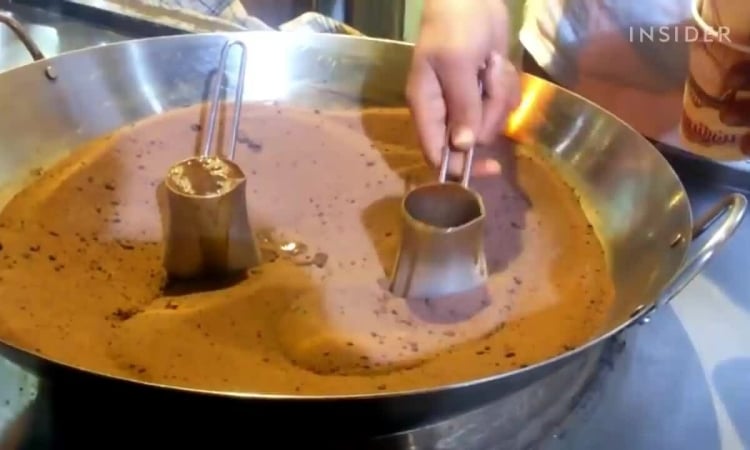
Turkish sand coffee
The Turks have a saying, "The memory of a cup of coffee lasts for 40 years," to describe their coffee-drinking culture.
Turkish sand coffee is unlike regular coffee, even though it uses the same ingredients. The different brewing methods result in different flavors and strengths. Many believe that using copper to heat the sand makes the coffee more aromatic and flavorful.
Regardless of the brewing method, a cup of Turkish coffee is generally characterized by its aromatic, rich flavor, frothy head, and warm temperature.
(By Anh Minh , based on UNESCO and Lonely Planet )
Source: https://vnexpress.net/ca-phe-cat-tho-nhi-ky-4656044.html






![[Image] Nearly 125,000 Hanoi students completed the Literature exam for the 10th grade entrance exam.](https://vphoto.vietnam.vn/thumb/1200x675/vietnam/resource/IMAGE/2026/05/30/1780117233041_ndo_br_thiet-ke-chua-co-ten-2-png.webp)
































































































Comment (0)