

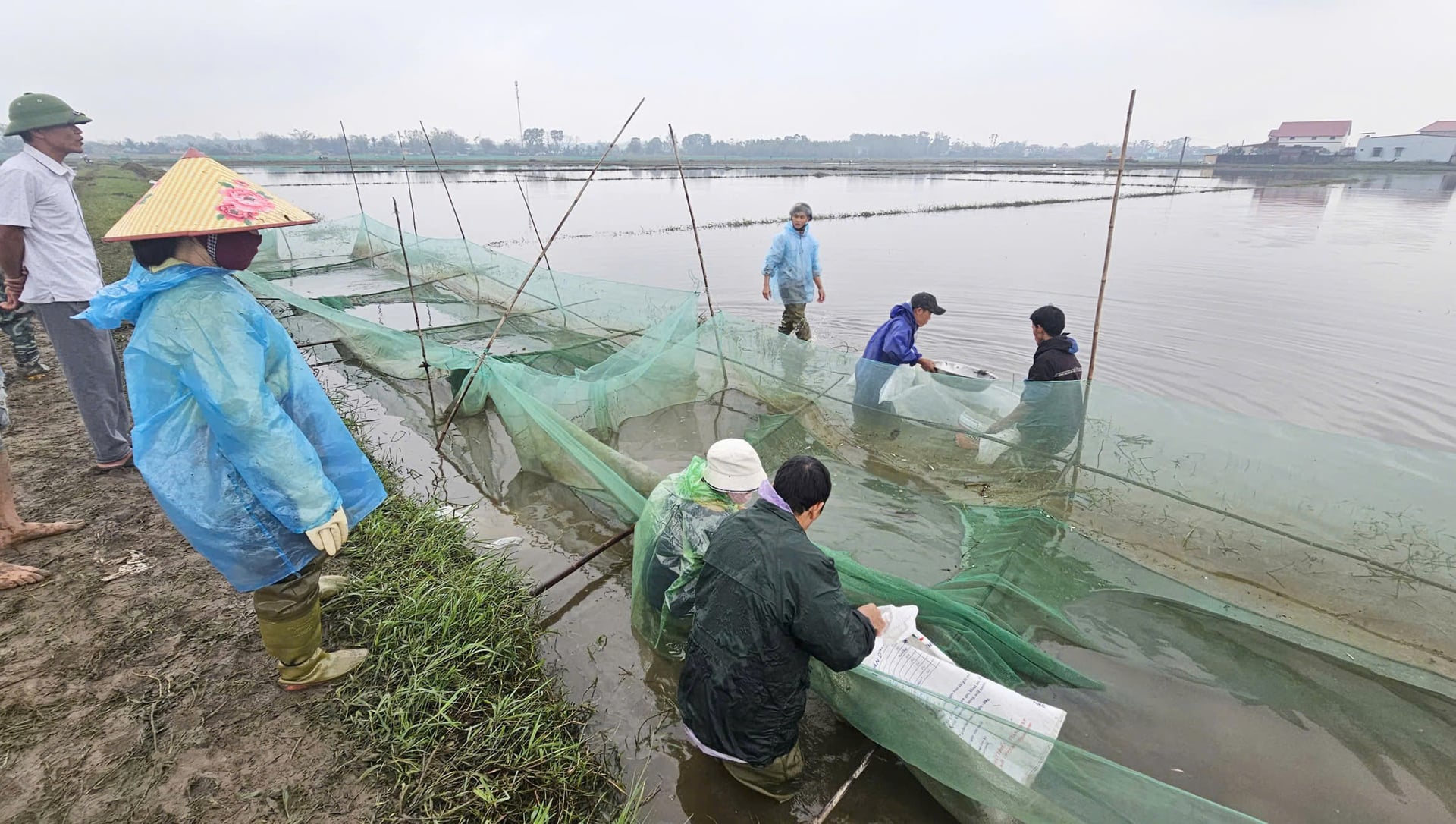
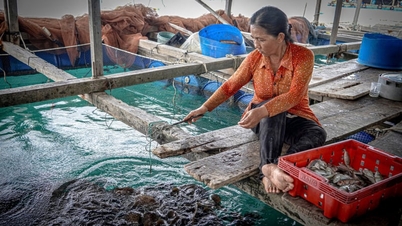
In the more than 10-hectare rice fields of Tan Ha village (Tan My commune, Quang Tri province ), there is a bustling scene of pumping water, pulling nets, and catching fish… Mr. Le Xuan Son, Head of Tan Ha village, said: “This year the weather has been quite favorable, so the third fish crop of the villagers is bountiful and fetches good prices. Almost no one has to go to the market to sell their fish; traders come directly to the fields to buy commercial fish and fish fry. After this fish harvest, the villagers are quickly preparing the land to plant the winter-spring crop.”
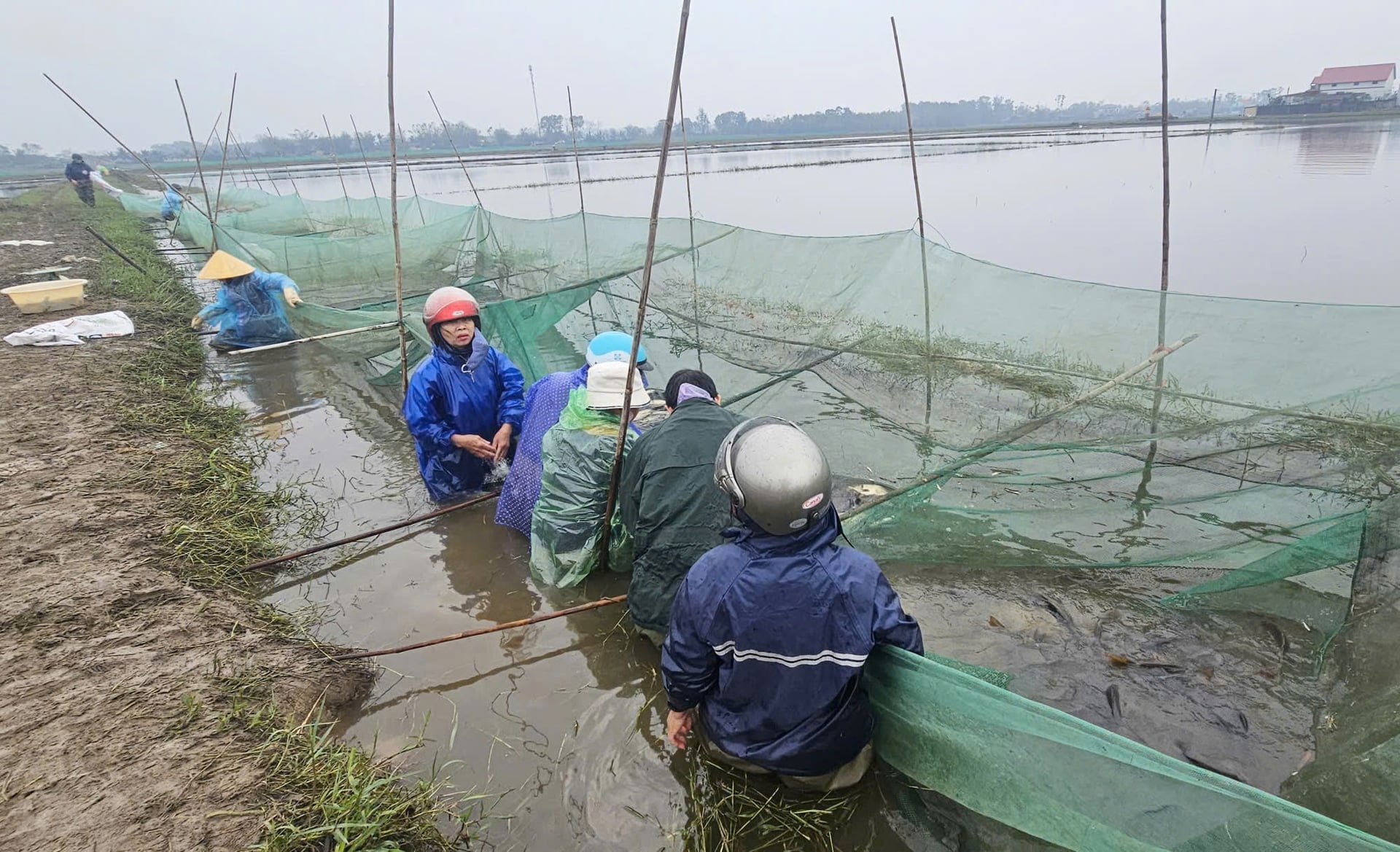
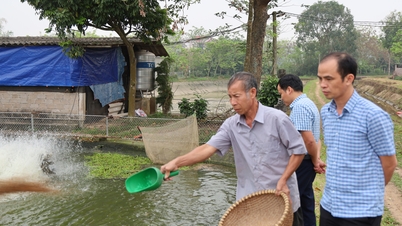
Harvesting the third fish crop in the Tan My rice fields. Photo: T. Duc.
Bustling activity in the third fish farming season.
The rural area of Tan Thuy (formerly Le Thuy district, Quang Binh province), now Tan My commune, has a tradition of raising fish in the third crop season. Mr. Le Xuan Son explained: "People call it the third fish crop season because after the winter-spring crop comes the summer-autumn crop, and after the summer-autumn crop comes the fish farming season in the rice fields."
Around the beginning of September each year, after harvesting the summer-autumn rice crop, instead of leaving the fields empty, the people of Tan My commune build embankments, set up nets, pump water into the fields, and release various freshwater fish species such as grass carp, silver carp, crucian carp, and snakehead fish... The fish fry are tiny, but thanks to food from rice grains, rice straw, or larvae, they grow quickly and become plump.
The entire field is guarded by only one person. In their free time, the villagers go to the fields, wading in to check if the embankments, dikes, and nets are damaged so they can repair them. The water in the fields is always above an adult's knees, so fish can swim freely and feed.
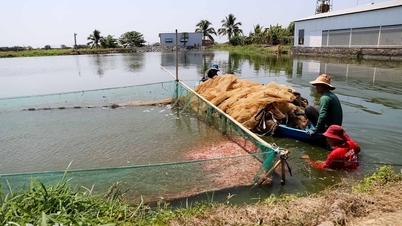
Without needing to spend any feed, after just three months, farmers can harvest fish in the fields and sell them to traders right there. Mr. Le Xuan Son said: "The fish harvests are like a festival in the fields. The whole family goes out to the fields to catch fish." As the pumps gradually drain the water from the fields, the fish thrash and jump around, turning the fields white. Farmers use nets to pull the fish back along the irrigation ditches that have been fenced off. Each square of net is stocked with a different species of fish, making sorting easier and facilitating buying and selling.
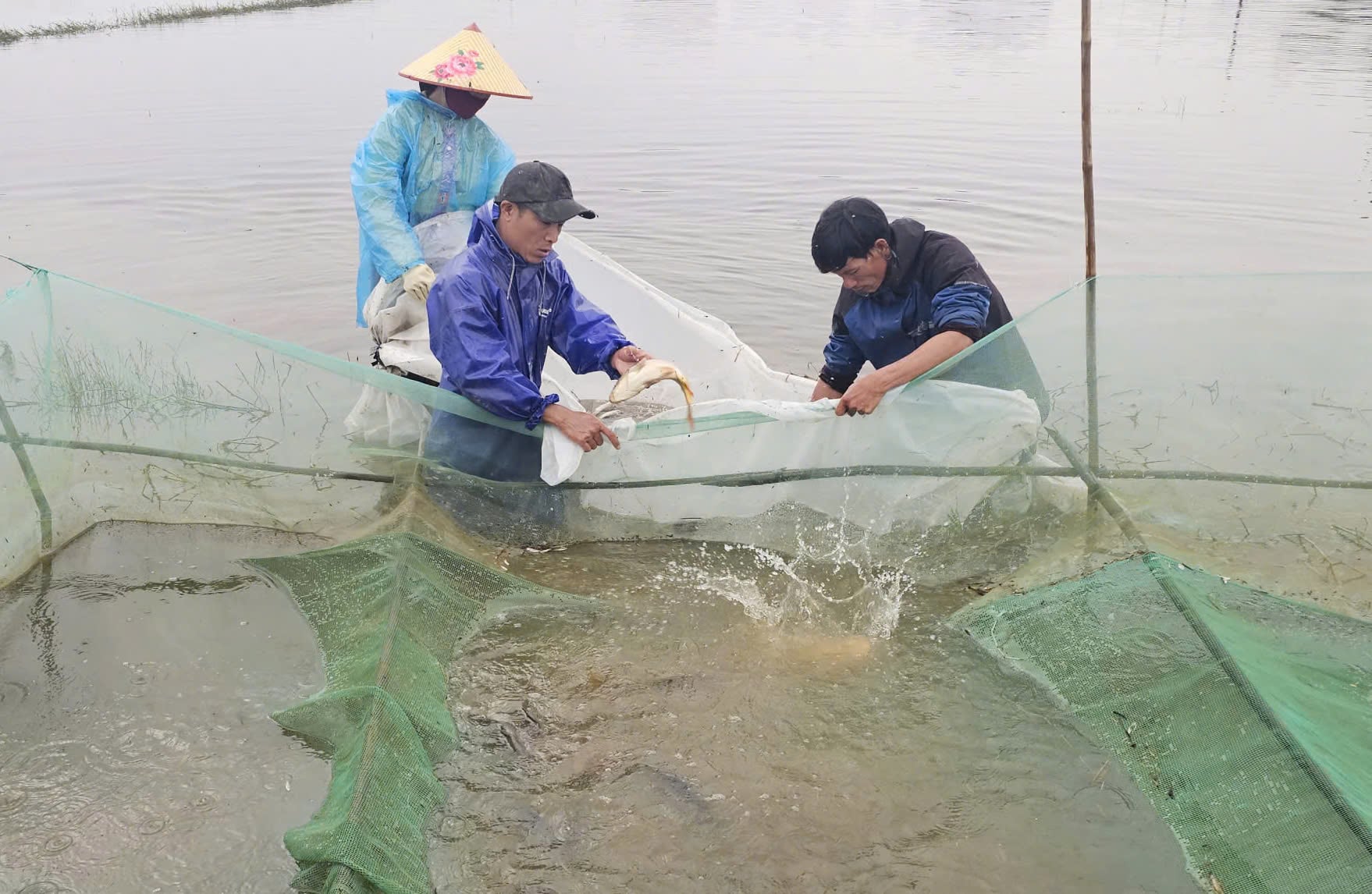
The fish are herded into net compartments according to species such as carp, tilapia, snakehead, etc. Photo: T. Duc.
Prices are set, traders simply state the quantity they want to buy, and baskets of fresh, wriggling fish are dumped into sacks lined with plastic bags to pump oxygen into them, ready for a long journey.
Besides supplying commercial fish, the Tan My fish farm also provides various types of fish fry to many localities in the province. Mr. Tran Minh Tien (Ninh Chau commune), who lives nearly 50km from Tan My commune, arrived early in the morning to wait to buy fish. This time he bought about 50 kilograms of grass carp (fish weighing around 1kg each).
“I buy fish from Tan My and supply them to families who need them. They raise them for about 7-8 months before selling them, at which point the fish weigh 4-5 kg each. The purchase price is now 60,000 VND/kg, but when the fish gain more weight, the selling price is 150,000 VND per kg,” Mr. Tien shared.
Mr. Tien also said that he is not the only intermediary; many others are involved. They buy fish fry from the Tan My fields and supply them according to the needs of farms and households with ponds that order specific types of fish such as grass carp, crucian carp, etc. "Each season, the intermediaries buy about 50 million VND worth of fish fry from Tan My to distribute. The profit is quite substantial after each season," Mr. Tien said enthusiastically.
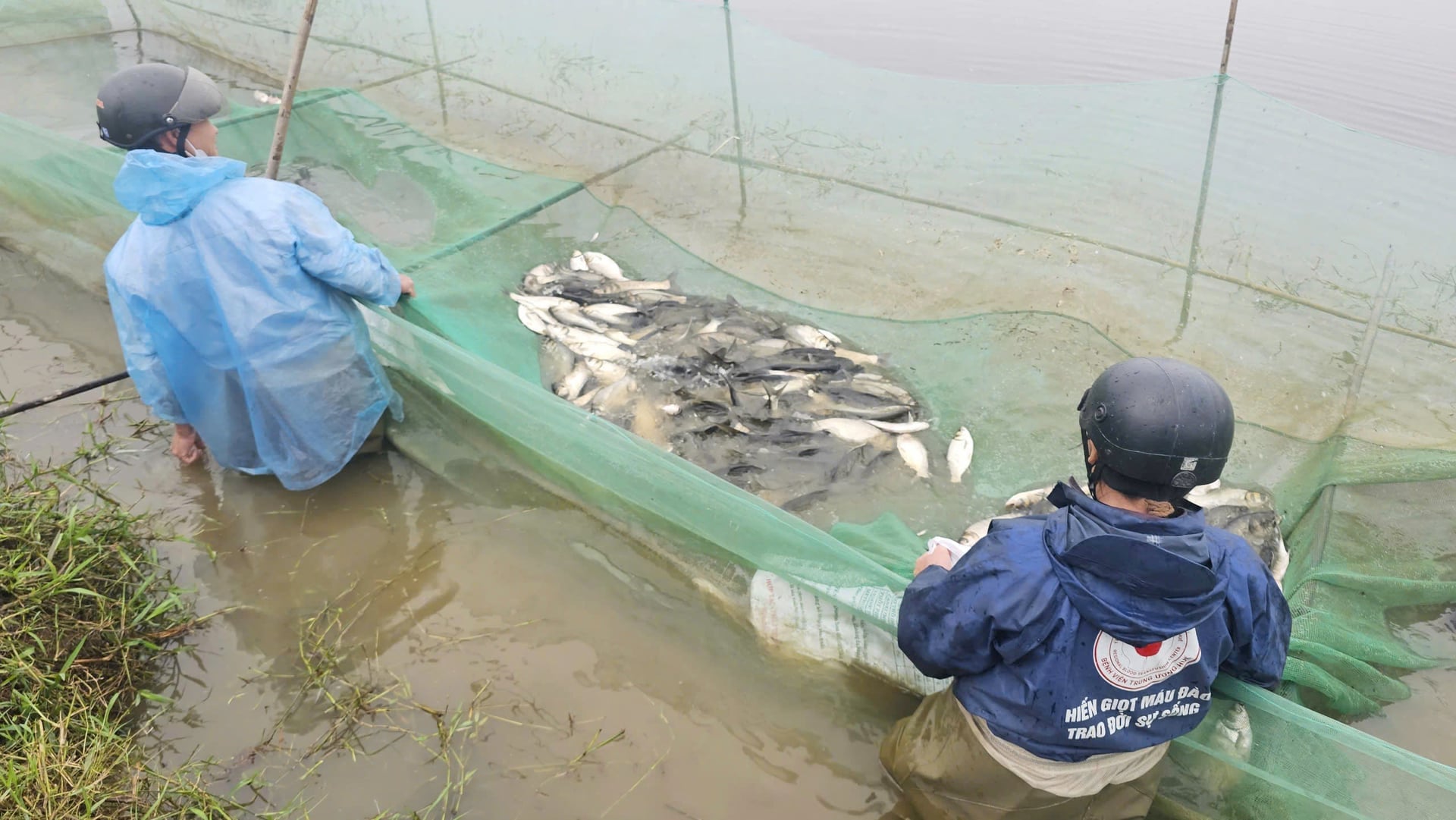
After 3 months of raising, each hectare of rice paddy yields 4-5 quintals of freshwater fish. Photo: T. Duc.
Building the Tan My brand of clean fish.
Mr. Le Xuan Ngoc, Director of Ngoc Tam Agricultural Cooperative, is the winning bidder for the third fish farming season in the rice fields of Tan Ha village. According to him, the third fish farming season has low investment costs, with the fish mainly utilizing rice stubble, regenerated young rice plants, and natural plankton as feed. Farmers only need to invest in fingerlings and land rental fees from the village. “On average, each hectare yields about 5-6 quintals of fish, with prices ranging from 50,000 to 60,000 VND/kg. Each hectare of water surface brings in about 30-35 million VND, resulting in a profit of over 20 million VND after deducting expenses,” Mr. Ngoc said.
According to Mr. Ngoc, the fish fry are very small when released but grow quickly thanks to the abundant food supply in the rice fields. The rice fields are cultivated organically, limiting the use of pesticides, so the farming environment is quite safe.
Despite the vast fish ponds, poaching and illegal fishing are rare occurrences. Even those who don't raise fish themselves are conscious of protecting their property as if it were their own. "In years when floods come unexpectedly, the entire pond is submerged in raging floodwaters. People gather to set up nets or work together to pull the fish into box nets to prevent them from being swept away. Both those who raise fish and those who don't wade through the floodwaters to save them. It's very touching to see such neighborly solidarity," Mr. Ngoc confided.
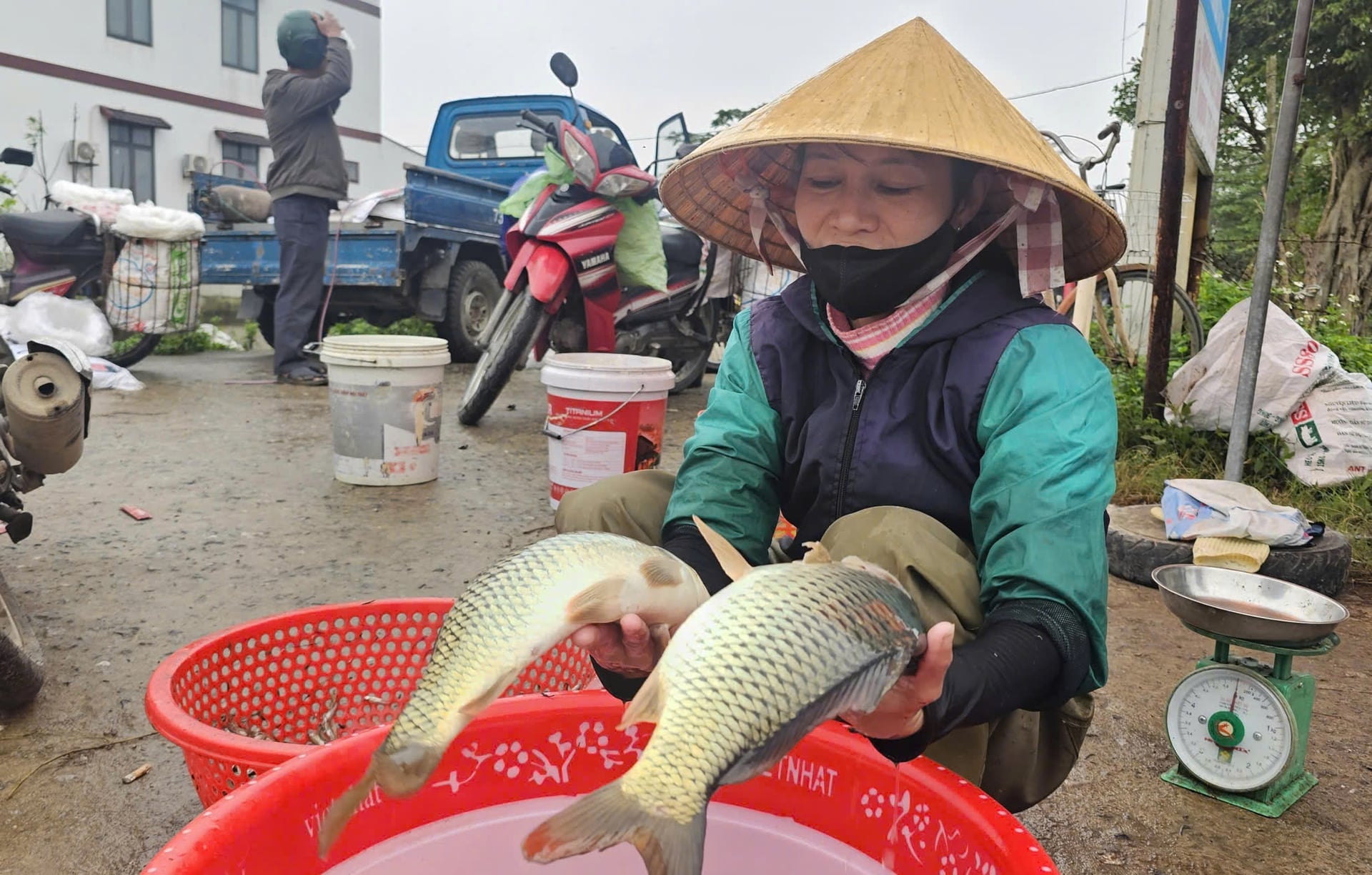
"Because it's homemade," the locals are willing to sell it cheaply to passersby. Photo: T. Duc.
Bidding for the third crop of fish farming also brings income to the landowners. If they do not participate in fish farming, they receive profits from the bidding process ranging from 2.5 to 3 million VND/hectare, depending on the year. After harvesting the fish and draining the water from the fields, the farmers begin preparing the land, clearing weeds from the field edges, and planting rice for the winter-spring crop.
Ms. Nguyen Thi Lon was clearing weeds from the rice paddy embankment not far from the fish-gathering ditch. While working, she said: “My family is small, so we were allocated nearly one sao (approximately 1000 square meters) of rice paddy in this area. After the fish harvest, we receive 100,000 dong in profit. It's good to have some extra; families with more land receive more. When harvesting the fish, people sell some and give some away, so we're all happy. After the fish harvest, the paddy is free of weeds, making it very convenient to prepare the land for planting rice in the spring.”
To date, Tan My commune has 13 villages with more than 40 households participating in the third-crop fish farming bidding model on a total area of about 100 hectares, including a variety of fish species. According to Mr. Tran Duy Hung, Head of the Economic Department of Tan My commune, the third-crop fish farming model not only brings income to the people but also has a great effect in enriching the soil of rice paddies and limiting harmful factors to rice plants.
Besides selling commercial fish, Tan My also supplies fish fry to fish farms in other localities. Photo: T. Duc.
Effectively utilizing the water surface area of abandoned rice paddies between two rice crops to raise fish in the third crop has brought considerable economic benefits to many households in Tan My commune. This is a direction that helps people in low-lying areas become more proactive in production and increase income per unit area.
"The local government is interested in developing this model to expand the area. At the same time, they are building a brand for clean freshwater fish from Tan My to bring the product to consumers and increase efficiency and income for the people," Mr. Hung said.
Mr. Le Xuan Ngoc, Director of Ngoc Tam Agricultural Cooperative, said: “Thanks to the clean environment and abundant food sources, the fish in the third crop in Tan My rice paddies grow quickly. If we stock 100 kg of fingerlings at the beginning of the season, after 3 months of farming we can harvest 400-500 kg of marketable fish. The fish sold as fingerlings for other farms are very popular because the fish from Tan My rice paddies are healthy, vigorous, and suitable for the ponds of other localities in the region.”
Source: https://nongnghiepmoitruong.vn/ca-vu-ba-ca-nha-di-bat-d791405.html

![[Video] Sunset at Lap An Lagoon – Where the sun sets over the fishing nets](https://vphoto.vietnam.vn/thumb/1200x675/vietnam/resource/IMAGE/2026/05/31/1780192137701_beach-landscape-sea-water-nature-grass-745871-pxhere-com.jpeg)











![[Video] Sunset at Lap An Lagoon – Where the sun sets over the fishing nets](https://vphoto.vietnam.vn/thumb/800x450/vietnam/resource/IMAGE/2026/05/31/1780192137701_beach-landscape-sea-water-nature-grass-745871-pxhere-com.jpeg)


![The Essence of Viet Bac Villages: [Part 3] The Precious Fragrance of Nghinh Tuong](https://vphoto.vietnam.vn/thumb/402x226/vietnam/resource/IMAGE/2026/05/29/1780020600366_5237-tinh-tuy-ban-lang-viet-bac-bai-3-chuyen-o-nghinh-tuong-050626_700.jpeg)
![The Quintessence of Northern Vietnam's Villages: [Part 2] The Famous Cassava Noodles of Kunming](https://vphoto.vietnam.vn/thumb/402x226/vietnam/resource/IMAGE/2026/05/28/1779937455892_3929-3144-mien-dong-15-nongnghiep-023138.jpeg)
![The Essence of the Village: [Part 1] Wine on the mountain, tea in the clouds - Bang Phuc](https://vphoto.vietnam.vn/thumb/402x226/vietnam/resource/IMAGE/2026/05/27/1779841729178_3821-1jpg-nongnghiep-103814.jpeg)
![[Image] A brilliant symphony and explosive power in the skies of Da Nang.](https://vphoto.vietnam.vn/thumb/1200x675/vietnam/resource/IMAGE/2026/05/31/1780196945787_anh-man-hinh-2026-05-31-luc-10-08-51.png)


























![[Video] Sunset at Lap An Lagoon – Where the sun sets over the fishing nets](https://vphoto.vietnam.vn/thumb/402x226/vietnam/resource/IMAGE/2026/05/31/1780192137701_beach-landscape-sea-water-nature-grass-745871-pxhere-com.jpeg)
































Comment (0)