Two-tiered fish pond - a unique design in Ho Thau.
The morning air in Ho Thau ( Tuyen Quang ) was fresh and cool. The wind from the mountain crevices carried a chill, making the air even clearer and sweetly cool. Ms. Phuong Mui Khe (Tan Thanh village, Ho Thau commune) quickly went to the storeroom to get a basin of fish feed pellets, scooping handfuls into the pond. The fish, accustomed to this routine, rushed to the surface to snatch the food, creating a commotion. Many types of fish, such as carp, grass carp, black carp, and eel, all surfaced at the same time.
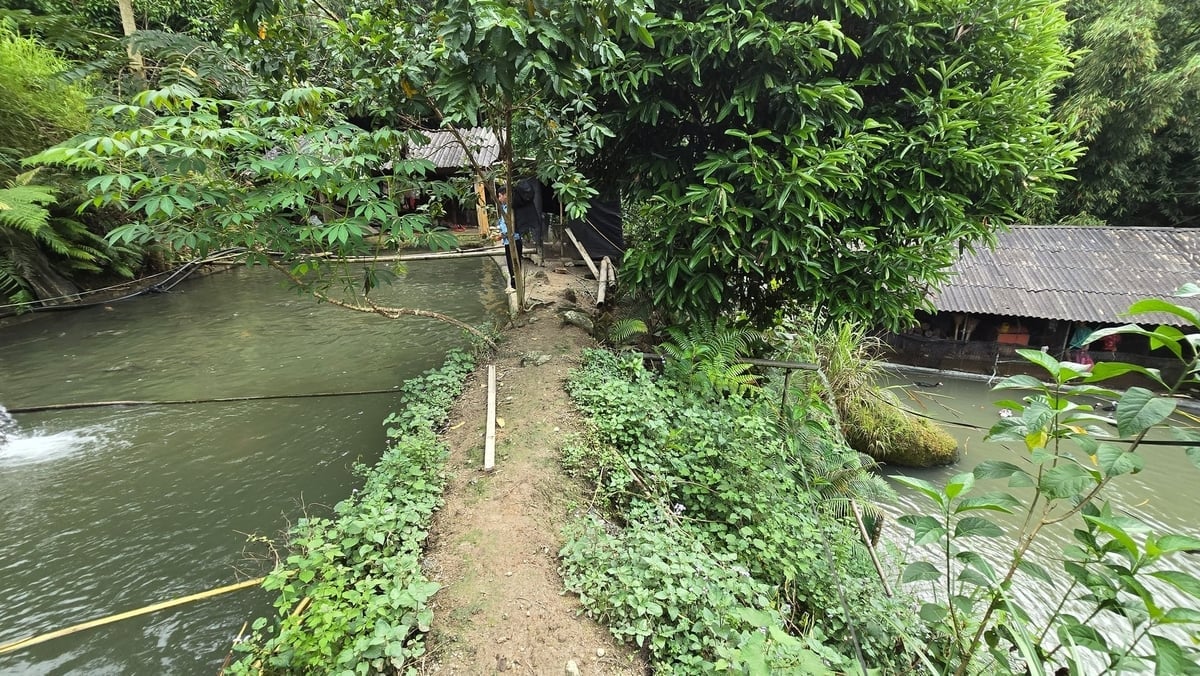
A two-tiered freshwater fish farming pond model on the mountain owned by Ms. Phuong Mui Khe. Photo: K. Trung.
This is the third year that Ms. Khé has been raising fish in two ponds at an altitude of 1,000 meters – a rare and unusual practice in the Dao ethnic minority village of Hồ Thầu commune. Even more remarkably, taking advantage of the sloping hillside terrain with abundant water resources, Ms. Khé's family built the two ponds in a tiered design, one higher and a larger one below, with a difference of about 1 meter in height, each pond covering hundreds of square meters.
Natural water from the mountain stream is channeled down through plastic pipes, always crystal clear. This is also the water used for daily life by the people in the mountainous region. The pipes have to run a long distance to reach the ponds, so Ms. Khé came up with the idea of creating two ponds at different heights to collect water from each other. When the upper pond is full, the water flows down a small channel along the bank to the lower pond, preserving the precious clean water while creating a flow that keeps both ponds from ever stagnating, ensuring they are always rich in oxygen without the need for aeration machines.
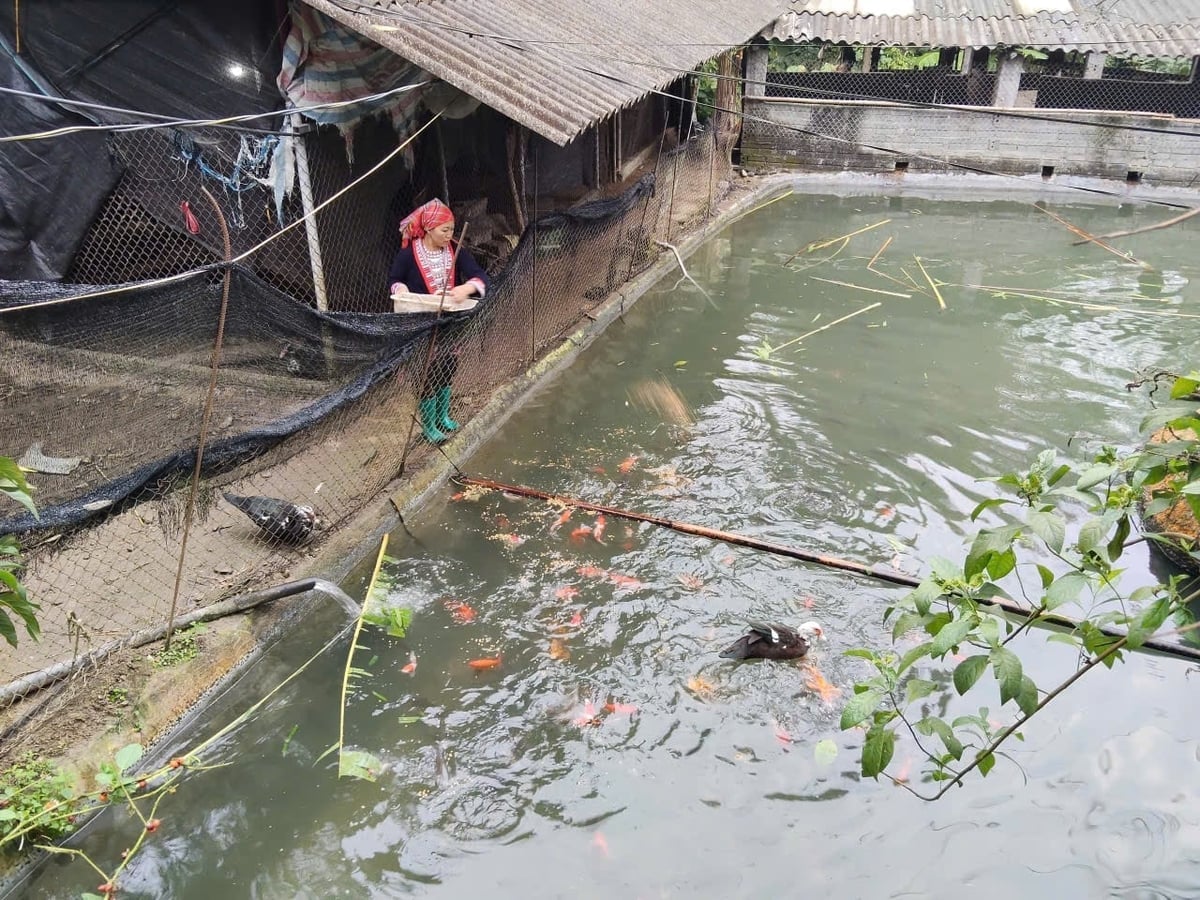
Ducks and fish live together peacefully in the two-tiered pond of Ms. Phuong Mui Khe. Photo: K. Trung.
In her pond, Ms. Khé raises various types of fish, but most notably grass carp, common carp, mud carp, goby, and cartilaginous eel... all raised naturally, harvested only once every two years or so. "Because they are raised for a long time, the fish are very delicious, with firm, fragrant, and sweet flesh. Therefore, the selling price of one kilogram of fish reaches 180,000 - 200,000 VND/kg," Ms. Khé explained.
Each time she drains her pond, Ms. Khé harvests 4-5 quintals of fish, generating revenue of 80-100 million VND. The fish is a delicious specialty, attracting many customers, especially homestay businesses in the scenic Ho Thau terraced rice fields. While earning income, Ms. Khé also contributes a local specialty to her village, encouraging tourists to stay longer.
What's special about Ms. Khé's mountain aquaculture model is not only the two-tiered pond design but also the extremely tranquil scenery. Below are the fish, while above, on the surface of the pond, flocks of native ducks with glossy black feathers interspersed with patches of white and gray, and necks that shimmer like beads, swim peacefully.
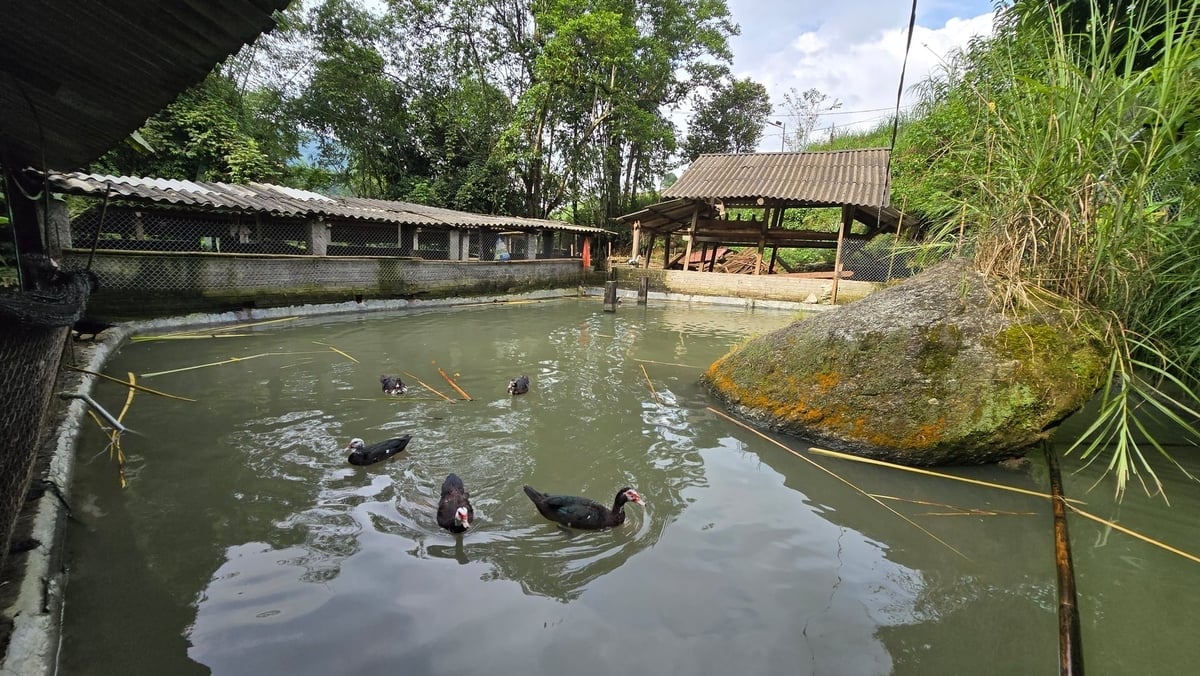
A peaceful scene at Ms. Khé's farm. Photo: K. Trung.
You may also like
Elderly people in Thieu Toan commune compete to excel in economic activities.In response to the "Elderly People Excelling in Economic Activities" emulation movement launched by the Central Committee of the Vietnam Association of Elderly People, the Elderly Association of Thieu Toan commune has actively propagated and encouraged its members to participate. Many elderly officials and members are dynamic, insightful, and proactive, dedicating their intellect and strength to enriching themselves, their families, and their homeland. When Ms. Khé throws food to the fish, schools of fish rise to the surface to snatch the bait, while the ducks remain unfazed, not bothering to catch the fish, and the fish are not afraid of the ducks. These "natural predators" coexist peacefully and amicably in the small pond, further enhancing the tranquil mountain scenery.
"I've been raising these ducks for many years just to get their eggs, which I then use for hatching ducklings. I've also been raising the fish for a long time, so they're used to each other, living together peacefully without conflict. The ducks don't catch the fish, and the fish aren't afraid of the ducks."
Just as Ms. Khé had said, the ducks swam around the surface of the pond, preening their elegant red feathers, then happily climbed onto a solitary rock jutting out of the pond to preen their feathers and bask in the sun. The fish, full of food, also circled around playfully, occasionally leaping out of the water, creating ripples that spread outwards. To provide the ducks with a clean space to play, Ms. Khé had dammed the stream bed to create a clear pool of water for raising the ducks, producing delicious duck meat.
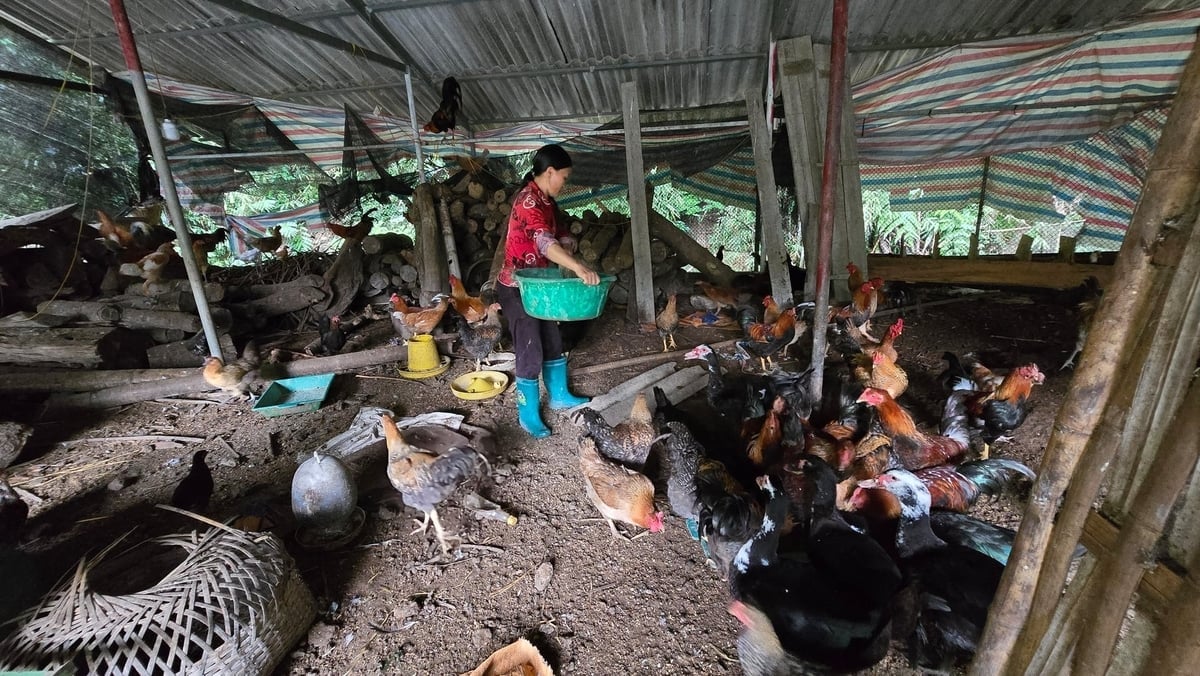
The castrated roosters belonging to Ms. Khé's family are being prepared for sale during Tet (Vietnamese Lunar New Year). Photo: K. Trung.
A self-contained, ecological garden-pond-livestock system.
In Ho Thau commune, Ms. Khe's diversified, self-contained livestock farming model is one of the rare exemplary economic models. As an outstanding member of the commune's Women's Association, Ms. Khe is a leading example in all fields. Her husband, Mr. Phuong Chan Nu, is the Vice Chairman of the commune and is busy with work from early morning until late at night, so Ms. Khe handles everything at home. Only on rare weekends does Mr. Phuong Chan Nu come home to help his wife.
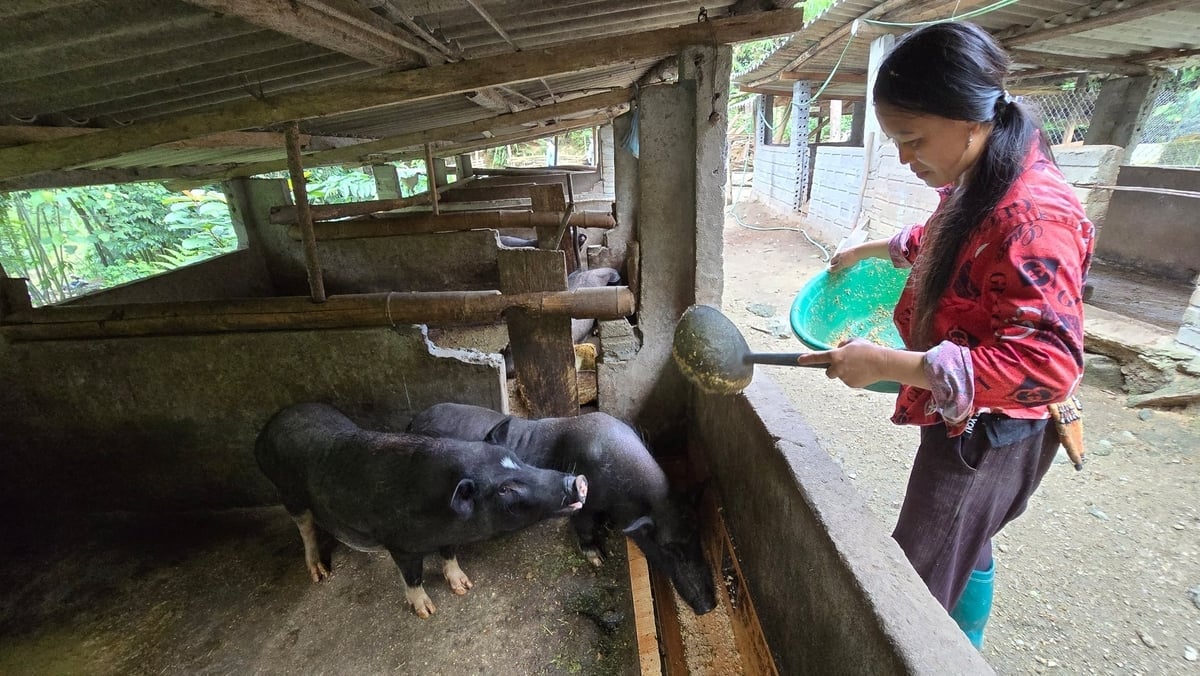
The integrated garden-pond-livestock model of Ms. Phuong Mui Khe's family is a model example in Ho Thau commune. Photo: K. Trung.
Besides raising ducks and fish, Ms. Khé also breeds a flock of over 100 free-range castrated roosters, aiming to sell them during Tet (Vietnamese New Year), along with 4 sows to supply black piglets for the entire village. Constantly busy, feeding the fish and ducks, chopping bananas for the pigs, scooping rice for the castrated chickens... Ms. Khé never has a moment's rest. Yet, she never forgets to tend to her nearly 3-hectare plot of land planted with 3-year-old cinnamon trees right on the hilltop behind her house.
In addition, Ms. Khé's family also raises 5 native sows to breed piglets for sale. Each year, Ms. Khé sells 8-10 litters of piglets from these 5 sows, earning over 50 million VND from her breeding stock.
“Our family farm covers about 3,000 square meters, mostly consisting of two fish ponds, chicken coops, and pigpens. Even though it’s far from residential areas, we still have to ensure environmental hygiene, preventing foul odors and wastewater from the farms from escaping,” Ms. Khé said enthusiastically.
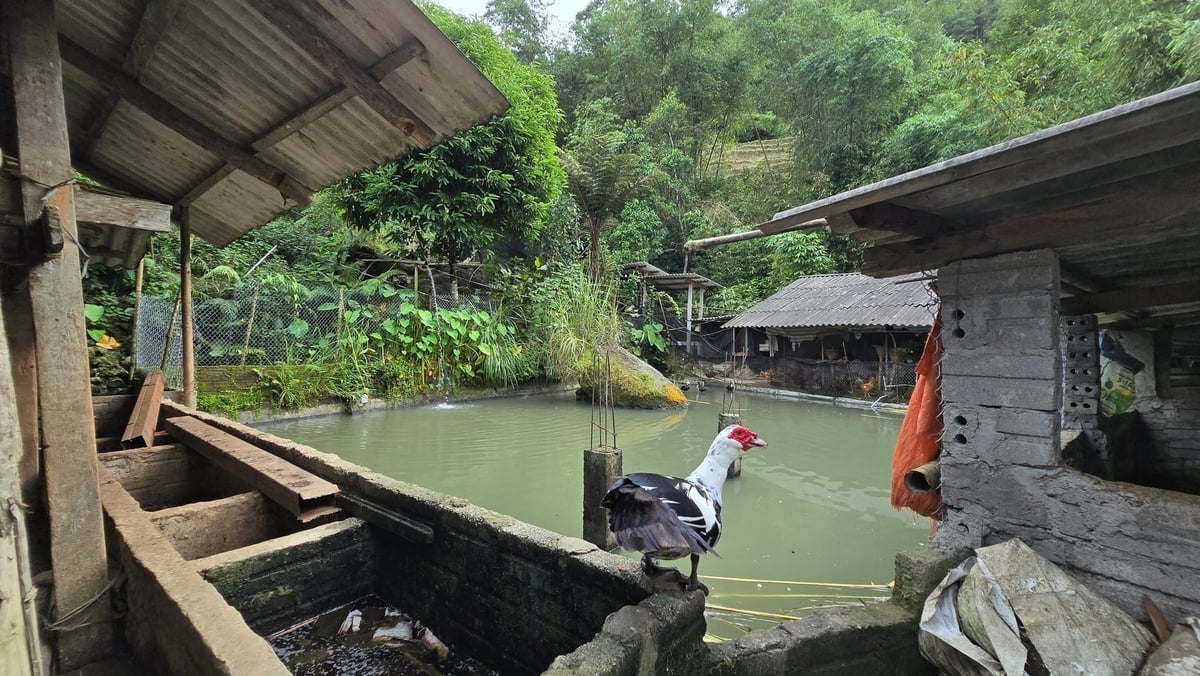
The ecological, closed-loop livestock farming model of Ms. Phuong Mui Khe. Photo: K. Trung.

Strengthening the friendship between Vietnam and the United States.On July 3rd, as part of the Pacific Partnership - Friends of the Pacific 2026 program, the U.S. Army Pacific delegation, led by Lieutenant General Joel Vowell, Deputy Commander of the U.S. Army Pacific, paid a courtesy visit to the Quang Tri Provincial Military Command. This hardworking woman had a plan from the very beginning of building her farm: the open land outside was fenced off to create an outdoor playground for her castrated roosters; the ducks swam in a pond; chicken and pig manure was collected through a sealed plastic pipe system buried in the ground, leading to a biogas pit. Wastewater was stored in a settling pit to be used for irrigating crops. This scientific arrangement ensured that Ms. Khé's farm had no foul odor, only the grunting of pigs, the splashing of fish snapping at food, and the noisy chatter of ducks and chickens when they demanded to eat…
A distinctive feature of mountainous communes is that people mostly raise livestock on a small scale, producing and consuming their own produce. Ms. Phuong Mui Khe's integrated farming model (garden-pond-livestock) is the largest-scale economic model in Ho Thau commune, supplying agricultural products to local tourism businesses. To ensure the health of her livestock, she researches ways to treat common diseases, proactively prevents outbreaks early, and is able to self-treat common illnesses if her animals contract them.
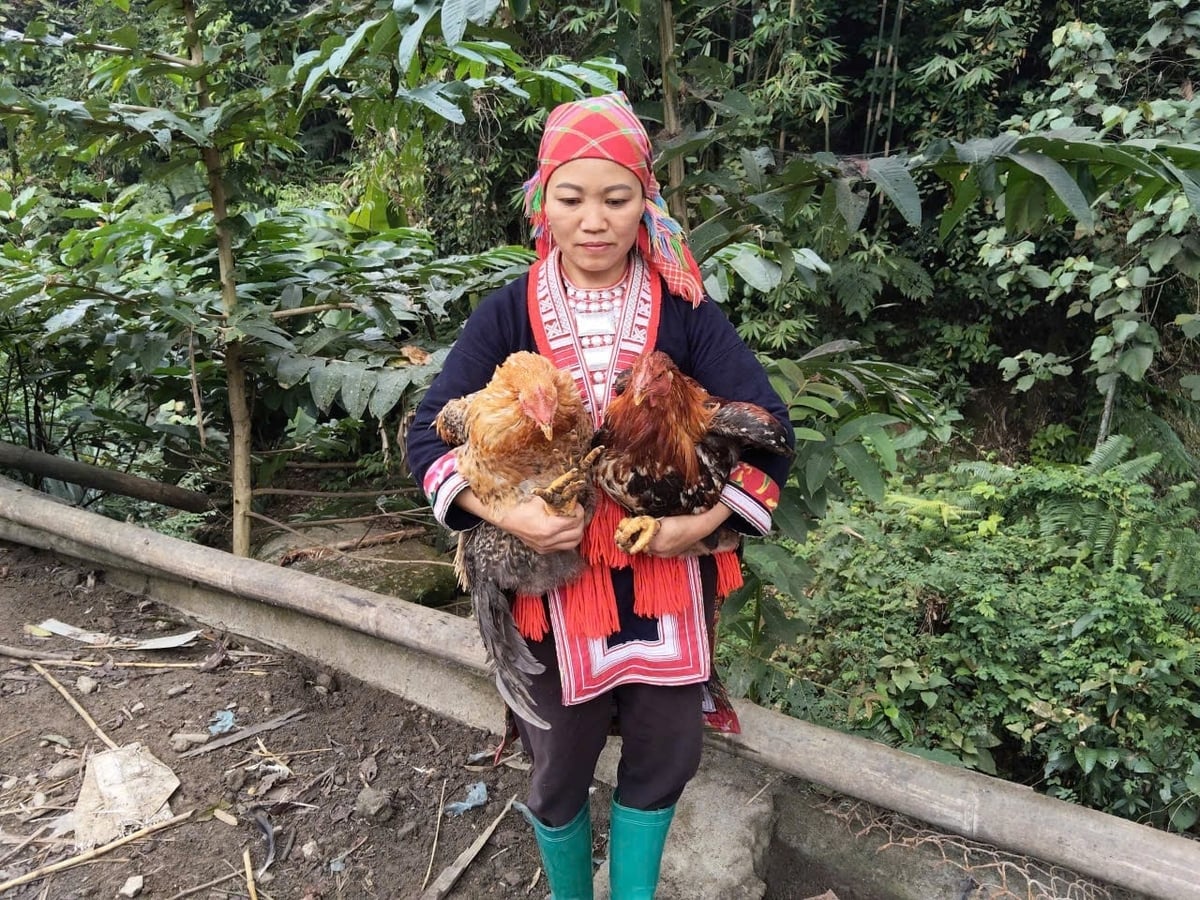
Free-range castrated chickens raised by Ms. Phượng Mùi Khé. Photo: K. Trung.
“Our family’s livestock farm is far from residential areas, so we have less contact with external sources of infection, making it quite safe and stable against disease outbreaks. Each year, after deducting expenses, the income from diversifying our livestock brings in 70-80 million VND. This is a stable and substantial source of income for households in the highlands,” shared Ms. Phuong Mui Khe.
Furthermore, Ms. Khé's family actively participates in reforestation. To date, she has 3 hectares of cinnamon trees over 4 years old covering the hills of Tan Thanh village. Under the forest canopy, she cultivates 2 hectares of purple cardamom, generating over 80 million VND in revenue annually. In addition, her family owns two orchards, mainly growing off-season pears and plums, each yielding over 40 million VND in revenue.
With her effective economic models, Ms. Phuong Mui Khe has always been a shining example, spreading good things to the people in the commune and contributing to the campaign "Studying and following the thoughts, ethics, and style of Ho Chi Minh" in the Ho Thau commune Party Committee.
Source: https://nongnghiepmoitruong.vn/chi-khe-lam-ao-2-tang-tren-nui-d788196.html























![The Essence of the Viet Bac Villages: [Part 3] The Precious Fragrance of Nghinh Tuong](https://vphoto.vietnam.vn/thumb/402x226/vietnam/resource/IMAGE/2026/05/29/1780020600366_5237-tinh-tuy-ban-lang-viet-bac-bai-3-chuyen-o-nghinh-tuong-050626_700.jpeg)
![The Quintessence of Northern Vietnam's Villages: [Part 2] The Famous Cassava Noodles of Kunming](https://vphoto.vietnam.vn/thumb/402x226/vietnam/resource/IMAGE/2026/05/28/1779937455892_3929-3144-mien-dong-15-nongnghiep-023138.jpeg)