

Contraception in the Chinese imperial court stemmed primarily from three reasons. Firstly, the emperor feared that historians would record his debauchery, leaving a bad reputation for posterity. Every instance of the emperor's "favor" with his concubines was meticulously documented. If contraception were implemented, the emperor could enjoy pleasure in the harem without damaging his prestige.
Secondly, the imperial harem, with its thousands of concubines, all desired the emperor's favor. To escape the lonely fate of being confined to the palace, they constantly sought ways to bear children for the emperor before their beauty faded. If the emperor disliked a concubine or suspected her of having ulterior motives, he would order the eunuchs to force her to use contraception.
Ultimately, the emperor feared his descendants vying for power and the throne. Stories of infighting and bloodshed over the throne are frequently recorded in history, such as the Xuanwu Gate Incident during the Tang Dynasty (618-907) and the Zhuying Mansion Incident during the Song Dynasty (960-1279). Contraception would save the emperor the headache of choosing a successor.
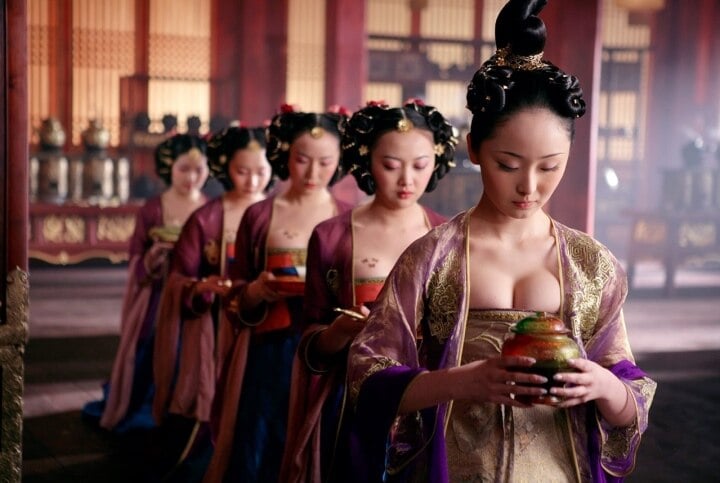
Court ladies from the Tang Dynasty in the 2016 film *Curse of the Golden Flower*. (Photo: Sohu )
To suit the king's preferences and needs, the royal physicians worked day and night to gather contraceptive remedies. Historical records mainly document four methods.
The first method was "pressing the acupoint on the anus." After the Qing Dynasty (1616-1912), emperors became even more careful about contraception. According to "An Unofficial History of the Qing Dynasty," when the emperor favored a concubine, the chief eunuch would kneel and await orders, asking the emperor whether to abort or keep the pregnancy. If the emperor ordered an abortion, the chief eunuch would gently press on the concubine's "posterior acupoint" to prevent conception. If the emperor wanted to keep the pregnancy, the eunuch would record the exact date and time as proof of conception.
The second method is "the navel insertion," which involves inserting musk into the navel. Two historical beauties, Zhao Fei Yan and Zhao He De, both used this method of contraception. Inserting musk into the navel is believed to render a woman infertile.
"Using saffron," or the third method , is considered the most effective contraceptive method in the imperial court according to Chinese historical records. This method was commonly used during the turbulent Five Dynasties and Ten Kingdoms period (907-960).
Using birth control pills was a last resort. These pills were primarily poisons. The contraceptive teas used by concubines or palace maids often contained small amounts of mercury. This method didn't directly cause death, but it was clearly effective.
Another method used by many courtesans was drinking "aphrodisiacs." These drugs contained musk, which not only effectively prevented pregnancy but also induced abortion. Empress Dowager Cixi, upon entering the palace and being intimate with Emperor Xianfeng, became pregnant for the first time but was secretly poisoned by someone who put musk in her tea, causing her to miscarry. While this drug had some beneficial effects, long-term use could lead to infertility.
HONG PHUC (Source: People)
Beneficial
Emotion
Creative
Unique
Wrath
Source
![[Image] Close-up view of the interchange connecting the two expressways and Long Thanh Airport.](https://vphoto.vietnam.vn/thumb/1200x675/vietnam/resource/IMAGE/2026/05/25/1779703378210_ndo_br_z7863716673926-224453a31600126cce10622af6290afd-4549-jpg.webp)
![[Image] Hanoi's urban life under the challenge of a "scorching hot" environment](https://vphoto.vietnam.vn/thumb/1200x675/vietnam/resource/IMAGE/2026/05/25/1779706979265_nang-nong-t5-2026-minh-duy-7-4636-jpg.webp)






























































































Comment (0)