


A section of Pha Din Pass in spring when the bauhinia flowers bloom, covering the forest in white. Photo: KK
Move
After a period of closure for upgrades, Dien Bien Airport reopened to passengers on December 2nd, 2023. Vietnam Airlines offers direct flights from Hanoi every day of the week, with round-trip fares ranging from 1.6 to 2.8 million VND. Travelers from Ho Chi Minh City can also fly with Vietnam Airlines, with a stopover in Hanoi. Vietjet offers direct flights from Ho Chi Minh City three times a week on Tuesdays, Thursdays, and Saturdays, with round-trip fares around 2 million VND.
Dien Bien Airport has been upgraded since 2022. Photo: Thanh Nien.
Accommodation
Hotels in Dien Bien are mainly concentrated in Dien Bien Phu city, offering a variety of room types, from guesthouses and homestays to 3-4 star hotels. Hotels such as Muong Thanh Dien Bien, Him Lam Hotel, Dien Bien - Hai Van, Phuong Nam, and An Loc have room rates ranging from 700,000 VND to 1,200,000 VND per night. Guesthouses in the city cost between 150,000 and 300,000 VND per night. Some homestays suggested by the Dien Bien Provincial Tourism Promotion Information Center include: Muong Then, Phuong Duc, Dien Bien - Rose Valley, and Nang Ban.Sightseeing
The Dien Bien Phu Victory Monument complex is an important part of any tour of historical sites in Dien Bien province. Most of these sites are located close together, making it convenient for visitors to visit them in a single day. (A1 Hill)
A panoramic view of Hill A1, with well-preserved traces from the historic Battle of Dien Bien Phu. Photo: Thanh Nien.
Located in Muong Thanh ward, Dien Bien Phu city, Hill A1 was one of the most important strongholds in the battle, considered the "throat" protecting the central area. The name A1 was given to the hill by the Vietnamese army; it had several other names before. Around A1, the French built a system of barbed wire fences in various shapes. The battle on Hill A1 was fierce, prolonged, and resulted in many casualties. At the top of the hill is a fortified bunker, originally a wine cellar of the French Consulate before 1945. The bunker is divided into two compartments, one of which served as the work area for the radio communications department. The bunker is made of sturdy materials, with solid brick walls and a thick concrete roof, capable of sheltering dozens of people. On Hill A1, there are still traces of the crater created by 960 kg of explosives. At Hill A1 today, in addition to sightseeing, visitors can also experience some hands-on activities such as cooking meals for soldiers using a traditional Hoàng Cầm stove, pushing bicycles to transport necessities, and listening to stories about the Dien Bien Phu campaign and the lives of soldiers during the war. De Castries Bunker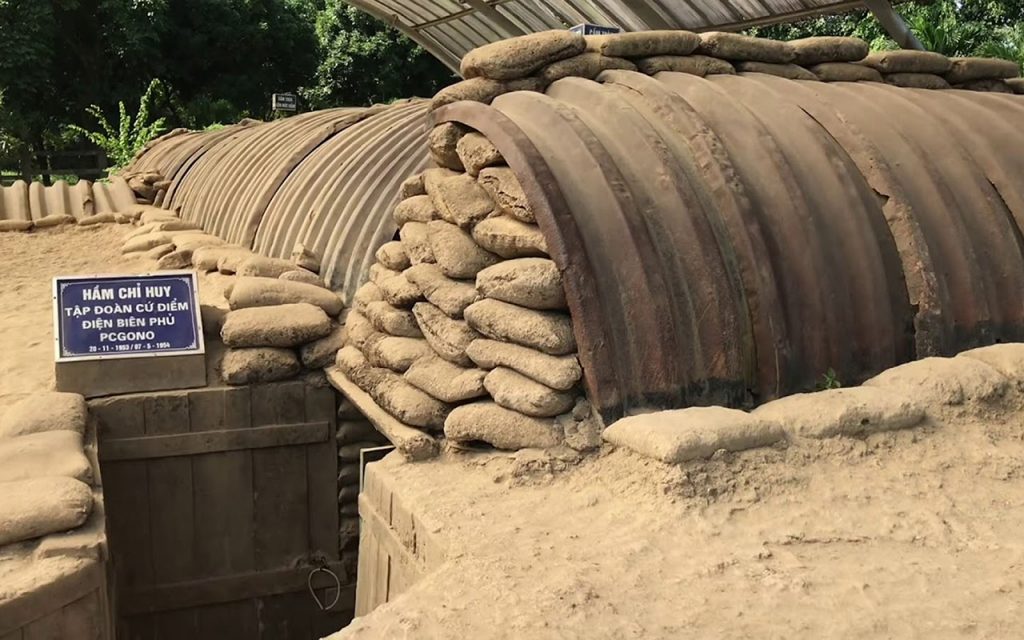

Outside the Dien Bien Phu Victory Museum. Photo: Van Dat
The museum is designed in the shape of a truncated cone, with rhombus-shaped decorations symbolizing the camouflage netting of soldiers' helmets. It consists of a basement and an above-ground level. The basement houses the visitor reception area, learning spaces, interactive areas, and recreational services. The above-ground level is a themed exhibition space dedicated to the victory at Dien Bien Phu. The above-ground section covers an area of 1,250 square meters and contains nearly 1,000 documents, artifacts, images, and maps.
Part of the panoramic painting at the Dien Bien Phu Victory Museum.
The highlight here is the panoramic painting featuring over 4,500 figures, measuring 132m in length, 20.5m in height, and 42m in diameter, with a 6m relief section, covering a total area of over 3,200m2. The painting was created using oil on canvas, starting in November 2019 and completing phase 1 in May 2021, with the participation of approximately 100 artists. The various stages of the 1954 Dien Bien Phu Campaign are depicted in a continuous and impressive manner through each brushstroke. (Dien Bien Phu Victory Monument)
The Dien Bien Phu Victory Monument. Photo: Van Dat
The monument was inaugurated on May 7, 2004, to commemorate the 50th anniversary of the Dien Bien Phu victory. The structure is located on D1 Hill, right in the city center. The monument complex is the tallest, largest, and heaviest group of bronze statues ever cast in Vietnam. The statues are 12.6 meters tall and made from 217 tons of bronze. (A1 National Martyrs Cemetery)
A1 National Martyrs' Cemetery. Photo: Van Dat
The cemetery is located on Vo Nguyen Giap Street, a few hundred meters from Hill A1. It is the resting place of 644 officers and soldiers who died in the Dien Bien Phu campaign. Most of the graves are unmarked. The caretaker's house features the characteristic stilt house architecture of the Thai people in Dien Bien, and the ceremonial platform outside is designed in the style of Khue Van Cac. The Dien Bien Phu Campaign Command Post in Muong Phang is located at an altitude of over 1,000 meters above sea level, at the foot of Pu Don mountain, hidden under the canopy of ancient forests, more than 30 km from the center of Dien Bien Phu city.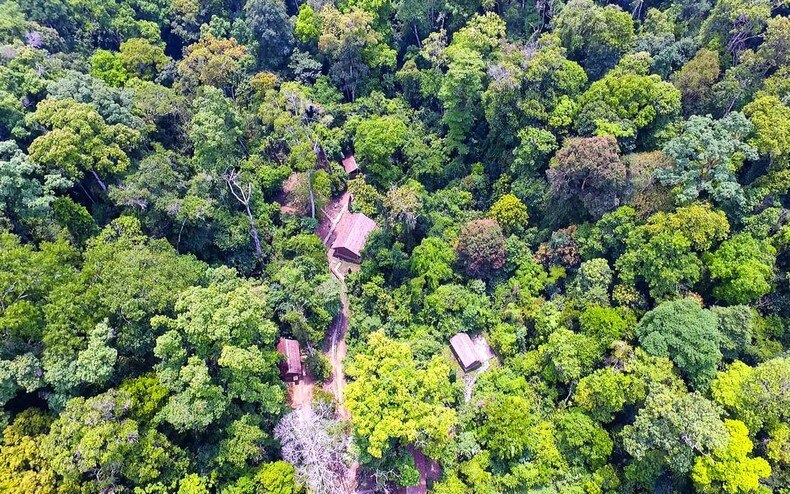
Panoramic view of Muong Phang base. Photo: Dien Bien Tourism
The Command Headquarters' structures were arranged in a continuous system, enclosing the front and back, with bunkers and shelters to ensure secrecy and safety. This was where General Vo Nguyen Giap worked and rested during the campaign. Many historical relics still retain their value, such as the living and working quarters of the General, Deputy Chief of the General Staff Hoang Van Thai, and Head of Communications Hoang Dao Thuy.
The Dien Bien Phu campaign headquarters in Muong Phang commune. Photo: Van Dat
From the highest point, visitors can observe the entire city of Dien Bien Phu, the Muong Thanh valley, and French military strongholds such as Him Lam Hill, Doc Lap Hill, D1 Hill, C1 Hill, and A1 Hill. The Victory Monument complex in Muong Phang Park (pictured above) is also a must-see when visiting. In addition, Muong Phang also boasts a cherry blossom garden that blooms profusely around Tet (Lunar New Year) on an island in the middle of Pa Khoang Lake. Visitors should plan their time accordingly to admire the beauty of this place. Pha Din Pass , 32 km long, is part of National Highway 6 and serves as the gateway to Dien Bien province. The highest point of the pass is 1,648 meters above sea level, with a cliff on one side and a ravine on the other. This is also where the Vietnamese people and army began their journey of hauling artillery, transporting food, weapons, and ammunition by human power during the Dien Bien Phu campaign.
A rest stop on Pha Din Pass. Photo: Thieu Hoa
Pha Din Pass is no longer as treacherous as before; narrow sections of the road have been widened, but there are still winding uphill and downhill stretches with countless hairpin bends. On Pha Din Pass is the Pha Din Pass tourist area, a stop for tourists to rest and admire the scenery, and also a meeting place for people from Dien Bien and Son La provinces. The Muong Thanh plain and the Nam Rom River: Located in the heart of the Dien Bien basin, the Muong Thanh plain is likened to a giant "warehouse" full of corn and rice. From the end of September, the rice in the Muong Thanh basin begins to ripen. Situated at an altitude of over 400m above sea level, the Muong Thanh plain stretches for more than 20km, with an average width of 6km. From above, the Muong Thanh plain, running along the banks of the Nam Rom River, spreads out like a bauhinia flower embracing the historical relics of the Dien Bien Phu battle. Muong Nha and the westernmost point.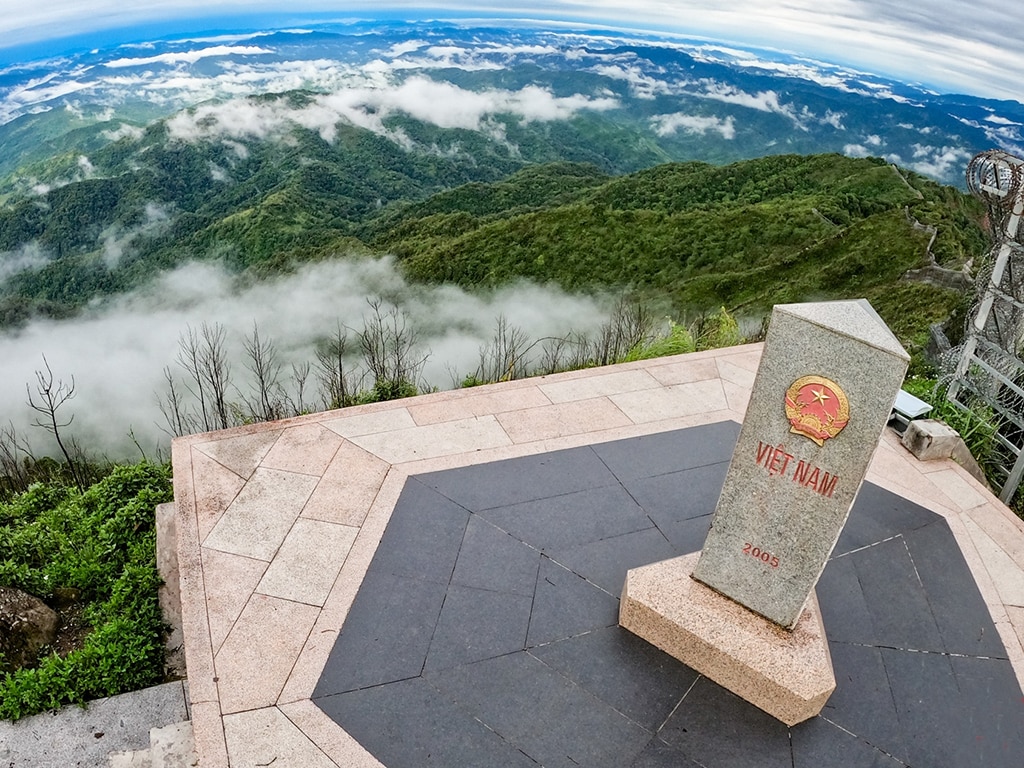
Border marker of three countries. Photo: To Quoc Newspaper
Muong Lay town
Muong Lay town is considered the capital of the White Thai people, where tourists can enjoy boat trips on the Da River, admire the natural beauty, and learn about the life and culture of the Thai people. In Muong Lay, visitors should visit Hang Tom Bridge, which connects Dien Bien and Lai Chau provinces. The old Hang Tom Bridge, built in 1967, was once the largest cable-stayed bridge in Indochina. In November 2012, the Son La hydroelectric dam filled with water, causing the entire old Muong Lay town, including the Hang Tom Bridge, to be submerged under the Da River reservoir. A new bridge, 70 meters higher than the old one, has been built near the site of the old Hang Tom Bridge. Dien Bien Dong is a district in the southeast of Dien Bien province, with many high mountain peaks, suitable for trekking and mountain climbing. Chop Ly peak, located 35 km from Dien Bien Phu city, is where visitors can admire the beauty of the mountains combined with the sky and clouds. The best time to go cloud hunting in Chop Ly is from April to September. Dien Bien Dong also has Noong U Lake, a natural lake with an area of about 4 hectares, nestled amidst lush green mountains. The lake attracts tourists who come to visit and enjoy the beautiful scenery. In addition, districts such as Muong Cha, Muong Ang, Nam Po, Tua Chua... all have eco-tourism areas and destinations suitable for experiential tourism such as mountain climbing or learning about the lives of the local ethnic people. U Va hot springs
Hot spring baths in U Va. Photo: Dulichpro
Located about 15 km from Dien Bien Phu city, in Dien Bien district, U Va hot spring covers a total area of 73,000 m2. The best time to visit is from November to April each year when the weather is cool. The hot spring offers many services to help visitors relax their minds, bodies, and skin. If you want to soak in the hot springs, you should do so in the early morning or in the afternoon. After bathing, you can participate in other recreational activities such as playing tennis, cycling, badminton, and enjoying cultural performances from the Dao and H'Mong ethnic groups. Entrance fees vary depending on the service, ranging from 20,000 VND to 120,000 VND per person. Accommodation in stilt houses ranges from 120,000 to 220,000 VND per room. Ban Phu Citadel (also known as Chieng Le Citadel), located in Dien Bien District, 8 km south of Dien Bien Phu city center, was built 200 years ago. It commemorates many notable events related to the hero Hoang Cong Chat, who embodies the spirit of national unity in the fight against foreign invaders. While much of the citadel was destroyed after the Trinh army occupied it in the 18th century, it retains its historical, cultural, and scientific value. In 1981, it was classified as a national historical and cultural relic.Eat and drink
Grilled Chicken with Mak Khen Spice: Mak Khen is a characteristic spice of the Northwest mountainous region, used to differentiate grilled chicken from similar dishes in other localities. The chicken is grilled over charcoal, with a moderate fire. There's no need to add extra fat during grilling as the chicken fat will render naturally. Once the meat is firm, the Mak Khen spice is brushed onto the skin. Don't forget to dip it in Cham Cheo sauce for the full flavor. Pa Pinh Top: This Dien Bien specialty has a rather unusual name, but it's actually grilled fish such as carp, catfish, or tilapia. After being cleaned, the fish is cut open along the spine. Spices are directly marinated and stuffed into the fish's belly, including ginger, lemongrass, herbs, and especially Mak Khen and the sprouts of the Sa Nhan plant. The outside is coated with galangal powder and roasted rice flour. Pa Pinh Top is grilled over charcoal fire. When grilling, bamboo skewers must be used to hold the fish so that the flavors are more intense as the spices penetrate deep into the flesh and release their aroma. The grilled fish is fragrant, sweet, and firm inside. This dish was once mentioned by a famous American chef on the culinary program "Exploring Vietnam".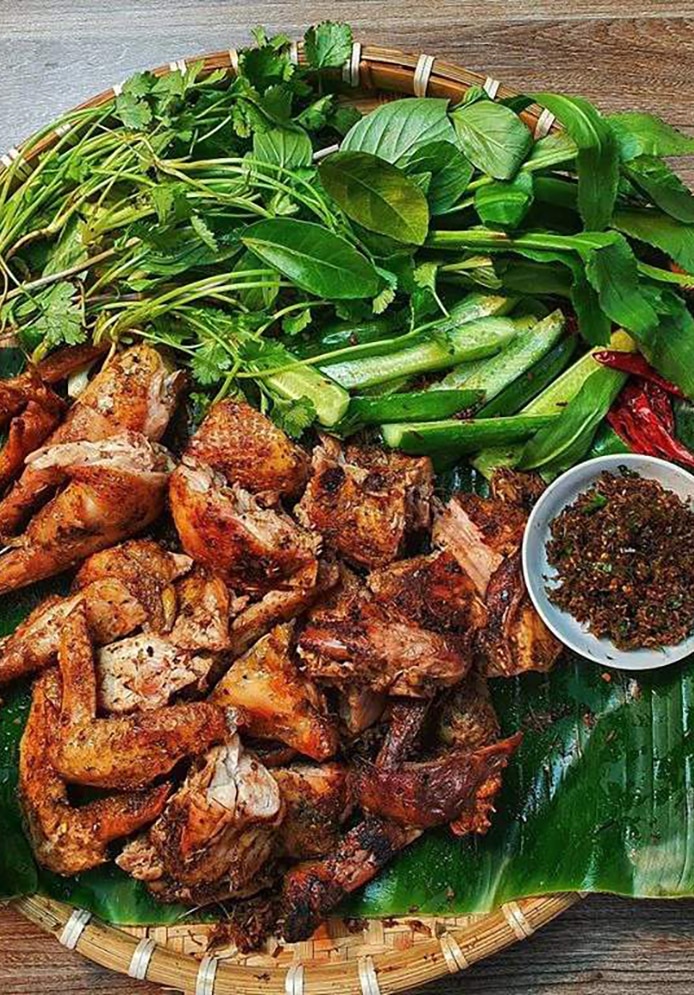
Grilled chicken with mắc khén spice.
Duck stewed in banana blossoms: Duck stewed in banana blossoms is a simple, easy-to-prepare dish of the local people. After cleaning, the duck meat is marinated with spices such as chili, ginger, lemongrass, and mắc khén (a type of spice), then wrapped in wild banana leaves and stewed for about 3 hours over low heat until cooked. People in Dien Bien often use long-stemmed wild banana blossoms because they are tastier, have a sweeter taste, less sap, and less bitterness. Although the dish may not look visually appealing, its aroma is intoxicating from the moment the banana leaves are opened. Steamed minced pork in banana leaves : This simple dish, as the name suggests, is made from finely minced pork marinated with spices, then wrapped in banana leaves and steamed for about an hour until cooked. One of the key factors making this dish delicious is the freshness and aroma of the meat. The dish is simple but easy to eat and memorable thanks to the aroma of the meat blending with the aroma of the banana leaves; the meat is tender, fatty, and clings tightly together. Stone moss
Rock moss.
Stone moss is green and grows clinging to submerged rocks in stream beds seasonally from September-October (lunar calendar) to the end of May. It doesn't need to be cultivated; it grows naturally. During the moss season, the Thai people living near rivers and streams often collect young moss, dry it, and use it for later consumption or prepare dishes such as steamed moss, moss soup, moss salad, and grilled moss. However, the best is still young moss, wrapped in banana leaves or dong leaves and grilled over charcoal. Stone moss can be grilled alone or with stream fish, pork, or chicken. Cham Cheo (or Cham Cheo) is a traditional spice of the Thai ethnic group in Dien Bien province in particular and the Northwest region in general. Cham Cheo is made primarily from the mắc khén fruit, along with anchovies, salt, dổi seeds, garlic, mint, herbs, chili powder, and lemongrass. After cleaning the mắc khén, it is roasted until crispy and then ground into a powder. This powder is then mixed with dried chili peppers, lemongrass, salt, and coriander to create a harmonious blend of flavors. Cham Cheo is used as a dipping sauce for sticky rice, boiled dishes, grilled foods, and raw vegetables.
Cham Cheo.
Note
Try to avoid visiting Dien Bien during the rainy season due to the high risk of landslides. Taxis in Dien Bien are relatively expensive, so tourists should consider bargaining or using other means of transportation such as motorbikes or motorcycle taxis.Tam Anh
source

![[Photo] National Assembly Chairman Tran Thanh Man working with the Standing Committee of the Law and Justice Committee](https://vphoto.vietnam.vn/thumb/1200x675/vietnam/resource/IMAGE/2026/05/21/1779378929214_ndo_br_1-4610-jpg.webp)
![[Photo] General Secretary and President To Lam presides over a working session with the Central Policy and Strategy Committee on the development of the materials industry.](https://vphoto.vietnam.vn/thumb/1200x675/vietnam/resource/IMAGE/2026/05/21/1779359935432_a3-bnd-3129-1412-jpg.webp)
































































Comment (0)