


However, what is thought-provoking is that for many years, this historically significant site has remained in a state of "uncertainty," where everyone acknowledges its value, but there has not been a sufficiently strong coordinated mechanism to preserve and promote it appropriately.
Do they have the vision to transcend "administrative boundaries"?
In the new context, as many localities are entering a phase of spatial restructuring for development, the story of Hoanh Son Pass is no longer just a matter of a single historical site. It raises a broader question: How will we manage inter-regional heritage sites? And do localities have the vision to overcome the "administrative boundary" mindset in order to jointly preserve a shared national value? Fortunately, Vietnam has a successful precedent worth considering: the collaboration between Hue and Da Nang in preserving and promoting the value of Hai Van Pass.
Many years ago, Hai Van Pass was in a situation quite similar to Hoanh Son Pass today. The site lies precisely on the administrative boundary between two localities, possessing immense historical value, but it suffered from prolonged deterioration, overlapping management, and a lack of coordinated investment. There was a time when there was considerable debate about "who it belonged to." But ultimately, the most important thing was recognized: Hai Van Pass is first and foremost a national heritage site, not an asset to be divided according to administrative boundaries.
Based on that understanding, Hue and Da Nang chose the path of cooperation instead of debating ownership. The two localities jointly compiled scientific dossiers, jointly proposed national monument ranking, jointly developed conservation plans, and jointly implemented restoration projects. This "co-governance" model has opened up a new approach to inter-regional heritage conservation in Vietnam.
Today, looking back at Hai Van Pass after its restoration, what is valuable is not just the restored gate or the improved landscape. The greater value lies in the fact that this historical site has become a symbol of cultural cooperation between localities. This is a lesson that Ha Tinh and Quang Binh, now, in the context of the new administrative boundaries of Ha Tinh and Quang Tri, can certainly learn from for the story of Hoanh Son Pass. Because, in many respects, Hoanh Son Pass even carries a greater symbolic significance.
This pass was built during the reign of Emperor Minh Mạng in 1833 to control the North-South highway and protect the northern gateway to the capital city of Huế. But more profoundly, Hoành Sơn is also associated with a special layer of historical memory for the nation. It was once considered the natural boundary between Đại Việt and Champa; it is a place associated with the famous prophecy of Nguyễn Bỉnh Khiêm: "Hoành Sơn, a land of refuge for generations"; and it is linked to the turning point when Lord Nguyễn Hoàng took control of Thuận Hóa in 1558, opening the way for the nation's strong southward expansion.
Beyond its political history, this place is also a unique cultural space for Vietnamese poetry. The image of Deo Ngang Pass in the poem by Mrs. Huyen Thanh Quan has almost become a part of the collective memory of many generations of Vietnamese people: "Approaching Deo Ngang Pass at sunset / Grass and trees intertwined with rocks, leaves mingled with flowers…"
Perhaps nowhere else are natural landscapes, territorial history, national memory, and poetry so harmoniously intertwined in one space as Hoành Sơn-Đèo Ngang. Therefore, if we continue to view Hoành Sơn Pass as a relic "belonging to a particular province," we will be diminishing the value of this heritage. What is needed now is a new approach, a truly systematic model of inter-provincial cooperation.
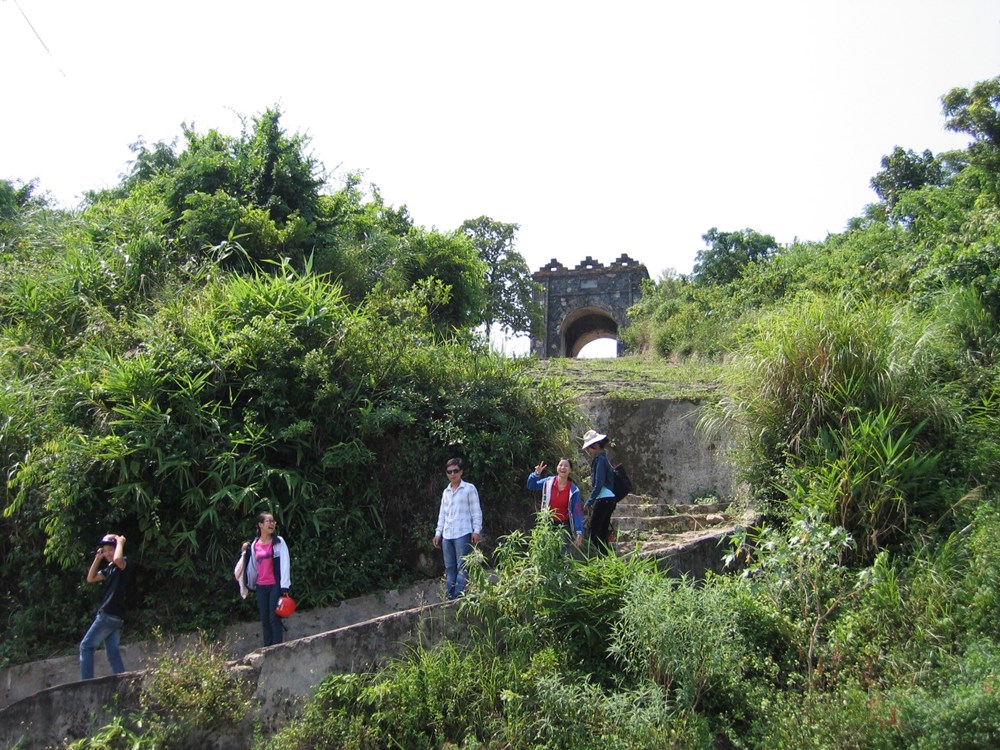
The two provinces should sit down together to reach an agreement.
First and foremost, Ha Tinh and Quang Tri provinces need to quickly sit down together under the chairmanship and guidance of the Ministry of Culture, Sports and Tourism to agree on an official coordination mechanism for the management and preservation of Hoanh Son Pass. These should not be merely goodwill exchanges, but should be institutionalized through a specific, long-term cooperation program with clearly defined responsibilities.
Most importantly, we need to jointly create a scientific dossier to propose Hoành Sơn Pass as a national monument, representing an inter-regional heritage site. Once its "legal status" is clearly established, all discussions about investment, planning, preservation, and promotion of its value will have a stable foundation for implementation.
But simply restoring the architecture is not enough. The lesson from Hai Van Pass shows that it is more important to expand the conservation space from "a gate" to "a heritage landscape." Hoanh Son Pass only truly reveals its value when placed within the overall context of the Hoanh Son mountain range, Deo Ngang Pass, the North-South highway, the memory of territorial expansion, and the cultural space associated with the Nguyen dynasty.
This means that a more comprehensive strategy for promoting the value of these sites is needed: connecting historical sites with historical tourism, scenic tourism, and experiential tourism; building a system for interpreting heritage using digital technology; digitizing all documents, current status, and related cultural value layers; and forming thematic tour routes linked to the history of the southward expansion, Vietnamese poetry, and the ancient North-South transportation route.
If done well, Hoanh Son Pass could absolutely become a unique cultural and tourist highlight of Central Vietnam, instead of just a "check-in" spot along the highway. Of course, the core issue remains heritage management thinking. Over the years, many heritage sites in Vietnam have deteriorated not necessarily due to a lack of funds, but because of a lack of effective coordination mechanisms. When each place views heritage from the perspective of administrative management, it easily leads to a situation where "no one takes full responsibility."
Meanwhile, inter-regional heritage requires precisely the opposite: consensus, shared responsibility, and a shared vision for long-term common interests. This spirit is also very much in line with the direction set by the Politburo in Resolution 80-NQ/TW: Shifting from a "management" mindset to a "governance" mindset for culture; viewing heritage as a resource for sustainable development; encouraging regional linkage models, mobilizing the community, and strongly applying digital transformation in cultural preservation.
From that perspective, Hoanh Son Pass could become a very valuable model. It's not just about restoring an ancient pass, but an opportunity to test a modern, civilized, and long-term model of inter-provincial heritage cooperation. Because ultimately, the greatest value of heritage lies not in the ancient stone walls, but in its ability to connect people with history, connect localities with each other, and connect the past with the future.
Hoành Sơn Pass was once a connecting point between the two regions of the country on the North-South highway. Today, perhaps that very heritage is awaiting a "new path," a path of cooperation, partnership, and shared preservation of the nation's common values.
Can one's "identity" be definitively determined?
On May 21st, the Union of Science and Technology Associations of Ha Tinh Province, in coordination with the People's Committee of Hoanh Son Ward, will organize a scientific seminar titled "Hoanh Son Quan - Deo Ngang Pass: Issues of History and Culture." At this seminar, one of the key issues of interest to researchers and administrators is whether the relevant parties can definitively determine the "identity" of the Hoanh Son Quan historical site, thereby fostering cooperation in its preservation and promotion, or whether the situation will remain one of "hesitation between you and me."
Source: https://baovanhoa.vn/van-hoa/can-lam-mo-hinh-hop-tac-bao-ton-lien-vung-228995.html

![[Image] Hanoi's urban life under the challenge of a "scorching hot" environment](https://vphoto.vietnam.vn/thumb/1200x675/vietnam/resource/IMAGE/2026/05/25/1779706979265_nang-nong-t5-2026-minh-duy-7-4636-jpg.webp)



![[Image] Close-up view of the interchange connecting the two expressways and Long Thanh Airport.](https://vphoto.vietnam.vn/thumb/1200x675/vietnam/resource/IMAGE/2026/05/25/1779703378210_ndo_br_z7863716673926-224453a31600126cce10622af6290afd-4549-jpg.webp)

















































































Comment (0)