

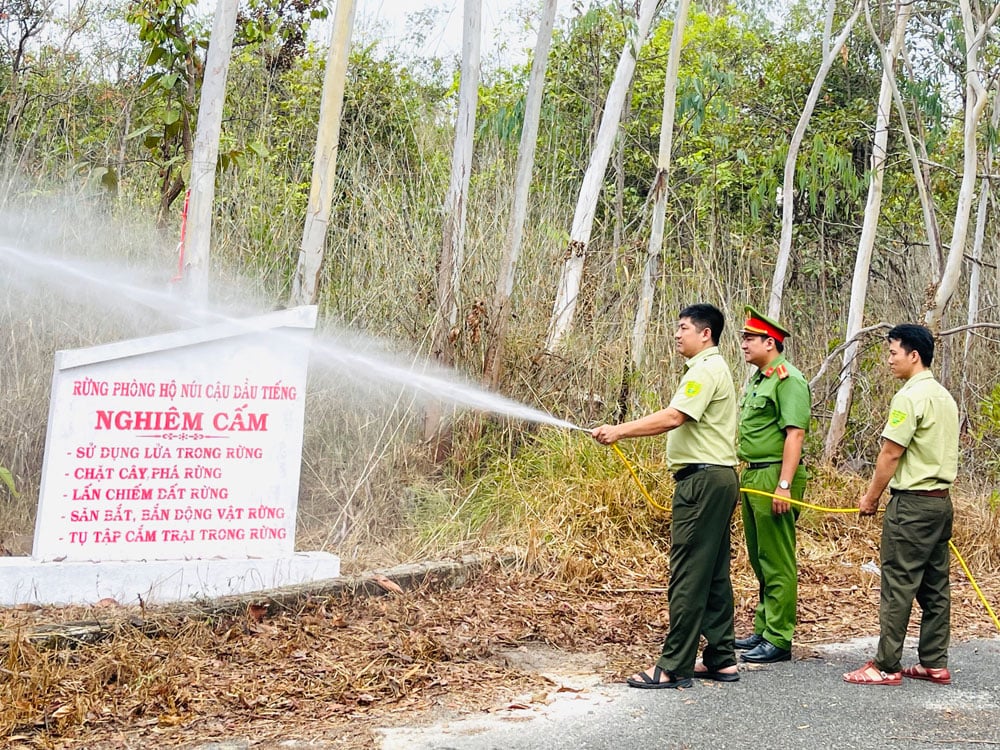
Guarding the forest day and night.
Affected by the six-month dry season, the Nui Cau protective forest in Dau Tieng (Dinh Thanh and Minh Hoa communes of Dau Tieng district) is currently experiencing scorching sun, with the soil becoming dry and barren, and the trees within the forest withering. This is a time when the forest faces a high risk of fire, therefore, the management, protection, and fire prevention and control efforts of provincial and local authorities are maintained 24/7.
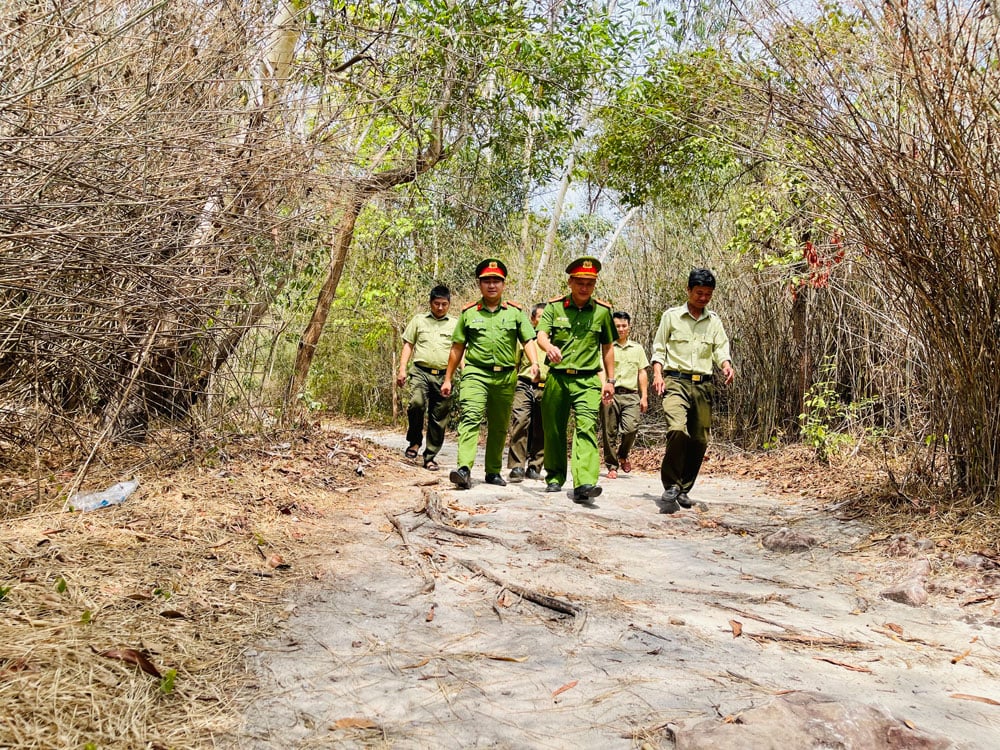
Implementing the plan to ensure fire safety in the Nui Cau protective forest in Dau Tieng, we followed the inter-agency force, a coordinated effort between the Fire and Rescue Police Team of Dau Tieng district, under the Fire and Rescue Police Department of the Provincial Police, and the Management Board of the Nui Cau Protective Forest in Dau Tieng, Dau Tieng Forest Ranger Station, along the "white firebreak" deep into the forest to conduct patrol and survey work.
Hurrying past a rocky bend, Major Nguyen Anh, Deputy Team Leader of the Fire and Rescue Police Team in Dau Tieng area, shared that depending on the location and actual conditions of the forest undergrowth, the authorities implement appropriate firebreaks. "White firebreaks" involve clearing undergrowth and flammable materials to create a boundary preventing fire spread, while "green firebreaks" involve planting and improving dense, fire-resistant vegetation to help contain and prevent fire spread. Surveys conducted during this year's dry season show that the functional units in the Nui Cau Dau Tieng protective forest area have proactively cleared and maintained over 30km of forest patrol roads and nearly 7km of firebreaks.
The forest is facing a potential fire risk level of 5 (extremely dangerous), shared Mr. Luu Tuan Bang, Deputy Head of the Forest Management, Protection and Development Department under the Nui Cau Dau Tieng Protective Forest Management Board. He explained that the Nui Cau Dau Tieng upstream protective forest is a highly critical forest requiring strict management and protection. The entire natural forest area is concentrated in Dinh Thanh commune, with complex terrain, steep slopes, and a limited and incomplete network of forest patrol roads connecting different sections and sub-areas. Along the edge of the Nui Cau Dau Tieng protective forest, there are households living interspersed with local people who frequently enter and exit the forest; especially tourists visiting Thai Son Nui Cau Pagoda for sightseeing , recreation, and camping. Furthermore, the majority of the undergrowth in the Nui Cau Dau Tieng protective forest consists of highly flammable plants such as bamboo, reeds, and stone grass, which have accumulated over many years, posing a high risk of fire.
“Every year, Nui Cau Mountain welcomes over 30,000 visitors who come to visit Thai Son Pagoda, a place of worship and experiential tourism, combined with activities like eating, lighting bonfires, and camping in the forest. The Nui Cau protective forest in Dau Tieng has many trails, making it accessible to everyone. Some locals make a living by going into the forest to collect dry firewood, light fires to collect honey, or smoke cigarettes, which increases the risk of fire. Even a small act of carelessness when using fire inside the forest can cause a fire to spread. Therefore, the authorities continuously broadcast warnings against lighting fires in and around the forest during the dry season to avoid fires and fire spread; they also disseminate legal knowledge about forest protection and fire prevention and control at locations with high traffic. On the other hand, the authorities have also met directly with each household and business around Thai Son Pagoda and Tha La Peninsula to disseminate information and sign commitments to effectively implement fire prevention and control measures,” Mr. Luu Tuan Bang added.
Ready to respond
The deeper into the Nui Cau Dau Tieng protected forest, the steeper and more rugged the terrain becomes. Sections of the road are interrupted, fragmented, and difficult to observe, which has somewhat limited and hampered the direct survey work of the authorities. At this time, the authorities have requested officers to use high-altitude fire monitoring equipment (Flycam) to monitor and supervise fire prevention and control safety from above.
While flying a high-altitude fire monitoring device, an official from the Nui Cau Dau Tieng Protective Forest Management Board stated that previously, in some areas within the Nui Cau Dau Tieng Protective Forest that were difficult to access by patrol, the unit had received attention and support from local Party committees and authorities in investing in guard posts and "fire watchtowers" at high locations to facilitate observation, unlike traditional methods which required the use of specialized personnel with years of forest experience. However, limitations remained, as it was impossible to detect fires in their initial stages and control wind direction and speed; these are crucial conditions for early and remote fire prevention and suppression. Therefore, the unit reported and proposed to the competent authorities to research and apply technology to equip high-altitude fire monitoring devices for professional work. After being equipped, this device has optimally utilized many features to reduce manpower and shorten travel time in hard-to-reach locations and complex terrains, posing safety risks to members of the patrol team. The high-altitude fire control device transmits image data to the control center, and with its ability to detect and analyze wind direction and speed, it allows authorities to monitor and plan effective response and fire suppression strategies, whether during the day or at night.
Stopping for a short break at the forest protection outpost on the western slope of Mount Cau in Dau Tieng, the team members didn't rush to rest but quickly divided themselves to survey the firefighting equipment and tools according to the "four on-the-spot" principle. The 10,000-liter water tanks were already full, and the sprayers, water containers, fire rakes, etc., were all ready for deployment.
Thanks to the silent and unwavering dedication of the units, functional forces, and local authorities in protecting and ensuring fire prevention and control in the Nui Cau protective forest in Dau Tieng, no fires have occurred since the beginning of the year. To protect the forest from the dangers of fire, the joint efforts of the people and tourists are needed to raise awareness and responsibility in ensuring fire prevention and control and protecting the "green lung" of Nui Cau, Dau Tieng.
According to authorities, although Nui Cau Mountain is located close to Dau Tieng Lake, "water far away cannot extinguish a fire nearby." Furthermore, some access roads to the lake are unsafe for specialized fire trucks to draw water, reducing the effectiveness of firefighting during the critical "golden hour" of the initial moments after a fire breaks out. Storing water in tanks, reservoirs, and shoulder-mounted sprayers is crucial in many locations. In addition, the authorities have equipped pickup trucks with booster pumps and 400 meters of water hoses to provide faster and more mobile firefighting. |
HUNG PHUOC
Source: https://baobinhduong.vn/cang-suc-phong-lua-giu-rung-a346637.html


![[Photo] National Assembly Chairman Tran Thanh Man meets with General Secretary and President of Laos Thongloun Sisoulith](/_next/image?url=https%3A%2F%2Fvphoto.vietnam.vn%2Fthumb%2F1200x675%2Fvietnam%2Fresource%2FIMAGE%2F2026%2F01%2F26%2F1769424443676_ndo_br_bnd-2007-jpg.webp&w=3840&q=75)


![OCOP during Tet season: [Part 1] Ba Den custard apples in their 'golden season'](/_next/image?url=https%3A%2F%2Fvphoto.vietnam.vn%2Fthumb%2F402x226%2Fvietnam%2Fresource%2FIMAGE%2F2026%2F01%2F26%2F1769417540049_03-174213_554-154843.jpeg&w=3840&q=75)






Comment (0)