

In the draft Political Report of the 13th Central Committee of the Communist Party of Vietnam at the 14th National Congress of the Party, there is a solemn opening statement: “Under the glorious banner of the Party, we will work together to successfully achieve the goals of national development by 2030; achieve strategic autonomy, self-reliance, self-confidence, and strong progress in the era of national advancement for peace, independence, democracy, prosperity, civilization, happiness, and steadily advance towards socialism.” These are the most powerful, confident, proud, and sacred words summarizing our country's path to socialism.
The report affirms that: "After 40 years of reform, the country's foundation, potential, position, and international prestige have been elevated to a new level," which is entirely true to reality, acknowledged by the world , and praised and emulated by international friends.
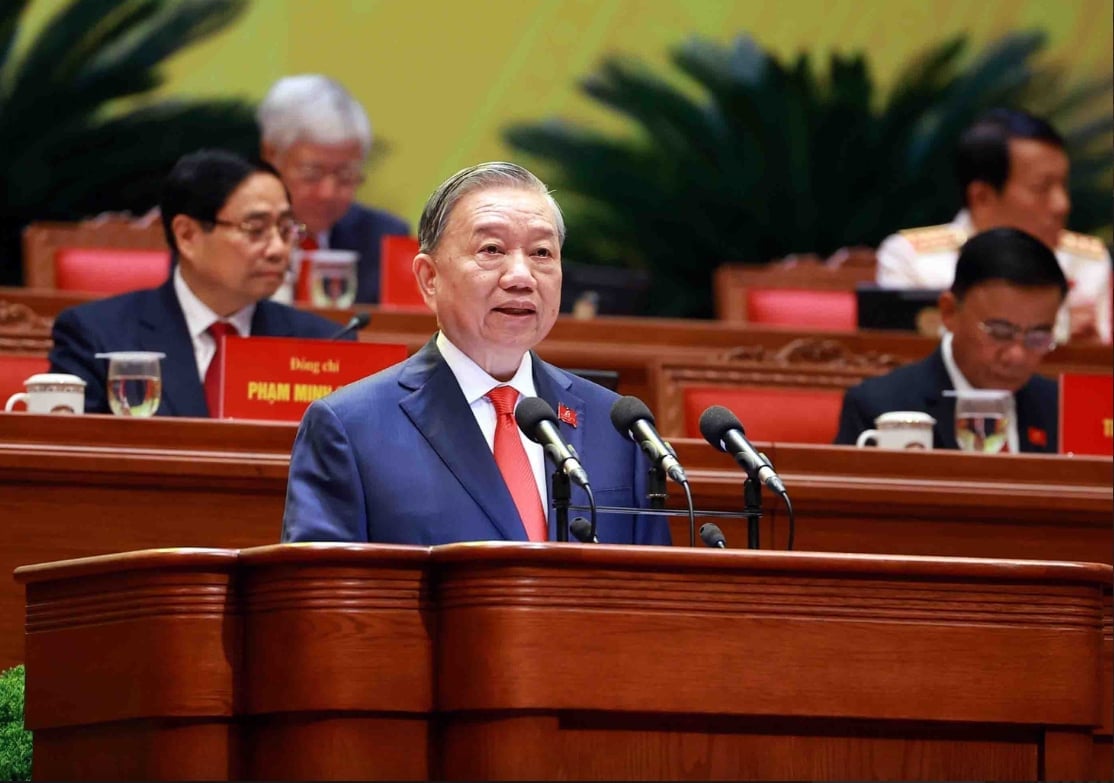
General Secretary To Lam presents the Report of the 13th Central Committee of the Party on the documents submitted to the 14th Party Congress. Photo: VNA.
After 40 years of reform, the country's foundation, potential, position, and international prestige have been elevated to a new level. Thanks to "REFORM," our country has achieved miraculous and remarkable "DEVELOPMENT."
The report uses the word "development" 296 times. This partly confirms that development has existed, is existing, and will continue to progress, reaching further and higher.
In some passages, the word "development" brings joy, excitement, and unwavering confidence: "With the motto of Unity - Democracy - Discipline - Breakthrough - Development , the Congress defines the thinking, vision, and strategic decisions for us to steadily advance in the new era, successfully achieving the national development goals by 2030, when our Party celebrates its 100th anniversary (1930 - 2030); and realizing the development vision until 2045, commemorating the 100th anniversary of the founding of the Socialist Republic of Vietnam (1945 - 2045)." There are certain, scientifically sound passages outlining a strategic direction: “Building and perfecting the institutional framework for developing an advanced Vietnamese culture, rich in national identity with fundamental values: national, democratic, humanistic, and scientific; ensuring cultural development is on par with politics, economics, and society, so that culture truly serves as the foundation, endogenous resource, great driving force, and regulatory system for the rapid and sustainable development of the country; building and implementing a comprehensive system of national values, cultural values, family values, and standards for Vietnamese people, meeting the requirements of development in the new era.”
The report contains the word "innovation" 130 times. In some sections, these two words are key to unlocking a direction: "Strongly innovate institutions, create unique and superior mechanisms and policies for the development of education and training. Continue to innovate state management of education, ensuring quality, efficiency, consistency, and uniformity, with reasonable division of labor, decentralization, and delegation of power; innovate governance, ensuring full and comprehensive autonomy and accountability of educational institutions, especially vocational and higher education; fundamentally reform the mechanisms and policies for finance and investment in education and training."
Thanks to "Renovation," our country has achieved miraculous and remarkable "Development": from a starting point of only US$26.34 billion in 1986, the size of Vietnam's economy is estimated to reach US$514 billion in 2025, ranking 32nd in the world; per capita income is over US$5,000, placing it in the upper-middle income group. Its position and prestige in the international arena have continuously improved. Our country has established diplomatic relations with 195 countries (including 42 strategic partners and comprehensive partners, 5 permanent members of the UN Security Council, and 7 G7 countries)... The 14th National Congress set the goal that by 2030, the 100th anniversary of the founding of the Party, Vietnam will become a developed country with modern industry and upper-middle income. The aim is to achieve an average GDP growth rate of 10% or more from now until 2030. The GDP per capita at the end of the term will be $8,500. By 2045 (100th anniversary of the nation's founding), Vietnam will become a developed, high-income country…
According to many leading experts, the documents of the 14th Party Congress were developed with a very new spirit: to bring the country not only to "growth" but to "breakthrough development"; no longer a mindset of "following behind and catching up" but a mindset of "breaking through and surpassing". We have every right to expect from the Party with this new mindset because since its inception, our Party has led the people from one victory to another.
In addition to the aforementioned factual basis, this expectation also has its foundation in mythology.
As humanity advances further into the horizons of civilization, the need to return to the past becomes increasingly acute. This serves as a foundation for development, explaining the present and predicting the future. In this search for origins, interpreting and deciphering symbols is the most important approach. As the central and fundamental element of culture, studying ancient symbols (archetypes, prototypes) reveals much of what our ancestors wanted to convey. As a meeting point and interaction between the reflections of the past and the reflections of customs and life on both sides of the historical flow, symbols always create a dazzling and captivating spectrum of light with a wide dispersion of cultural meaning. Every community is proud to possess archetypes that encapsulate profound philosophies. Vietnamese culture is proud to have Saint Gióng – a unique figure in human culture.
History is a flowing stream, and the primeval upstream region—where the meaning of human life is integrated with a distant past—is crucial. Archetypes, with their secret core of yesterday, are sown in the soil of the present, thus germinating and growing to bear fruit with new meanings, both traditional and contemporary. Therefore, archetypes like Saint Gióng can still be used to explain the "striving" of today and tomorrow. Playing the role of opening and closing the two doors of history and the future, the hinge of the "archetype" is highly studied.
The 14th National Congress of the Communist Party of Vietnam aims for Vietnam to become a developed country with a modern industrial base and a high-middle income by 2030, the 100th anniversary of the Party's founding. The goal is to achieve an average GDP growth rate of 10% or higher from now until 2030; and a per capita GDP of US$8,500 by the end of the term. By 2045 (100th anniversary of the nation's founding), Vietnam will become a developed, high-income country…
In Vietnamese culture, if the legends of the Hung Kings are the songs of nation-building, then the legend of Saint Giong is the song of nation-preserving. The image of Giong growing rapidly symbolizes the aspiration for unparalleled strength to protect the country and to live and work in peace and security.
The story concludes with words but opens up a whole dimension of aspiration, faith, dreams, and a vast sky of meaning: After driving out the invaders, Giong and his horse flying to heaven is also flying into the sky of Vietnamese culture, honoring the most selfless spirit of heroism for the happiness of the people. The motif of "flying up" is present in many cultures, but it is particularly special in Vietnamese culture, with the "dragon flying" during the relocation of the capital and the "horse flying" after victory over the invaders.
Tracing back to the ancient origins, the "dragon" and "horse" are closely related (ancient Eastern philosophy considered the "dragon" to be the embodiment of the "horse"). The concept of "dragon-horse" (long = dragon; ma = horse) refers to a mythical creature that "blends" the forms of both horse and dragon. The dragon symbolizes good fortune, happiness, and wealth... "Flying dragon/horse" symbolizes development, peace, and prosperity. Ancient Eastern beliefs held that anyone who dreamed of a mythical creature (dragon, lion, turtle, phoenix) would become extremely wealthy. In Vietnamese culture, the aspiration for peace and prosperity is strong, practical, and more concrete, hence the legend of the king (Ly Thai To) "seeing" a "flying dragon" (!?).
The legend of Saint Gióng (set in the context of having just repelled the Yin invaders) reveals a general principle about development: one can only "soar" when the country is at peace, free from war and invaders!
With grand archetypes, every detail shines with meaning. The detail of Giong stretching his arms becomes a symbol of renewal and development with new miracles. Many world historians are still amazed that the August Revolution of 1945, one of the most successful revolutions in world history, took place in a country that was poor and backward, with very limited transportation and communication, and in the shortest time (over half a month), across the widest and longest geographical area (from North to South), with the most radical objectives.
Drawing on legend, some studies offer an interesting explanation: The Vietnamese people, in times of war, fully demonstrated the "spirit of Saint Gióng." After driving out the invaders, Gióng and his horse flew to heaven. This embodies a great ideal: the national hero is absolutely selfless, serving the people and the cause, without seeking any fame or position. In the Ho Chi Minh era, the central figures also carry this meaning: Uncle Ho, the Party, the Ho Chi Minh Army, and the outstanding citizens ready to sacrifice themselves to serve the people and the country. More broadly, it represents the entire nation of Vietnam "shaking off the mud" of poverty and backwardness to "shine brightly" alongside advanced nations around the world. "Flying up" represents the aspiration for victory, the belief in triumph.
Inspired by the spirit of Saint Gióng, the Trần dynasty defeated the Yuan army with a small, efficient, and powerful force (only about 300,000 troops). With 100,000 troops, the great Quang Trung annihilated 290,000 Qing troops… Today, the strategy of building a streamlined and efficient administrative system by our Party and State is also to create the “spirit of Saint Gióng” in peacetime, aiming to improve the efficiency of state governance and create opportunities for people to have happier lives. The legend of King Lý Thái Tổ moving the capital (which also reorganized the country) to Đại La, seeing a dragon flying up, and then renaming the new capital Thăng Long, reflects the era of rising up: the Vietnamese “Dragon” is soaring!
The documents of the 14th National Congress were developed with a very new spirit: to bring the country not only to "growth" but to "breakthrough development"; no longer a mindset of "following behind and catching up" but a mindset of "breaking through and surpassing". We have every right to expect from the Party with this new mindset because since its inception, our Party has led the people from one victory to another.
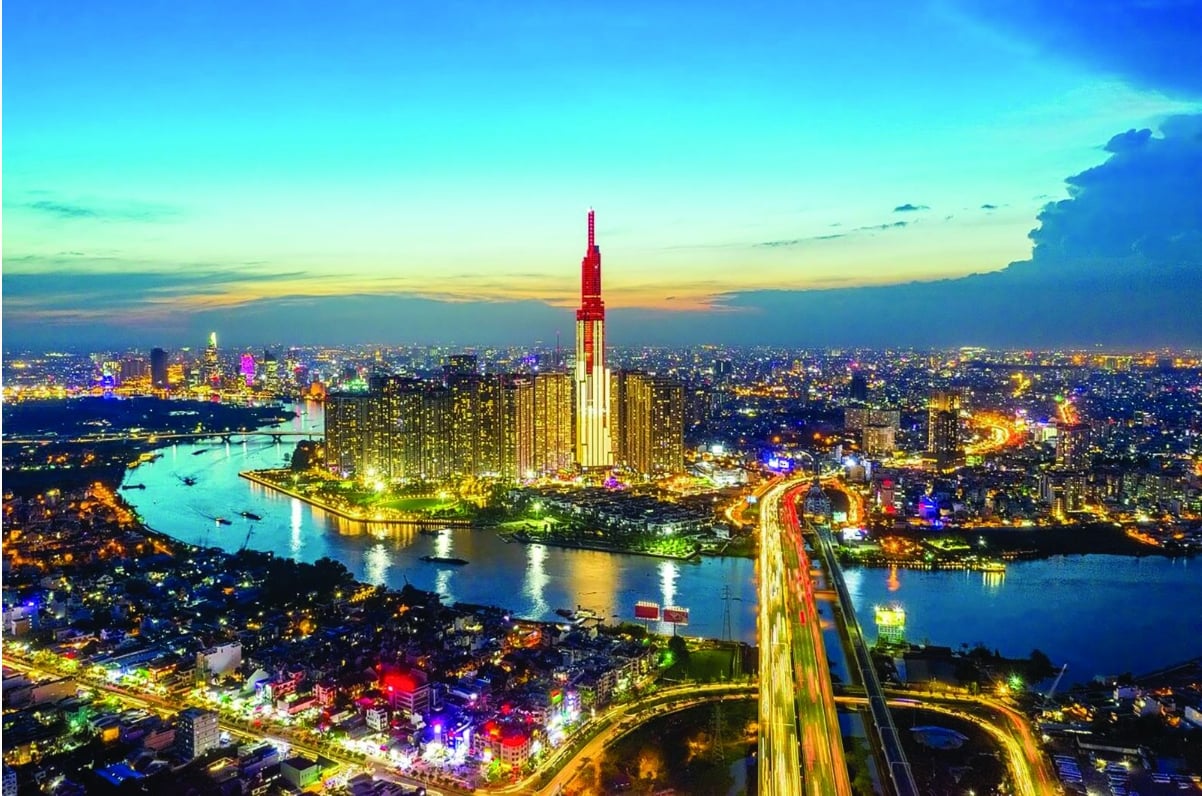
Image source: Forum and Business Magazine.
In ancient times, Saint Giong stretched his arms to realize the historical aspiration: a peaceful nation. Today, the Vietnamese Saint Giong stretches himself to realize the national aspiration: self-reliance, self-strength, a prosperous people, a strong nation, happiness, and a positive contribution to peace and development in the region and the world.
Sixty-six years ago (1960), in his poem "The Man Who Seeks the Image of the Nation," Che Lan Vien pondered the question: "When will the Truong Son mountain range awaken from its slumber / When will the divine arm of Phu Dong reach the clouds?" The answer has been, once was, and is now. And, even more powerfully, from today – starting in 2026 – the year of the Fire Horse – the year of the brilliantly successful 14th National Congress of the Party – the divine arm of Phu Dong will reach the clouds!
Source: https://nongnghiepmoitruong.vn/canh-tay-than-phu-dong-se-vuon-may-d794778.html

![[Photo] Prime Minister Pham Minh Chinh receives the Director of RMIT University Melbourne (Australia)](https://vphoto.vietnam.vn/thumb/1200x675/vietnam/resource/IMAGE/2026/04/02/1775142120087_thiet-ke-chua-co-ten-2026-04-02t214220784-png.webp)













































Comment (0)