

According to Israel, the July 27 airstrike occurred at a soccer field in the town of Majdal Shams on the Golan Heights, home to a large Druze community, and killed at least 12 children.
Israel accused Hezbollah of being behind the attack and vowed retaliation. However, the powerful militant group in Lebanon denied responsibility for the attack.
Below is information about the Golan Heights, as well as the Druze religious and ethnic minority community – victims of the attack.
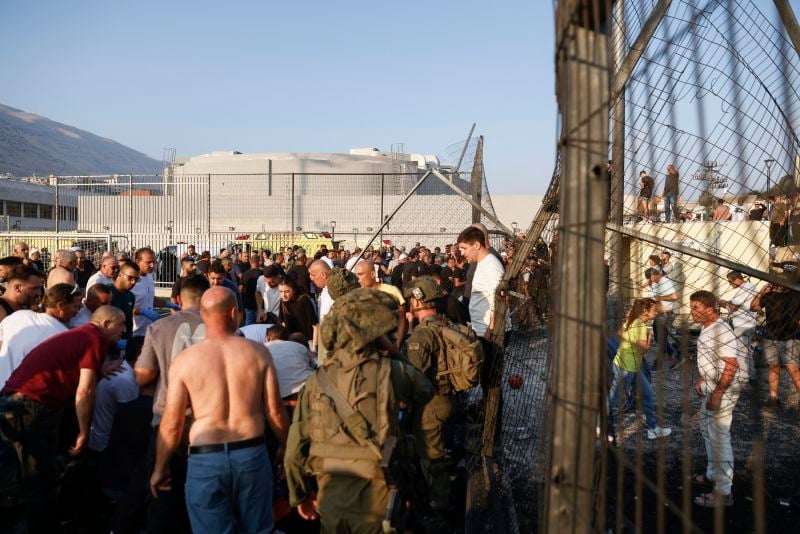
Israeli security forces and local residents gather at the site of an airstrike in the Golan Heights on July 27. Photo: AFP
What is the Golan Heights?
The Golan Heights is a strategic plateau that Israel seized from Syria during the Six-Day War in 1967, before declaring its annexation in 1981. This mountainous territory, spanning approximately 1,300 square kilometers, also borders Jordan and Lebanon.
From the rocky summit of the Golan Heights, the Syrian capital Damascus can be seen. The Israeli-occupied portion of the area is separated from Syria by a UN-backed buffer zone.
The Golan Heights are considered occupied territory under international law and United Nations Security Council resolutions, and Syria continues to demand its return.
This region is often a flashpoint, most recently in 2019 when former President Donald Trump announced that the U.S. would recognize Israel's sovereignty over the Golan Heights – a move that reversed years of policy and increased tensions with Syria.
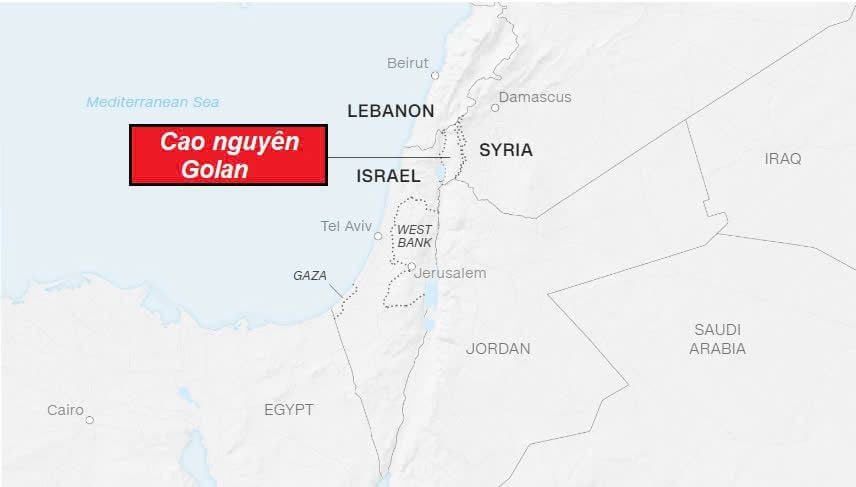
Israel views the Golan Heights as key to its national security interests and says it needs control of the region to counter threats from Syria and militant groups in the area.
The July 27 airstrike was not the first airstrike in the Golan Heights since Israel's war with Hamas in Gaza began following the October 7 attack.
In early July, a Hezbollah missile attack killed two people in the area, prompting the head of Israel's Golan Heights Regional Council to call for retaliation "with force" against the Lebanese group. Hezbollah had previously stated that it had fired dozens of Katyusha rockets into the Golan Heights "in response" to an alleged Israeli attack in Syria targeting a key Hezbollah member.
Who are the Druze people?
The Druze are an Arab sect of approximately 1 million people, primarily residing in Syria, Lebanon, and Israel. Originating in Egypt in the 11th century, this group is a branch of Islam that does not permit conversion—conversion or abandonment of the religion—and prohibits intermarriage.
Over 20,000 Druze live in the Golan Heights. Most identify themselves as Syrian and refused offers of Israeli citizenship when Israel occupied the area in 1967.
The Majdal Shams regional council said that none of the Druze killed in the July 27 attack on the football stadium were Israeli citizens.
The Druze in the Golan Heights share territory with approximately 25,000 Israeli Jews, spread across more than 30 settlements. Last year, the United Nations Human Rights Council raised the alarm about Israel's plan to double the settlement population in the Golan Heights by 2027.
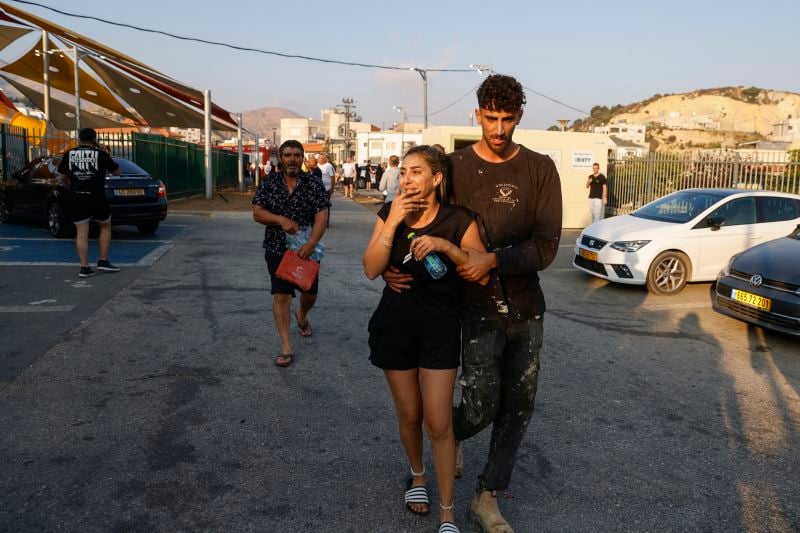
Residents at the site of the airstrike in the Golan Heights on July 27. Photo: AFP
According to the United Nations Committee on the Elimination of Racial Discrimination, Syrian Druze in the Golan Heights suffer from discriminatory policies, particularly those related to land and water allocation.
The UN committee stated: "For many years, expanding Israeli settlements and their activities have reduced Syrian farmers' access to water due to discriminatory policies related to prices and fees."
The Druze in the Golan Heights have long opposed Israeli laws, which they view as attempts at "Israelification." In 2018, thousands of Druze-led protesters demonstrated against the Basic Law on the Jewish State, passed by the Israeli parliament , fearing it would increase discrimination.
Druze leaders at the time said the controversial law made them feel like second-class citizens because it made no mention of equality or minority rights.
Recent data reported by the Israeli press shows that the number of Druze from the Golan Heights applying for Israeli citizenship is increasing, but the number of people doing so remains extremely small: from 75 in 2017 to 239 in 2021.
However, outside the Golan Heights, there are approximately 130,000 Israeli Druze living in Carmel and Galilee in northern Israel.
Ngoc Anh (according to CNN)
Source: https://www.congluan.vn/cao-nguyen-golan-la-gi-va-nguoi-druze-la-ai-post305387.html





















![[Video] Sunset at Lap An Lagoon – Where the sun sets over the fishing nets](https://vphoto.vietnam.vn/thumb/340x192/vietnam/resource/IMAGE/2026/05/31/1780192137701_beach-landscape-sea-water-nature-grass-745871-pxhere-com.jpeg)








![[Image] A brilliant symphony and explosive power in the skies of Da Nang.](https://vphoto.vietnam.vn/thumb/1200x675/vietnam/resource/IMAGE/2026/05/31/1780196945787_anh-man-hinh-2026-05-31-luc-10-08-51.png)




































































Comment (0)