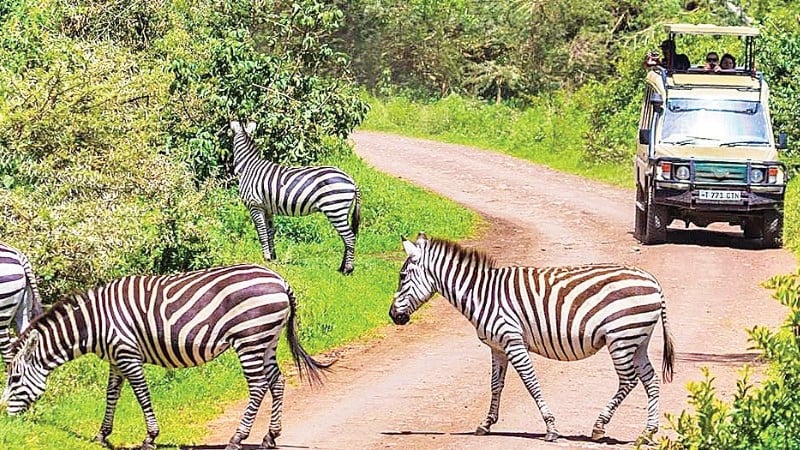
Africa is increasingly attracting the attention of many international tourists. (Photo: XINHUA)
The latest report from the World Tourism Organization (UN Tourism) shows that in the first quarter of 2025, Africa will lead the world in international tourist arrivals growth with a 9% increase compared to the same period in 2024. Notable countries such as Gambia, Morocco, Ethiopia, and South Africa all recorded impressive results.
Along with rising travel demand, according to data from the International Air Transport Association (IATA), in the first four months of the year, travel demand to Africa increased by 9.1% compared to the same period in 2024, which is one and a half times higher than the global average increase of 6%. To meet this high demand, many international airlines are expanding or increasing the frequency of flights to Africa. China Southern Airlines announced that from July 24th, it will increase the number of round-trip flights between Guangzhou (China) and Nairobi (Kenya) to three flights per week.
One of the key factors attracting tourists to Africa is its wild nature and unique adventure tours such as safaris, where visitors can spot rare animals like lions, zebras, elephants, and giraffes in vast natural landscapes. The Mastercard Institute for Economic Research 's "Tourism Trends 2025" report indicates that three tourism product lines are shaping the development of African tourism: nature tourism, wellness tourism, and local culinary experiences.
Mark Elliot, President of Mastercard's Africa region, stated: “Africa is becoming a leading destination in targeted travel, where travelers seek connection with nature, wellness, and unique culinary experiences. This presents a great opportunity for Africa to drive inclusive and sustainable growth and solidify its position on the global tourism map.”
To capitalize on the potential of the tourism industry, many African countries are proactively launching major promotional initiatives and events in the first half of 2025, most notably Africa's Travel Indaba—one of the region's largest tourism marketing events.
Speaking at the event, South African Vice President Paul Mashatile highlighted Africa's rich cultural heritage and the economic opportunities in the tourism sector. He stated that tourism is projected to contribute 10.4% of Africa's GDP by 2030, up from the current 6.8%. In South Africa alone, tourism contributes 8.9% of GDP and supports 1.68 million jobs, with plans to increase that number to over 2 million by 2030.
Also at the event, Zimbabwe's Deputy Minister of Tourism, Tongai Mnangagwa, stated that the country is implementing a "Look East" policy, leveraging its traditional relationship with China to attract tourists from this nation of over a billion people to Zimbabwe for leisure, medical treatment, and business purposes.
At the ITB Berlin International Travel Fair (Germany), the East African Community (EAC) launched a joint slogan: "Visit East Africa: Feel the Vibe," with the goal of transforming the region into a unified tourist destination.
The new East African tourism brand aims to showcase the beauty and cultural richness, as well as the allure, of East Africa as a seamless, multi-destination experience.
In 2024, the EAC recorded approximately 8.5 million international tourists, an increase from 7.7 million in 2019. The bloc aims to attract more than 11 million tourists by the end of 2027.
With coordinated efforts between African countries and the international community, especially the Asian market, Africa is increasingly asserting its position as one of the strategic and sustainable destinations for global tourism in the near future.
However, tourism in Africa faces many challenges due to conflict, political instability, poverty, unemployment, and inequality leading to hardship and widespread violence.
Given the need to integrate technology, innovation, and sustainable development strategies, Africa needs to invest more in skills development and digital transformation to thrive in the tourism sector. African countries must promote innovation and sustainable practices to ensure long-term economic growth.
THANH HAI
Source: https://nhandan.vn/chau-phi-diem-den-du-lich-dang-troi-day-post894727.html













![[Video] Deploying 24/7 surveillance cameras at railway level crossings](https://vphoto.vietnam.vn/thumb/402x226/vietnam/resource/IMAGE/2026/05/24/1779584547691_5-png.webp)
![[Video] Prime Minister orders completion of 100 border boarding schools before August 30th](https://vphoto.vietnam.vn/thumb/402x226/vietnam/resource/IMAGE/2026/05/24/1779582749065_1080-jpg.webp)
![[Video] Proper first aid for children who are drowning](https://vphoto.vietnam.vn/thumb/402x226/vietnam/resource/IMAGE/2026/05/24/1779580944976_duoi-nuoc-png.webp)



























































Comment (0)