

 |
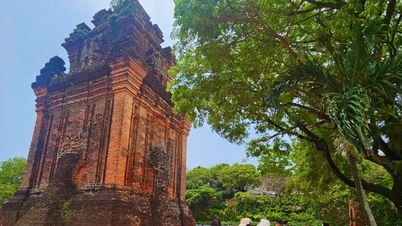
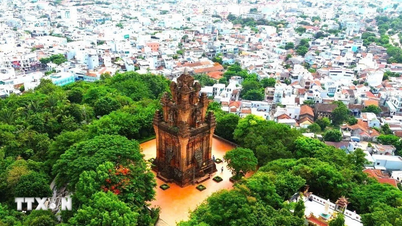
| The Swallow Tower viewed from the front. Photo: Thuy Trang |
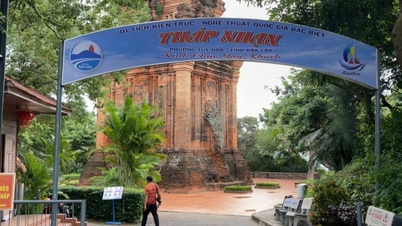
Phu Yen boasts unique natural landscapes, impressive historical sites and tourist attractions rich in cultural value such as: Ganh Da Dia (Disk Rock Cliff), Bai Xep (Xep Beach), O Loan Lagoon, Mang Lang Church, Nghinh Phong Tower… and especially the Nhan Tower located right in the center of the former Tuy Hoa city, now Tuy Hoa ward ( Dak Lak province).
The Swallow Tower has transitioned from everyday life into folk songs.
We visited the Swallow Tower in the middle of this year's dry season, so even before noon, the sun was quite intense. Fortunately, this historical site is located right in the center of Tuy Hoa ward, about a 5-minute motorbike ride from our accommodation. Surprisingly, there is no entrance fee; visitors who want to use the electric tram can buy a round-trip ticket for only 10,000 VND per person. This was very convenient, especially since our group included elderly people and young children, as climbing a mountain over 60 meters above sea level in such hot weather is not easy.
 |
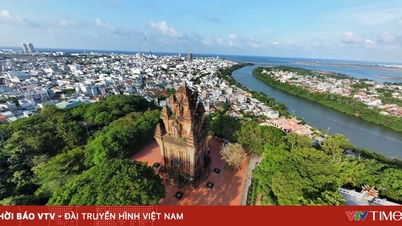
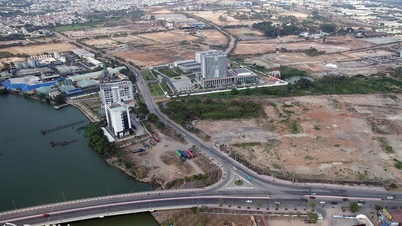
| The view of Tuy Hoa ward (Dak Lak province) from Nhan Mountain. |
Mr. Nguyen Minh Vuong (from Tuy Hoa ward) said: "The Nhan Tower is located on Nhan Mountain, right in the center of the ward, so when you reach the top, you can get a panoramic view of Tuy Hoa with the gentle Ba River flowing into the sea. Along with the Da Rang Bridge, the Nhan Tower is one of the symbols deeply ingrained in the hearts and minds of the people of Phu Yen. Every person from Phu Yen, no matter where they go, is always proud and admires this sacred ancient tower, dating back to the Champa era," Mr. Minh Vuong shared.
Indeed, as the electric tram ascends the mountain, the majestic and sturdy Yan Tower emerges. From afar, the Yan Tower, with its striking red-orange bricks, stands out against the lush green forest. Standing in the spacious, airy grounds, with a gentle breeze blowing, visitors can gaze out at the peaceful Tuy Hoa ward below, with the winding Ba River flowing endlessly into the sea… Admiring the picturesque landscape and listening to folk songs about Tuy Hoa - Phu Yen, truly evokes a feeling of deep emotion:
- My hometown Tuy Hoa has the Thap Nhan rock formation / Where the Cau River is shaded by cool coconut trees.
- Phu Yen has Cu Mong peak / It has Thap Nhan islet, it has the Ba River / It has the daughter of Tuy Hoa / It has the young men of Phuong Lua, the old man of La Hai
- Looking out at the Tuy Hoa Swallow Tower / Looking towards Mount Mot, our homeland is so charming.
- Looking up at the Goose Pagoda, I feel so sorry for you...
The place names mentioned in folk songs serve as reminders of the deep affection of those who have a close connection to their homeland, as well as a sincere invitation to visitors from afar to come to this beautiful place.
Not only tourists visit the Swan Tower, but also local people often come to visit this spiritual tourist site. In particular, many people visit during holidays and festivals, especially during the Lantern Festival (the 15th day of the first lunar month), when the annual Lantern Festival poetry night is held here, making it very meaningful. We hope that this cultural relic will always be preserved and its value will be further enhanced today and in the future.”
Mr. NGUYEN MINH VUONG
(in Tuy Hoa ward, Dak Lak province)
A special national architectural and artistic monument.
Through my research, there are differing opinions regarding the name and construction date of the tower. Some believe the mountain's shape resembles a swallow spreading its wings, hence its name, Nhạn Mountain (Swallow Mountain). Others suggest that in the past, this mountain was an island in Tuy Hòa Bay, where swallows took refuge, hence the name Nhạn Mountain. Gradually, the alluvial deposits of the Ba River connected Nhạn Island to the mainland, so the Champa people built the tower in the 12th century (some sources say the 14th century). Meanwhile, according to information recorded at the site, Nhạn Tower is an ancient Champa temple-tower architectural relic dating back to approximately the 11th century. The tower has a square base, each side measuring about 10m, and a height of 23.5m.
Overall, the Swallow Tower has three parts. The base is sturdy. The tower's massive body rises high, decorated with pilasters and grooves that extend deep into the structure, creating an elegant and majestic appearance. The roof tapers gradually in three tiers, with each tier being a smaller version of the one below. At the top of the tower is a stone Linga – a sacred relic of the Cham people. The main entrance and facade of the tower face east. The other three sides are decorated with patterns and feature false doorways. The tower is primarily constructed of tightly fitted bricks.
Mr. Nguyen Van Dien (a tourist from Xuan Huong ward, Da Lat, Lam Dong province) shared: "For a long time, I have greatly admired and wanted to learn about Cham architecture, especially the exquisite craftsmanship of the bricks. I have visited many Cham temples and towers in the central region of our country. This time, coming to Nhan Tower, I am very impressed by the historical site located on a beautiful mountain right in the center of the ward, facing the river, and especially by the architecture of the tower, which is both majestic and sturdy, yet refined and harmonious…"
According to information at the site, due to the impact of nature and war, the tower gate collapsed long ago, leaving only traces of the foundation. Therefore, from 1994 to 2000, this site was restored and renovated by the State; it was classified as a special national architectural and artistic monument in 1998.
Thuy Trang
Source: https://baodongnai.com.vn/dong-nai-cuoi-tuan/202604/chiem-nguong-thap-nhan-e281abc/




















































































Comment (0)