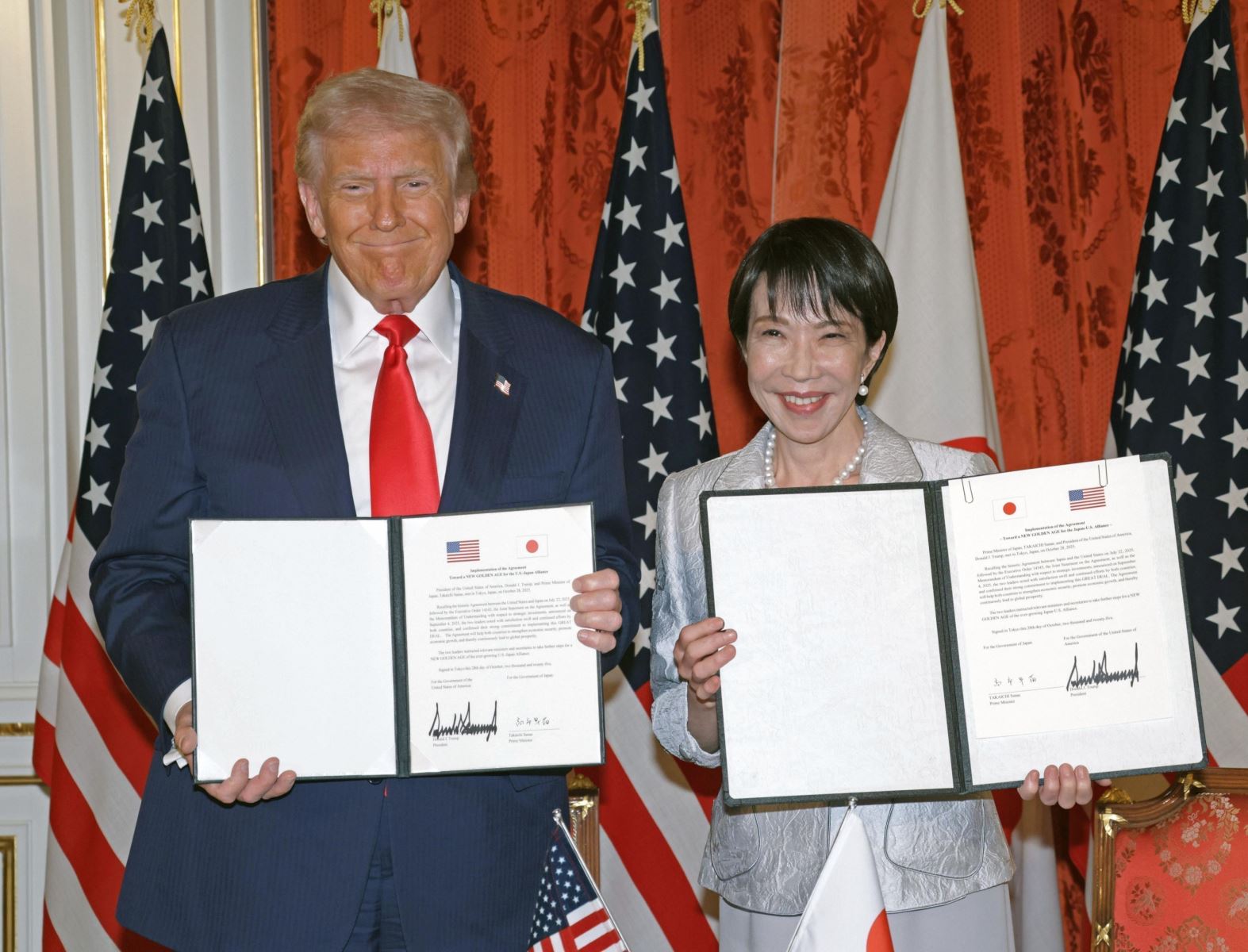
The documents signed in Tokyo emphasize diversification of minerals, AI, quantum technology, and energy, laying the foundation for the US-Japan alliance to become a new pillar of the global economy . Photo: Kyodo/VNA
According to a recent assessment by Associate Professor Daisuke Kawai, Director of the Economic Security and Policy Innovation Program (ESPI) at RCAST, University of Tokyo, published on the website of the UK-based Research Institute for Defence and Security Studies (RUSI.org), during US President Donald Trump's state visit to Tokyo in late October, economic issues became the focus, overshadowing even defense concerns. This event was declared by Japanese Prime Minister Sanae Takaichi and President Trump as the beginning of a "new golden age" for the US-Japan alliance, based on strategic economic cooperation and bilateral stability.
The image of the two leaders standing aboard the USS George Washington aircraft carrier conveyed a message of alliance continuity, but the actual content of the visit leaned heavily towards economic diplomacy . The joint statement and signed documents reaffirmed that cooperation, not confrontation, would shape the future of this relationship.
Platform for bilateral economic cooperation
Four key documents were signed to formalize the new economic focus: Firstly, a document outlining the direction towards a new Golden Age, reaffirming the investment and tariff framework established in July 2025 and directing ministries and agencies to implement it.
Secondly, the Framework on Critical Minerals and Rare Earths: Sets out a common action plan to diversify supply chains from mining to refining, including a ministerial meeting within 180 days.
Third is the Memorandum of Understanding on Shipbuilding Cooperation: Establishing a working group to expand shipyard capacity and introduce advanced manufacturing technologies.
Fourth is the Memorandum of Understanding (MOC) on "Prosperity and Technology": Focusing on the fields of AI, quantum computing, 6G, space energy, and fusion, emphasizing public-private collaboration in Research & Development (R&D) and standardization.
By reaffirming the $550 billion investment framework for Japanese companies in the U.S., the two governments dispelled initial concerns about Takaichi's "reconsideration of tariff negotiations" stance. In return, Washington reaffirmed that reciprocal tariffs would be limited to 15%, providing predictability for both economies.
Notably, the visit barely touched upon sensitive issues such as Japan's increased defense spending or the coordination of Western sanctions against Russia. Instead, President Trump's attention was clearly focused on the economy. Discussions about energy were limited to Prime Minister Takaichi explaining that immediately halting Russian LNG imports was "difficult," and US Treasury Secretary Scott Bessent expressing hope that imports would "gradually decrease."
Prime Minister Takaichi's formula for domestic governance.
Prime Minister Takaichi led with speed and decisiveness, balancing populist responses with technocratic control through her formula of "short-term relief, medium-term investment, long-term fiscal discipline." Regarding the domestic economy: The top priority was curbing inflation and wage stagnation. She acted to abolish the "temporary" gasoline surcharge, introduced energy subsidies, and implemented targeted support measures for small businesses and households.
Regarding defense and industry: Ms. Takaichi is accelerating the defense spending target to 2% of GDP ahead of schedule, emphasizing domestic production, advanced capabilities (cybersecurity, space, long-range attack), and revising the National Security Strategy by 2026. Industrial policies reflect this logic: strategic investments in semiconductors, AI, biotechnology, and shipbuilding. In terms of energy, she prioritizes restarting nuclear power and fusion energy R&D.
Politically: Prime Minister Takaichi leads from a fragile minority, forcing her to negotiate each issue with opposition blocs. However, the blend of experience and youth in the cabinet has provided momentum. Notably, three women are shaping the face of the new government: Prime Minister Takaichi, Finance Minister Satsuki Katayama (the first woman to hold this position in Japan), and Economic Security Minister Kimi Onoda. Public opinion remains very positive, with approval ratings ranging from 64% to 75% thanks to the swift response to inflation.
Shifting to tripartite cooperation
The new framework on essential minerals commits to convening a ministerial meeting within 180 days, effectively launching the economic security roadmap in early 2026. These steps are expected to draw in South Korea's participation.
At recent APEC meetings, Prime Minister Takaichi and South Korean President Lee Jae-myung agreed to resume shuttle diplomacy, establishing a relationship of trust. South Korea's strengths in semiconductors, batteries, and AI infrastructure will complement Japan's industrial base.
If Washington and Seoul sign a tariff and investment agreement, mirroring the US-Japan model, the three advanced economies of the Indo-Pacific could move from theoretical cooperation to structured trilateral economic security agreements. This would include the possibility of joint procurement, harmonized AI and 6G standards, and coordinated energy and grid resilience.
Expert Kawai concluded that President Trump's 2025 visit to Tokyo, with its focus on trade and investment, helped Tokyo reassure Washington and strengthen bilateral stability. If Japan, the U.S., and South Korea can synchronize their efforts in critical mineral resources, AI, and energy supply chains, a "new golden age" could shift from mere rhetoric into a concrete framework of action.
Source: https://baotintuc.vn/phan-tichnhan-dinh/chien-luoc-kinh-te-moi-cua-nhat-ban-va-my-20251117221913480.htm
























































































Comment (0)