


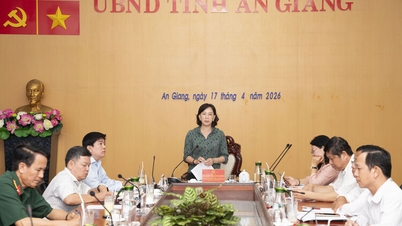
The Standing Committee of the Provincial People's Committee presents appointment and transfer decisions to officials. Photo: TRONG TIN
For decades, the criteria of "virtue and talent" were the pillars of personnel management. However, the addition of "strength" represents a significant shift in thinking in the current era. This isn't a change in slogan, but rather an adjustment of standards to suit the new reality – where work pressure is greater, the pace of operations is faster, and the demands for responsibility are higher. "Virtue" remains the foundation. Without virtue, talent can easily slip into opportunism, group interests, or abuse of power. "Talent" is still a necessary condition for effective organizational operation. But "strength"—both physical and mental—has become an indispensable condition for shouldering responsibility and seeing things through to the end.
Experts have clearly analyzed the two layers of meaning of "strength." In its direct sense, it refers to physical health and strength—the minimum requirement for work. In its broader sense, it refers to mental strength, the capacity for action, and mental health. An official lacking mental health will easily waver in the face of difficulties, easily evade responsibility, or choose safe solutions instead of the right ones. In the context of profound reform, "fear of making mistakes, fear of responsibility" is a manifestation of a lack of "strength" at the mental level.
Including "strength" in the criteria for officials sets a very clear and strict requirement: Health is for carrying out tasks and serving, not for displaying power, oppressing decent people, or destroying nature and society for personal gain. True health is not about muscles or endurance, but about moral and spiritual resilience, the positive energy to work to the end, to defend what is right, to stand on the side of good values, and to dare to protect those who are "weak and vulnerable." Conversely, using "strength" as a pretext to impose power, collude with interest groups, and suppress what is right is not a manifestation of competence, but a dangerous deviation that stifles talent and damages the moral foundation of society.
In reality, the abuse of power by factions and "underground forces" distorts personnel management and erodes social discipline. That is why General Secretary To Lam emphasized the absolute requirement to prevent those who seek positions and power through illicit means, opportunists, and factionalists from infiltrating Party organizations. These individuals will sooner or later find ways to "recover their investment," and the ultimate price society pays will be corruption, waste, and loss of trust.
In the new set of standards, integrity has become a pervasive requirement. This is clearly demonstrated in the requirements for personnel of the Central Inspection Commission : They must be "as pure as a mirror, as sharp as a sword," knowledgeable in law, proficient in their profession, and truly a "sharp sword" safeguarding the Party's discipline. This image is highly symbolic, affirming that discipline is not for punishment but for protecting the organization and those who do the right thing.
Along with improved human resources, the mindset regarding power management has also undergone a significant shift. The placement of key personnel in local positions is a step aimed at limiting parochialism and breaking down the intricate web of power and vested interests. This reform is not easy, but it is necessary to ensure the objectivity, integrity, and effectiveness of the system.
Choosing who to entrust with important tasks is no longer an internal matter of the organization, but a matter linked to the nation's destiny. Every personnel decision today will shape the operational capacity of the system tomorrow. Ultimately, all institutional reforms revolve around one point: people. If the criteria of "virtue, strength, and talent" are seriously implemented without relaxation or compromise, it will be a turning point in building a team of officials where power is accompanied by responsibility, position is linked to results, and prestige is measured by dedication.
Choosing the right people to entrust with key tasks is the ultimate test of reformist integrity. The ultimate measure of such choices lies not in written documents, but in the trust of the people and the concrete changes the country undergoes.
PHAN THANH
(Provincial Party Committee's Inspection Commission)
Source: https://baoangiang.com.vn/chon-nguoi-de-giao-viec-a472870.html

![[Photo] National Assembly Chairman Tran Thanh Man successfully concludes his participation in IPU-152](https://vphoto.vietnam.vn/thumb/1200x675/vietnam/resource/IMAGE/2026/04/18/1776502638199_vna-potal-chu-tich-quoc-hoi-ket-thuc-tot-dep-chuong-trinh-tham-du-ipu-152-8709975-jpg.webp)

















































































Comment (0)