

Currently, the two leading names in the global chip foundry industry are TSMC and Samsung Foundry, respectively. Both began applying extreme ultraviolet (EUV) lithography technology to chip production in 2019, paving the way for nodes under 7 nm.
Simply put, the smaller the process, the smaller the transistors on the chip, resulting in higher processing power and energy efficiency. Therefore, the race to smaller nodes is a common competition among the world's leading semiconductor giants.
Smaller transistors increase density within the same area; and modern chips can contain tens of billions of transistors (for example, the 3nm A17 Pro has up to 20 billion transistors per chip), in addition to having extremely thin spacing between them. This is where EUV lithography becomes important. This machine is manufactured by only one company in the world: ASML of the Netherlands.
The next generation of extreme ultraviolet lithography, or high EUV NA, has begun shipping. Intel, which has pledged to reclaim the node process leadership by 2025 from TSMC and Samsung Foundry, was the first to purchase the new $400 million high EUV NA machine, increasing the Numerical Aperture from 0.33 to 0.55. (NA is the light-gathering capacity of a lens system and is often used to assess the resolution achievable by an optical system).
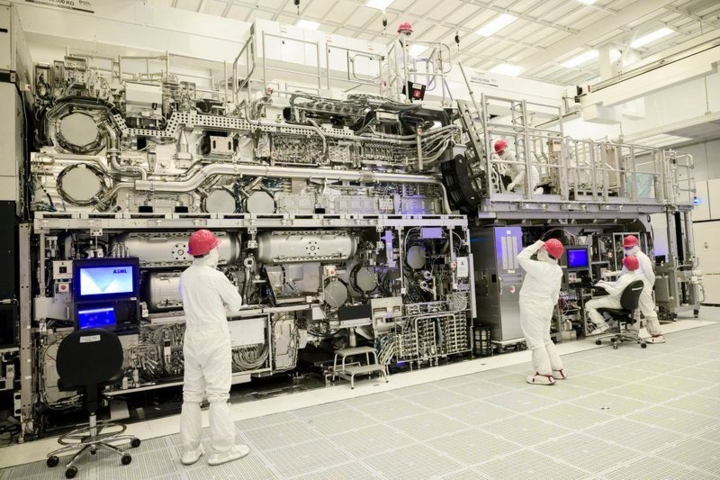
A high-NA EUV lithography machine is being assembled in Oregon, USA. (Photo: Intel)
This allows the etching machine to engrave semiconductor details that are 1.7 times smaller and increases the transistor density of the chip by 2.9 times.
First-generation EUV machines helped foundries unlock the 7 nm node, and more advanced high-NA EUV machines will bring chip manufacturing to the 1 nm process node and even lower. ASML states that the higher NA of 0.55 on next-generation machines is a factor that helps the new equipment perform better than first-generation EUV machines.
Intel is reportedly planning to own 11 high-NA EUV machines, with the first one completed in 2025. Meanwhile, TSMC plans to use its new machines in 2028 with a 1.4 nm process node or in 2030 with a 1 nm process node. TSMC, however, will continue using its older EUV machines to produce 2 nm chips next year. With high-NA EUV, Intel aims to catch up with TSMC and Samsung in the most advanced chip foundry sector.
However, Intel is still facing low production, financial losses, and a stock price that has plummeted to the point of being removed from the Dow Industrial Index, which comprises the 30 strongest stocks on the US stock market. The situation is so dire for Intel that they have to outsource the production of 3nm and larger chips to TSMC.
As China's leading chip foundry and the world's third largest after TSMC and Samsung Foundry, SMIC wasn't even allowed to purchase first-generation EUV lithography machines due to US sanctions. Instead, they were forced to use even older Deep Ultraviolet (DUV) lithography machines, struggling to produce sub-7 nm node chips.
Source























































































Comment (0)