

As a leading public vocational education institution in Hanoi and the country, HHT not only trains and supplies thousands of high-quality workers to the labor market, but also contributes ideas to the development of vocational training. Representatives from the school have actively participated in major forums organized by the Ministry of Science and Technology, the Ministry of Labor, Invalids and Social Affairs, the Ministry of Education and Training , and the Hanoi People's Committee, contributing many valuable and practical suggestions.
Feedback from the workshop
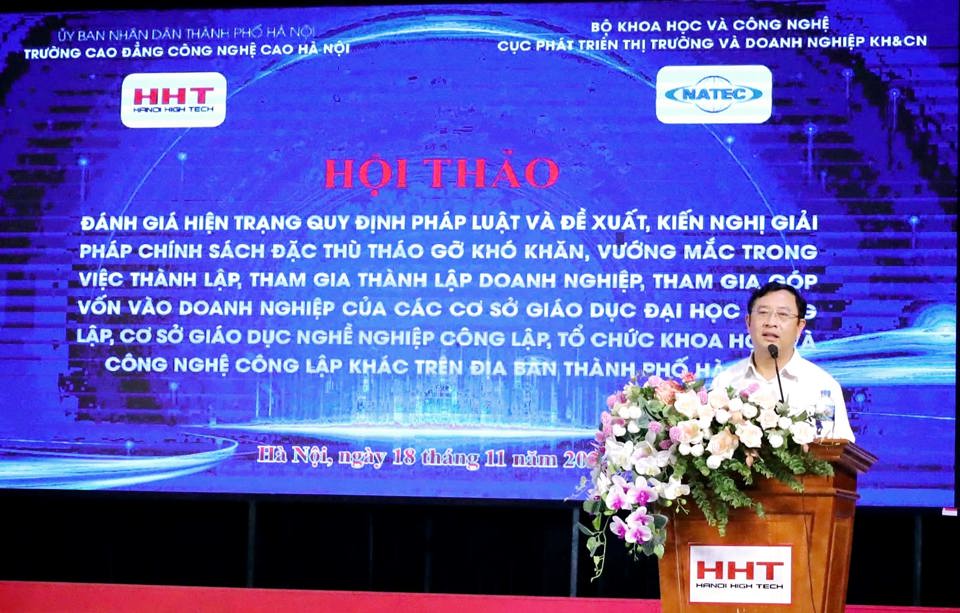
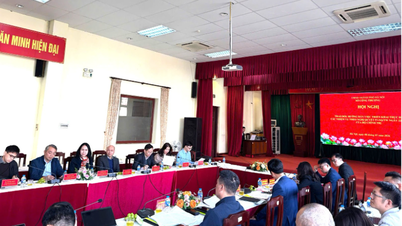
Recently, HHT collaborated with the Department of Market Development and Science and Technology Enterprises (Ministry of Science and Technology) to successfully organize the workshop "Assessing the current state of legal regulations and proposing specific policy solutions to overcome difficulties and obstacles in establishing, participating in the establishment of enterprises, and contributing capital to enterprises by public higher education institutions, public vocational education institutions, and other public science and technology organizations in Hanoi."
Speaking about the workshop, Associate Professor Dr. Pham Xuan Khanh - Principal of Hanoi High-Tech College, said: Article 23 of the Law on the Capital City, "Developing science and technology, innovation, and digital transformation," stipulates that in the coming period, Hanoi will focus on "Developing all fields of science and technology in a comprehensive manner; prioritizing investment resources to build the Capital City into a leading center for innovation, digital transformation, research, development, and technology transfer in the country and the region."
"While universities and research institutes in the city approach science and technology as organizations that bring together leading scientists and managers deeply involved in research and manufacturing, HHT, as a leading vocational education institution in the capital, will offer solutions to overcome difficulties and obstacles in the development of vocational training."
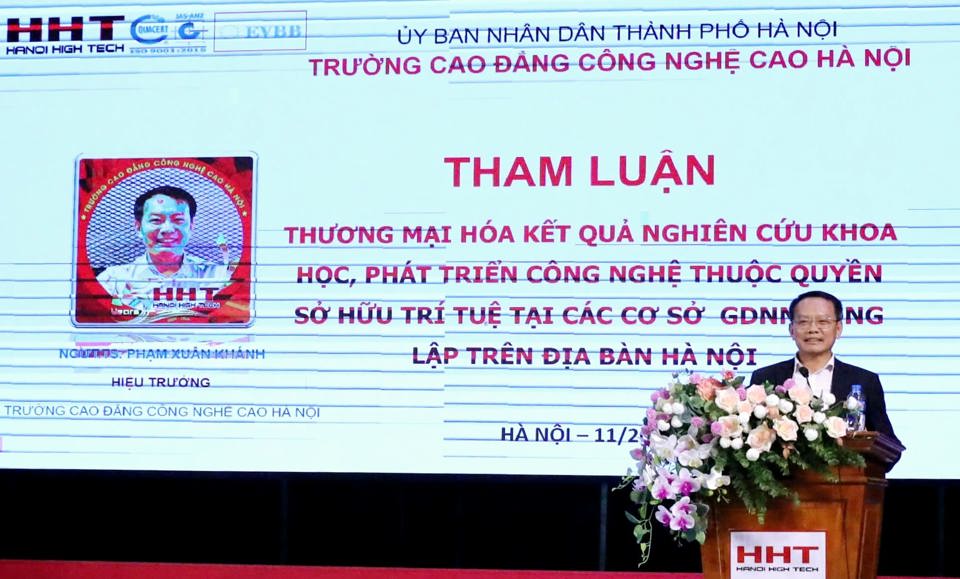
Following this direction, the presentation "Implementing the commercialization of scientific research results and technological development under intellectual property rights at public vocational education institutions in Hanoi: Obstacles in current legal regulations and proposed solutions" by Meritorious Teacher, Dr. Pham Xuan Khanh immediately attracted the attention of the participating delegates. This was not simply the opening presentation of the host institution; Dr. Pham Xuan Khanh directly addressed the issues that many educational institutions are facing when implementing the school-enterprise model, resolving the shortcomings in applying the Education Law to vocational schools.
Professor Pham Xuan Khanh, drawing on his 15 years of experience as a manager at HHT, summarized his findings in a short presentation, highlighting obstacles and proposing practical solutions to the Ministry of Science and Technology. Currently, the school offers three levels of training: college, intermediate, and basic, covering over 45 professions in fields facing severe labor market shortages: mechanics, electrical engineering, electronics, information technology, foreign languages, economics, automotive technology, beauty care, agriculture, and environmental resources… with approximately 3,000 students and aiming for 5,000 students in the next few years. However, maintaining the current training model makes it difficult to attract talented teachers and establish laboratories and practical training facilities to produce high-quality human resources.
The presentation by Assoc. Prof. Dr. Phan Quoc Nguyen (Vietnam National University, Hanoi) at the conference, "The current situation of exploiting intellectual property (IP) by public universities and research institutes to establish businesses, the potential for exploiting protection certificates, and contributing capital with IP assets according to specialized laws (Law on Management and Use of Public Assets; Law on Enterprises; Law on Management and Use of State Capital for Production and Business; Law on Higher Education;… and regulations of the amended Law on the Capital City). Proposals and solutions," also heated up the discussion session. The operational experience of two companies of Vietnam National University, Hanoi, namely the Science and Technology Consulting and Training Company Limited and the Science and Tourism Services Company Limited, which conducts tourism, services, and science, is highly worthy of attention and study by other educational institutions.
Reaching new heights
According to the Capital City Law: “Innovative start-up businesses in key science and technology sectors of the Capital City operating within the city's boundaries will receive support for incubation costs, including costs for organizing project selection activities, hiring experts, direct labor, innovation start-up services, and costs for using technical facilities, incubation centers, and co-working spaces.” This is an opportunity for HHT and other educational and training institutions in the Capital City to develop further in the future.
After concluding a memorable 15-year journey, HHT aims to become a leading vocational training center in key science and technology fields in the capital city. A challenging road awaits both teachers and students at HHT!
Source: https://kinhtedothi.vn/chung-tay-dua-luat-thu-do-vao-cac-co-so-giao-duc.html




















































































Comment (0)