

 |
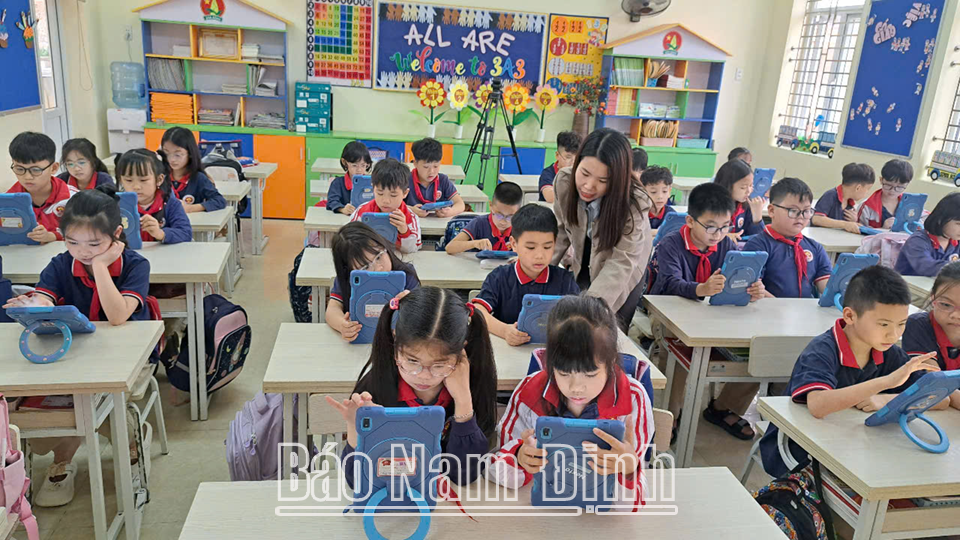
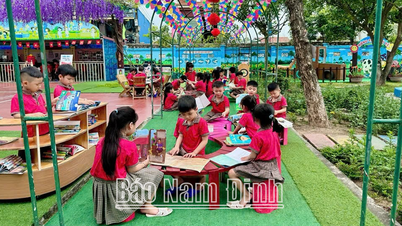
| The smart classroom of the teacher and students at Tran Nhan Tong Primary School ( Nam Dinh city). |
Accordingly, in implementing the policy of innovation, application of information technology, and digital transformation in education , Tong Van Tran Secondary School (Nam Dinh City) has implemented many specific and effective solutions. The school has upgraded its internet infrastructure, utilized software for teaching and management, and organized training for staff and teachers on the use of relevant software. Currently, 100% of classrooms have computers with high-speed fiber optic internet connections, effectively supporting teaching and learning for teachers and students. The school has one computer lab with 23 computers and one server. Functional rooms and administrative offices have computers with high-speed internet connections. 100% of management staff and teachers apply information technology (IT) in management and teaching. Teachers receive and exchange information, announcements, and professional discussions via email, personal Zalo accounts, and the teaching staff group Zalo. To facilitate the application of IT and digital transformation in the performance of duties by staff, teachers, and employees, all staff and teachers have received training and skill development in organizing and managing blended learning activities; designing e-learning lessons, video lectures, and digital teaching equipment; effectively managing and deploying educational management software; information security skills; implementing school management software; collecting educational services through cashless methods, and 100% of parents have complied well. In professional work, management staff use Vnedu software and databases to manage and evaluate students; teachers are basically proficient in using Vnedu software to manage personal and student information in their classes; using PowerPoint to design lectures; and using Camtasia software to create videos. Timetable scheduling software... Many digital transformation initiatives have been actively implemented by 100% of the school's teachers, helping to increase the effectiveness of knowledge acquisition and create enthusiasm for students in each lesson, class, and subject. The application of IT and digital transformation has contributed to improving the effectiveness of the school's education. In the past academic year, at the provincial science and technology innovation competition, the school's student group won third prize; in the provincial IOE competition, they won one second prize and two third prizes; and one student won third prize in Literature at the provincial level. The percentage of students achieving good and excellent academic performance reached 69.3%. The school maintains a high level of "Friendly School, Active Students," is green, clean, and beautiful, meets national standards, and has achieved level three educational quality.
With the goal of continuously innovating and improving the quality of education, Tran Nhan Tong Primary School (Nam Dinh City) is striving to promote the application of information technology and digital transformation at all levels, building models of smart classrooms and smart schools. The school is honored to be selected in Nam Dinh City's high-quality education facility development project, being the first unit to pilot digital transformation starting from the 2023-2024 school year. Currently, the school has two smart classrooms in grades 2 and 3 with 80 students. These classrooms are all connected to high-speed internet, equipped with projectors and interactive whiteboards. Through the smart learning equipment system, students' answers are synchronized to the whiteboard, allowing teachers to monitor the progress and quality of the entire class's answers. Teachers can also correct assignments remotely, or proactively select a student's work and project it onto the whiteboard for correction. Simultaneously, it helps reduce workload and time thanks to tools that support automatic lesson planning, grading, and correction. The real-time learning reporting system allows teachers to quickly grasp the learning progress of each student, thereby personalizing learning paths, providing timely support according to each student's needs, and ensuring timeliness and fairness in the classroom. To implement the smart classroom model, the school's management board has selected teachers with strong pedagogical and professional qualifications, proficient in applying IT and smart devices in teaching; and regularly innovate teaching and learning methods, using open learning approaches. They actively guide students to develop self-learning and research skills and encourage them to passionately explore knowledge. The process of checking and evaluating student quality is simplified thanks to this model. The introduction of smart devices into teaching helps teachers realize their ideas, making lessons more lively and engaging. Students acquire knowledge through new methods, leading to increased enthusiasm and passion, better academic results, and improved creativity and critical thinking skills. This not only fosters proactiveness and self-learning skills but also helps them access technology safely, in a controlled manner, and with a clear purpose. Furthermore, learning through engaging and visually appealing lectures, gamified lessons, and timely support from teachers during the learning process also motivates students to enjoy learning more.
Currently, 100% of schools in the province have applied digital technology in teaching methods and educational management. 100% of educational institutions have implemented and used: school management software (VNPT's Vnedu and Viettel's Smas) to support school administration and integrate digital workspaces; electronic record applications (electronic gradebooks, electronic student records); online payment of educational fees; applications for connecting, interacting, and exchanging information between parents and schools on digital platforms, applying free solutions such as OTT messaging, email, mobile applications, and educational websites; electronic administrative management system (E-Office); electronic portal, educational email... Annually, the Department of Education and Training strengthens training to improve IT skills for teachers; deploys IT applications in management, direction, operation, and education administration. The Department of Education and Training has implemented IT applications to support innovation in teaching content, methods, and assessment; developed industry-wide databases on education; deployed IT infrastructure and equipment; and provided other necessary support. To date, all general education teachers have been guided in organizing and managing online classes, developing digital learning materials, utilizing online learning resources, and using software for creating e-learning lectures, online quizzes, and virtual experiments. Teachers have also received training in integrating artificial intelligence (AI) to innovate teaching content, methods, and management skills. Furthermore, the Department has implemented cross-border connected teaching, enabling teachers and students to exchange expertise and international culture. In addition, thousands of digital lectures and teaching aids have been developed by teachers, winning high awards in ministerial and national competitions. In the "Nam Dinh Province Digital Teaching Equipment Development Competition 2024", the entire education sector submitted 1,808 entries. The organizing committee recognized 1,440 entries, including 31 first prizes, 70 second prizes, 113 third prizes, 370 consolation prizes, and 856 "Satisfactory" entries.
To actively implement digital transformation, in the coming time, the Department of Education and Training will continue to refine policies and innovative education models based on digital platforms; ensure 100% of educational institutions have access to modern technology, improve the application of AI, VR, and AR in teaching and management; continue to comprehensively digitize educational data, from student information to records and documents, creating optimal conditions for management and operation; expand online public services, and improve convenience and transparency in educational administrative procedures.
Text and photos: Hong Minh
Source: https://baonamdinh.vn/xa-hoi/202505/chuyen-doi-so-gop-phannang-cao-chat-luong-day-va-hoc-73244f2/









































































Comment (0)