

Memories of a not-so-distant past
For our generation, those were very memorable early years—the 1960s.
The South seethed with hatred for the crimes of the US-Diem and US-Khanh regimes. A general uprising was underway, driven by the resolve to "Drive the Americans out, overthrow the puppet regime," liberate the South, and unify the country. The heroic spirit of "Rise up, heroic people of the South! Rise up, brave the storms! We swear to save the nation, we swear to sacrifice to the end! Take up swords, take up guns, and charge forward!" Victory followed victory. The uprisings in Ben Tre and Binh Gia, and the great victory defeating the Special War, thrilled the people of both North and South Vietnam. Following their defeat on the Southern battlefield, on August 5, 1964, the US imperialists fabricated the Gulf of Tonkin incident, launching a frenzied air campaign against the North in an attempt to thwart our will to unify the two regions.
Then came a shocking event that autumn. The US reversed its decision and executed Saigon commando Nguyen Van Troi at 9:30 AM on October 15, 1964. At that time, getting news was extremely difficult. Everything depended on information from the Voice of Vietnam radio station , which ordinary people in the Northern Delta listened to through their transistor radios… But through that, we saw a wave of indignation and hatred for the enemy rising up, unprecedented in our people and in progressive humanity worldwide. Through the radio, sometimes using local dialects, there were news reports mentioning Nguyen Van Troi, poems calling him Nguyen Van Troi… and later, everything was referred to as Nguyen Van Troi…
My memory recalls: Electrician Nguyen Van Troi was born and raised in Thanh Quyt village, Dien Thang commune, Dien Ban district, Quang Nam province. He was the third child in a poor peasant family. The French killed his mother when he was only three years old, and he lived with his uncle and cousins. At 15 or 16, he went to Saigon to work and earn a living. He used to work as a cyclo driver, then he apprenticed as an electrician and quickly became a skilled electrician. He worked at the Ngoc Anh workshop, and with his deep patriotism and hatred of the enemy, he was enlightened by the Party and joined the Youth Union. He became a commando soldier in the 65th Special Forces, belonging to the Southwest Saigon Suicide Squad, Saigon-Gia Dinh Military Region.
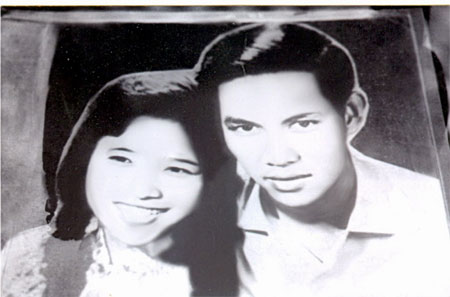
Nguyen Van Troi and his wife after their wedding day. Archival photo.
In 1964, he received training in urban guerrilla warfare at the Rung Thom base in Duc Hoa (Long An province). He met Phan Thi Quyen through a friend of hers who worked at the Bach Tuyet Cotton Factory. They fell in love for over a year before getting married on April 21, 1964. On May 2, 1964, he was assigned the task of planting mines at Cong Ly Bridge (now Nguyen Van Troi Bridge) to assassinate a high-ranking political and military delegation of the US government led by Secretary of Defense Robert McNamara.
While on a mission, he was unfortunately captured by the enemy at 10 PM on May 9, 1964. In prison, despite enduring numerous brutal tortures and tempting offers from the enemy, Nguyen Van Troi remained steadfast in his refusal to betray his comrades, remaining loyal to the Party, the organization, and the ideals he had chosen. To rescue him, a guerrilla organization in Caracas, Venezuela, demanded an exchange for US Air Force Colonel Michael Smolen, who had just been kidnapped by this guerrilla group, declaring, "If Nguyen Van Troi is executed in Vietnam, then an hour later they will execute Colonel Smolen in Venezuela."
However, shortly after Michael Smolen was released, the Military Court of the Republic of Vietnam executed Nguyen Van Troi at 9:45 AM on October 15, 1964, in the vegetable garden of Chi Hoa prison in Saigon. He remained calm as he walked to the execution grounds. Before a large crowd of domestic and foreign journalists, he exposed the crimes of American imperialism. When the enemy blindfolded him, he pulled it off and said, "No, I must see this land, my beloved land." Before dying, he shouted, "Remember my words! Down with American imperialism! Down with Nguyen Khanh! Long live Vietnam! Long live Ho Chi Minh!"
The phrase "Long live Ho Chi Minh!" was shouted three times by him. The fighting spirit and heroic sacrifice of Nguyen Van Troi at the execution ground became a symbol for the Vietnamese youth during the anti-American war. Our beloved leader, President Ho Chi Minh, wrote on a photograph of Troi: "For the Fatherland, for the people, martyr Nguyen Van Troi bravely fought against American imperialism to his last breath. The indomitable spirit of Hero Troi is a shining revolutionary example for all patriots, especially for young people to learn from."
"There are moments that make history."
There is a death that transforms into immortality.
There are words that are more powerful than any song.
There are people born as embodiments of truth…”
To Huu
The heroic sacrifice of Anh Troi is known to people around the world and has had a widespread impact; even 60 years later, I still remember the spirit of those years…
The story of writer Tran Dinh Van about his book "Living Like Him"
In my journalistic work, I've met journalist Thai Duy – Tran Dinh Van a few times (twice at his house at 8 Ly Thuong Kiet Street and once at a seminar at the Vietnam Journalism Museum), the author of "Living Like Him," a once-famous and touching story about revolutionary heroism, but I rarely had the chance to chat with this veteran journalist…
On July 5, 2019, Mrs. Phan Thi Quyen, wife of the heroic martyr Nguyen Van Troi, passed away. It was also the 55th anniversary of Troi's sacrifice. I visited journalist Thai Duy – Tran Dinh Van (real name Tran Duy Tan), who has helped us understand more about the sacrifice and noble qualities of young people through literature and journalism. His work, "Living Like Him," is a bedside guide. Like "The Nation Rises Up," "Hon Dat," "A Story Written in the Hospital," "Mother Bay's Family," "The Mother with a Gun," etc., "Living Like Him" is like a call from the nation urging generations to go to war, drive out the enemy, and liberate their homeland.
He confided: In 1964, he was a reporter for the Liberation Newspaper, the organ of the National Liberation Front Committee of South Vietnam, with its editorial office in Tay Ninh. After Nguyen Van Troi's death, the Saigon regime's press reported extensively on the event. At that time, Tran Dinh Van was working in Long An, only 30 kilometers from Saigon. Through that, we learned more about the unsuccessful battle at Cong Ly Bridge. As war correspondents, upon hearing the story, he and his colleagues all thought they had to do something to honor Troi's bravery. Later, Tran Dinh Van learned that Phan Thi Quyen, the wife of Martyr Nguyen Van Troi, had been brought to the National Liberation Front's base by Saigon commandos and attended the Congress of Heroes and Emulation Fighters of South Vietnam. Upon approaching her, he initially wrote an article titled: "The Last Meetings of Ms. Quyen and Mr. Troi," which was published in the Liberation Newspaper. But then, journalist Thai Duy received instructions that a book about Anh Troi was needed, so he decided to go to Cu Chi to meet with comrades who had worked and been imprisoned with Anh Troi to gather more information… After finishing the book titled “The Last Meetings,” the agency asked a Soviet reporter to send it to Hanoi via Cambodian air travel…
Journalist Thai Duy recalled: "Later I learned that the comrades in the Politburo and the Secretariat were very interested in the book. Prime Minister Pham Van Dong renamed the book 'Living Like Him.' Uncle Ho wrote the preface. Just about a month after it was sent, we in the battlefield heard 'Living Like Him' read aloud on the Voice of Vietnam radio... In 1966, journalist Thai Duy was transferred to work in the North. He met with Ms. Quyen a few more times. One day after liberation, on May 1, 1975, journalist and writer Thai Duy visited and paid respects at the grave of Anh Troi in his maternal hometown..."
By natural law, at nearly a hundred years old, writer Thai Duy-Tran Dinh Van has also passed away. But he was the one who upheld the moral example and dedicated style of a revolutionary journalist and artist. And the heroic martyr Nguyen Van Troi, for the past 60 years and forever, has become one with his homeland, embodied in the names of streets, schools, and the example of "Living like him"...
Huu Minh
Source: https://www.congluan.vn/co-cai-chet-hoa-thanh-bat-tu-post316511.html



![[Photo] National Assembly Chairman Tran Thanh Man working with the Standing Committee of the Law and Justice Committee](https://vphoto.vietnam.vn/thumb/1200x675/vietnam/resource/IMAGE/2026/05/21/1779378929214_ndo_br_1-4610-jpg.webp)
![[Photo] General Secretary and President To Lam presides over a working session with the Central Policy and Strategy Committee on the development of the materials industry.](https://vphoto.vietnam.vn/thumb/1200x675/vietnam/resource/IMAGE/2026/05/21/1779359935432_a3-bnd-3129-1412-jpg.webp)































































Comment (0)