


Mrs. Nguyen Thi Ly's house (80 years old), in Co My village, Vinh Giang commune, is only a few hundred meters from the old Ferry Crossing C. She led me along a rough dirt road to the lush green rice fields beside the riverbank. "In the past, there were four ferry crossings connecting the North and South banks of the Ben Hai River. But only Ferry Crossing C didn't transport people to the battlefield; it only brought the wounded and the dead back to Vinh Linh. Therefore, this ferry crossing is more poignant, sadder, and quieter than all the others," Mrs. Ly said, her voice choked with emotion.
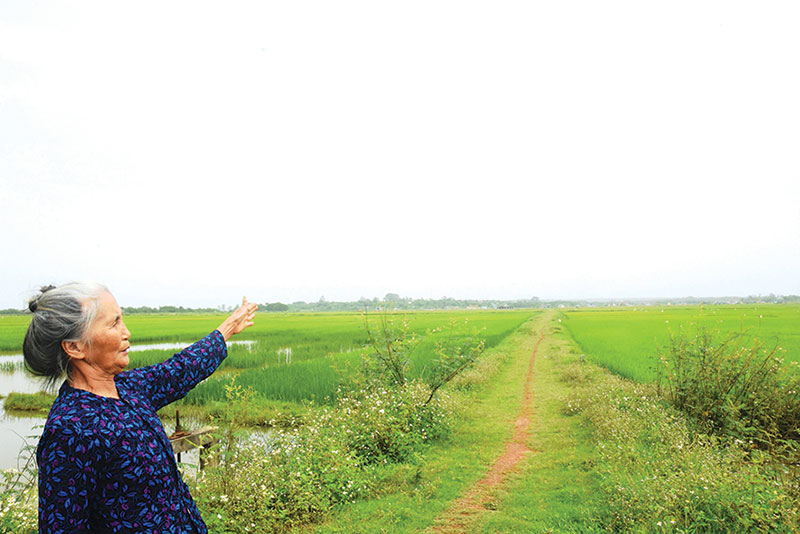
As someone who directly participated in rowing boats, carrying wounded soldiers on stretchers, and transporting fallen soldiers back to the rear, Mrs. Ly still vividly remembers those journeys in the darkness. "Traveling at night, without lights or noise. Even a faint light like a firefly was enough to trigger enemy artillery fire from Doc Mieu," she recalled thoughtfully. "We would grope our way through the mud, silently calling out to each other when we found a soldier's body, and then together we would carry it back to Dong Soi for burial."
The period of 1972 was a time of heavy casualties. Some nights, Ms. Ly, along with hundreds of militiamen and guerrillas, were divided into many groups, each carrying dozens of wounded and fallen soldiers on stretchers. "Some nights I carried 11 or 12 soldiers at once; those who were healthy even carried extra backpacks. Some wounded soldiers were barely alive, so we tried to get them to a place with military medical personnel. As for the fallen soldiers, we brought them back to be buried right in the local area so we could retreat before the shelling," she recounted, her eyes filled with longing for the riverbank.
Mr. Nguyen Van Thi (86 years old), also from Vinh Giang commune, former head of the ferry team at Wharf C, still fondly recalls those brutal days. He directly commanded numerous ferry trips transporting ammunition and wounded soldiers, and often joined his comrades in collecting the bodies of fallen soldiers from hotspots. "I remember most vividly the battle at Hill 31, Gio Linh. The enemy surrounded us, and we suffered many casualties. It took us four days to gather about 40-50 bodies. Some bodies, even after being buried, were still churned up by bombs; it was heartbreaking!" Mr. Thi recounted, his voice faltering.
In Vinh Giang commune, there is also Mrs. Ngo Thi Tho, a disabled veteran (category 1/4), who also participated in ferrying people across the Ben Hai River. She still vividly remembers the young faces returning to Ferry Terminal C in silence. "Ferries A and B took people to fight the enemy. Ferry Terminal C brought people back, all of them eighteen or twenty-year-olds. It was heartbreaking to see," she said, her eyes welling up with tears as she recalled. She had rowed dozens of ferry trips during the fierce war, amidst the gunfire and smoke.
According to Mr. Nguyen Van An, Secretary of the Party Committee of Vinh Giang commune, local Party history books record that during the resistance war against the US, there were four ferry crossings connecting the North and South on the river route from Cua Tung, Vinh Quang commune, through Tung Luat, Vinh Giang commune, to Hoi Cu, Vinh Son commune (Vinh Linh district). Among them, crossings A - Vinh Quang and B - Tung Luat were key points, as they served as the main gathering points for forces and supplies from the North to the South. From here, goods, weapons, medical supplies, and soldiers secretly crossed the river at night, traversing the front lines. And from here, wounded soldiers and those who died in fierce battles were transported back to the North, to the rear.
By May 1967, the war had entered a fierce phase. The number of wounded and fallen soldiers being transferred from the Southern front increased steadily. To alleviate the psychological pressure on the fighting forces crossing the river, a new ferry crossing was established in Co Trai village (now Co My village), more than 1km west of Tung Luat ferry crossing. This crossing, named Ferry Crossing C, was specifically for receiving wounded and fallen soldiers. A reception point without gunfire or flags, yet filled with tragic stories.
Ferry Terminal C was staffed with three combat platoons, with clear assignments. The Tan Son, Tan My, Co My, and Di Loan units were responsible for transporting the wounded; the Tung Luat unit directly operated ferry terminals B and C. Between 1968 and 1972, these two terminals transported over 1,382 soldiers, militiamen, and civilian workers on the front lines, received and transported 8,112 wounded and deceased soldiers, helped over 2,000 civilians cross the river to safety, and carried out 251 supply trips to Con Co Island…
According to Mr. An, it is regrettable that many sites within the "Hien Luong - Ben Hai" National Special Monument have been restored, while ferry terminal C has yet to be reconstructed.
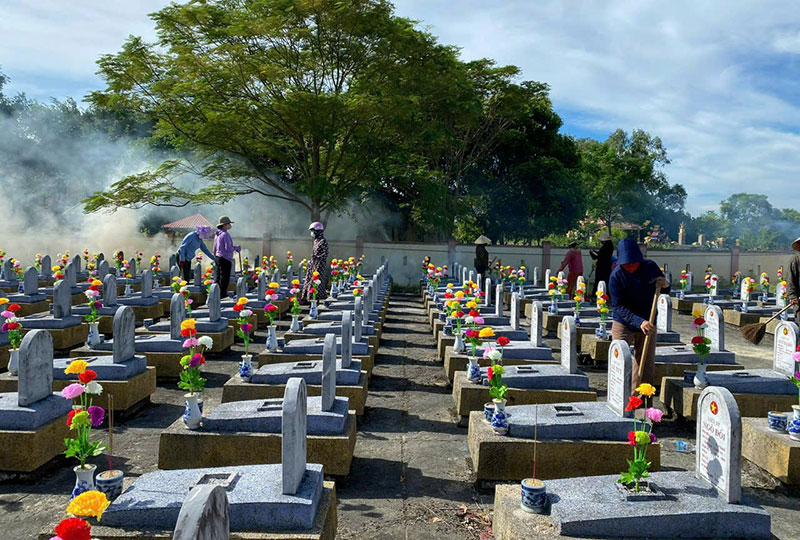
Leaving Ferry Terminal C, we visited the Martyrs' Cemetery in Vinh Giang commune. The monument commemorating the fallen heroes, over 16 meters high, still bears the unsightly marks of bombs and bullets on one side, a testament to the war. Mrs. Ly walked slowly, her voice somber as she recounted the past: "At its peak, more than 2,000 martyrs rest here. All fought and died on the South bank, and were later brought here via Ferry Terminal C. Besides Ferry Terminal B, Ferry Terminal C also holds the tragic stories of the soldiers and people of Vinh Giang. Therefore, we hope that the relevant agencies will soon gather documents and restore this historical site so that it will not be forgotten over time."
Speaking with a reporter from the Public Security Newspaper, Mr. Le Minh Tuan, Director of the Department of Culture, Sports and Tourism of Quang Tri province, said that according to Decision 2383/QD-TTg dated December 9, 2013, of the Prime Minister, Ferry Terminal C is one of the six component points of the Special National Monument "Hien Luong - Ben Hai". However, while Hien Luong Bridge has been renovated and Tung Luat Wharf has been restored, Ferry Terminal C remains a "blank spot" in the map of memory. Many groups of visitors, including local students, pass through without knowing that this place was once one of the largest reception points for wounded soldiers and fallen soldiers of the Vinh Linh battlefront. Currently, the unit has included the restoration of this ferry terminal in the plan and is awaiting approval from higher authorities…
If one day the C ferry crossing is rebuilt, not only with construction materials, but also with memories and gratitude, it will not only be the restoration of a historical site, but also the reconnection of the hearts that once silently upheld the sense of brotherhood amidst the dividing river!
Source: https://cand.com.vn/doi-song/co-mot-ben-do-c-ben-dong-ben-hai-i767719/












































Comment (0)