

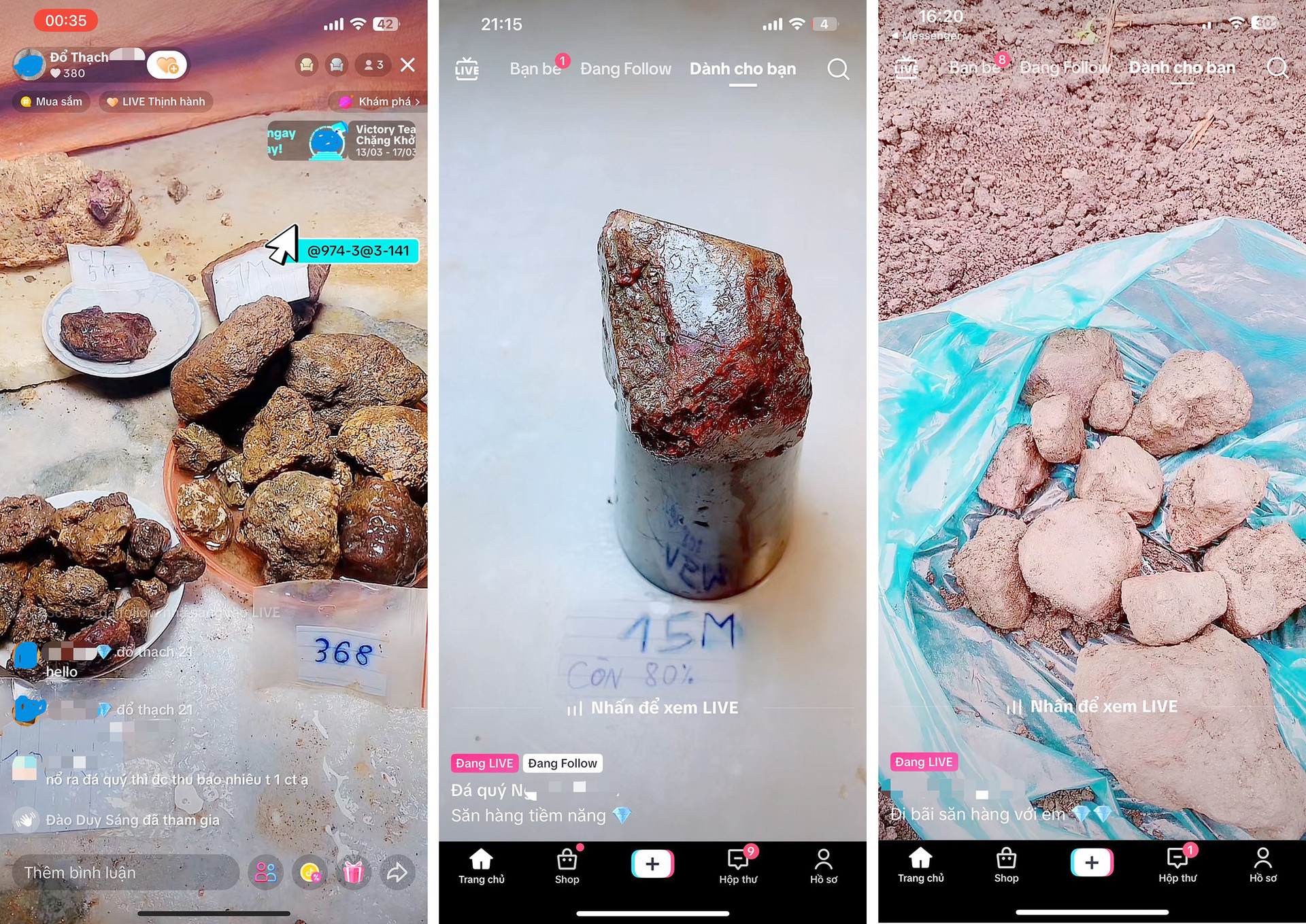
"Gem cutting" refers to the process of separating and processing rough stones surrounded by sandstone (a layer of minerals adhering to the outside of the gemstone) to obtain finished gemstone crystals.
It's inevitable that tricks are used; the stones might be empty when broken open, but the person breaking them quickly puts in precious stones and has a decoy pretend to win big to entice players. However, if a real player plays, they're almost certain to lose.
Mr. P.D.
Working together day and night to find gemstones.
Over the past year or so, "rock smashing" has suddenly become a trending phenomenon on social media, leading to a proliferation of live-streamed rock smashing platforms on TikTok.
Mr. Nguyen Thanh (name changed), owner of a gemstone shop in Luc Yen district (Yen Bai province), said: "This trend of 'stone pouring' originated from a few individuals in Yen Bai city, then due to the demand for stones to livestream 'stone pouring', this trend spread back to Luc Yen and is now popular throughout the country."
Day and night, hundreds of TikTok accounts compete to livestream and sell various types of stones in different shapes, sizes, and colors, priced from a few hundred thousand to tens of millions of VND per stone. The sellers claim they are raw gemstones.
At noon on April 9th, we tried participating in a live stream of "stone trading." A bright-colored stone, about the size of a fist and weighing over 600 grams, was being offered for sale at 3 million VND.
On the livestream, the seller caressed the stone: "This stone's market value should be around 8 million VND or more, but my younger brother is only selling it for 3 million VND. He already has a 30% stake, there's still 70% left, so come on in and grab it!"
Like a game of chance, players bet money on the stones on the "floor." If they're lucky enough to find a precious stone, the seller will buy it back at a high price, and the player will profit. Besides individual purchases, players can also pool their money, contributing shares to jointly buy stones.
At that time, TikTok user HV stated that he had transferred 30% of the gemstone's price, encouraging viewers to "follow" him to quickly "hammer" (the process of smashing, cutting, and finding the gemstone). However, more than an hour passed and no one had "shared the same goal," so he seemed impatient: "While waiting for this one, get me the 1.5M (1.5 million VND) one."
Immediately, the seller took out the requested stone, began hammering it, and exclaimed, "Here it is!". To the astonishment of many onlookers, a pink stone, believed to be a spinel, appeared, weighing 2.6 carats, and the seller bought it for 6 million VND.
TikTok user HV announced that he had received a profit of 4.5 million VND and continued to encourage viewers to join him. However, after waiting another 30 minutes and still no one had "joined the bet," the GB Gemstone platform quietly ended the livestream.
Later that evening, another TikTok channel, G. Gemstones, was "kicking off" the auction with a gemstone priced at 22 million VND. During the livestream, the crystals, believed to be gemstones, were sorted into separate plates according to their clarity and purity.
This person said: "I charge 800,000 VND/carat for defective stones, but for clean, flawless ones, it's up to you. If a stone is under 5 carats, it's 1.2 million VND/carat; from 5-10 carats, it's 1.5 million VND/carat; and over 10 carats, it's 2 million VND/carat!"
During the weighing process, this person roughly calculated that the defective goods amounted to 106 carats, equivalent to over 80 million VND. Adding the intact, clean goods worth over 240 million VND, the total was over 320 million VND.
Many viewers, seeing the "big spender" at the beginning of the livestream, were further motivated to "bet" on the gemstones priced at 2.5M, 8M, 9M, 15M, 20M... that were lined up on the screen.
However, when all of these stones were broken open, no gemstone crystals were found inside, and they were immediately "crushed" (destroyed) by the waves.
The seller quickly reassured them: "These raw stones are very heavy, so they haven't fully turned into jade yet. There are very few of these that turn into real gems, folks. Many are cracked and broken, so just be happy about it!"
The clock has struck 1 AM, but the live streams of people smashing rocks are still going strong and show no signs of slowing down. As the night progresses, the number of participants increases, and the rocks being sold fetch increasingly high prices, reaching as much as 60-80 million VND.
Many distortions have negatively impacted the reputation of the "land of pearls".
Mr. Tran Van Khanh (46 years old, name changed), a skilled gemstone craftsman in Luc Yen district (Yen Bai province), said: "Gemstone cutting can be considered a long-standing cultural tradition in the gemstone industry. The essence of this work is the exchange of experience among craftsmen, sharing the risks and profits when cutting a stone, not a story of luck or chance like on TikTok."
According to Khanh, the types of stones used for casting gemstones, after being extracted from ore, are often covered by a very thick layer of sandstone. The craftsmen have to meticulously cut through them to find high-purity gemstone crystals.
He explained: "No one can determine the 100% accuracy and purity of a rough gemstone. When using a light to examine the stone's interior, many factors must be considered, such as light absorption, color perception, the nature of cracks, the grain, and the structure. So, how can you assess it just by looking at a livestream screen?"
Mr. Minh Luan (name changed), the owner of another gemstone shop in Luc Yen district, also said: "We personally hammer the high-value stones to obtain the finished products instead of selling them on livestream. The stones used for online gemstone casting are usually spinel. This stone is not rare, and the price is only about 200,000 VND/kg or from 1-3 million VND/piece."
In Luc Yen, the gemstone capital, the gemstone-making community has unanimously voiced their frustration over the increasingly complex and distorted nature of the "gemstone trading" industry. Many "platforms" are employing various tricks to lure and entice players.
Having suffered losses playing online "gem-gambling," Mr. P.D. (40 years old, Thanh Xuan district, Hanoi ) reflected: "That time I played on several platforms, losing nearly ten million dong before realizing I'd been scammed. While watching the livestream, they kept releasing gemstones, but when it was my turn, I didn't get a single one. This kind of thing isn't just gambling, it's pure fraud..."
Nevertheless, more and more people are drawn to this game, and many have become addicted to it, becoming more and more greedy as the more they win and more and more eager to recoup their losses as they lose.
According to reports, many online "shops" brazenly livestream to sell river stones and slag (stones with low value) at exorbitant prices. Many stones that cost only a few hundred thousand dong when purchased are advertised on livestreams as worth tens of millions of dong, with sellers soliciting "shares." In this case, customers only need to invest 10-20% for the seller to make a profit.
Many people in the gemstone industry say that the practice of "stone casting" has now degenerated into a game of chance, with elements of gambling, negatively impacting the traditional cultural beauty and reputation of Luc Yen, the land of gemstones.
Does it have gambling implications?
Speaking to reporters, lawyer Nguyen Ngo Quang Nhat ( Ho Chi Minh City Bar Association) said that fraud crimes committed to seize property through social media are becoming increasingly creative with many unique and unusual forms and tricks.
Most criminals exploit people's greed and "luck" mentality, leading them through pre-planned scenarios and games with the ultimate goal of stealing money from participants.
Regarding online live stream jade casting activities, if the seller knows that the rough stones do not contain precious gems but still takes advantage of the buyer's lack of knowledge, engaging in fraudulent behavior and using deceptive tactics to sell fake or worthless stones at high prices to collect real money, this behavior shows signs of fraud and misappropriation of property.
According to Japanese lawyers, depending on the nature and severity of the violation, the act of fraud and appropriation of property can be subject to administrative penalties or criminal prosecution, with the lightest sentence being 6 months and the highest being life imprisonment (based on Article 174 of the 2015 Criminal Code, amended and supplemented in 2017).
"Currently, no participants in the online jelly-pouring game have spoken out about the consequences of this scam, nor are there any legal documents reflecting regulations on livestreaming jelly-pouring on the TikTok platform. Therefore, to say whether this activity can be considered a form of gambling, we need to wait for the authorities to investigate and clarify," Mr. Nhat added.
Source

































































































Comment (0)