

A wave of outrage erupted after her performance on May 8th, when the 23-year-old pop star wore a short white babydoll dress with floral patterns, bows, and crystals from the French brand Generation78. She paired the design with see-through bloomer pants and black Dr. Martens knee-high leather boots. Furthermore, during a segment of the performance, Olivia Rodrigo briefly lifted her dress to reveal her underwear.
Immediately afterward, a barrage of critical keywords appeared on social media platform X (formerly Twitter), with many harsh comments accusing the Grammy winner of deliberately "childifying" her own image.
One user expressed outrage on social media platform X: "Olivia Rodrigo can dress like a normal pop star and stop trying to dress like a child, can't she? If you can't see that, then you're blind." The debate intensified when another user bluntly commented: "Olivia Rodrigo is wearing baby pajamas and diapers."
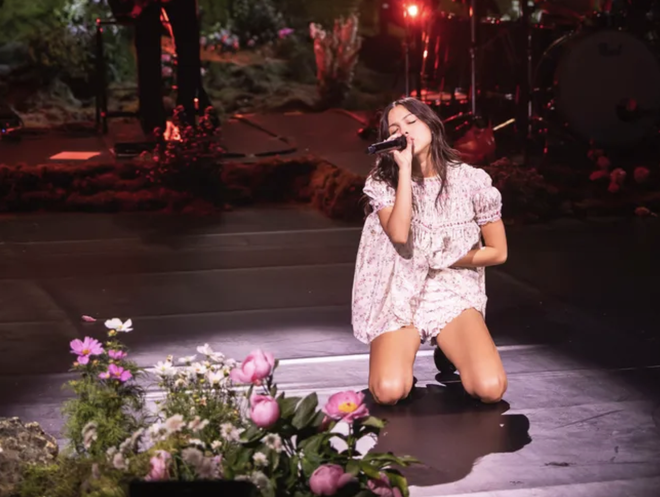

The focus of the controversy has shifted to what some social media users call a "deviant" trend where contemporary pop stars dress in overly revealing and provocative outfits while simultaneously mimicking the image of young girls.
Viewers pointed out that the Vampire singer's dress didn't have the mature silhouette of the 1960s, but instead used a pink color and style similar to a child's dress, combined with lace underneath. Sharing this view, one fan questioned the current trend among female artists: "We need to talk about the strange trend of pop stars dressing too revealingly and provocatively, like little girls."
The backlash raises serious questions about whether this style is truly appropriate and wholesome for an artist whose target audience is primarily teenagers.

One account spoke out about the strange fashion trend of pop stars dressing in overly revealing and provocative outfits.
PHOTO: SCREENSHOT
Despite the negative reactions, Olivia Rodrigo's fan community quickly spoke up in her defense and refuted the accusations. "Olivia Rodrigo has a lot of allusions to the past during her time, and the babydoll nightgown is one of them. While the name might be misleading, its design history and purpose clearly relate to women's lingerie and have nothing to do with children's clothing," one account shared.
They presented historical fashion evidence to assert that the babydoll dress was originally created in 1942 by designer Sylvia Pedlar as a type of underwear specifically for adult women to save fabric during wartime, and was later elevated by haute couture fashion houses such as Cristóbal Balenciaga.
By the 1990s, this style had become a symbol of powerful and rebellious resistance for female grunge rockers like Courtney Love and Kat Bjelland. Fans argued that the fault lay not with the pop stars but with the prejudiced views of a segment of the public.

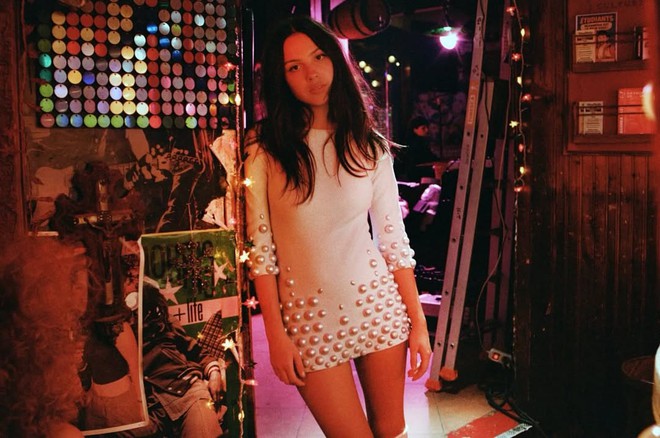

Olivia Rodrigo's rebellious fashion in the music video for "Drop Dead"
PHOTO: @INSTAGRAM
In fact, the controversial outfit in Barcelona was part of Olivia Rodrigo's strategy to build a consistent aesthetic for her new musical era, linked to her upcoming third studio album, * You Seem Pretty Sad for a Girl So in Love *.
Speaking to British Vogue , the singer admitted to being heavily influenced by 1970s style and the rock generation of 1990s artists, leading to an image that is both innocent and rebellious in her new projects, such as the music video for " Drop Dead ."
Olivia Rodrigo's case continues the ongoing debate about the boundaries between artistic individuality and societal norms for female artists in Hollywood, similar to the cases of Sabrina Carpenter and Millie Bobby Brown that they faced previously.
Source: https://thanhnien.vn/cong-chua-nhac-pop-olivia-rodrigo-gay-phan-no-185260514233027003.htm


![[Image] Hanoi's urban life under the challenge of a "scorching hot" environment](https://vphoto.vietnam.vn/thumb/1200x675/vietnam/resource/IMAGE/2026/05/25/1779706979265_nang-nong-t5-2026-minh-duy-7-4636-jpg.webp)

![[Image] Close-up view of the interchange connecting the two expressways and Long Thanh Airport.](https://vphoto.vietnam.vn/thumb/1200x675/vietnam/resource/IMAGE/2026/05/25/1779703378210_ndo_br_z7863716673926-224453a31600126cce10622af6290afd-4549-jpg.webp)























































































Comment (0)