

 |
Japan's Kioxia focuses most of its investment on NAND flash memory technology. Photo: Nikkei . |
Kioxia Holdings, a Japanese manufacturer of storage memory, is preparing to announce a new strategy to regain market share from rivals. This move comes amid soaring demand for data center memory, driving up the NAND flash storage market.
According to Nikkei , Kioxia is expected to share its technology development roadmap at an investor meeting on June 2nd. Since its last meeting, the company's stock price has increased 34-fold.
"We invested earlier because we believed in the future potential of NAND flash memory. We have a significant advantage over our competitors," a Kioxia engineer emphasized.
The race in the NAND flash memory market focuses on increasing capacity by stacking memory cells vertically.
This technology was developed in 2007 by Toshiba, the predecessor of Kioxia. However, recently, Kioxia has been criticized for lagging behind its competitors in terms of the number of stackable layers.
In early 2023, Kioxia announced the successful development of a product containing 218 layers of memory cells. Shortly after, South Korea's SK Hynix stated that it had created a product with over 300 layers. Kioxia's main solutions still feature 218 layers.
Under pressure from competitors, Kioxia found a new direction thanks to its proprietary interconnected technology. In addition to information storage cells, the NAND memory also contains control circuits that manage data input/output.
Memory cells and control circuits are typically mounted on the same semiconductor wafer, which acts as the substrate. Kioxia's technology, called CBA, can integrate the two components onto two separate semiconductor wafers and then link them together. This increases storage density and data transfer speed.
The process of linking semiconductor wafers requires high precision. According to Kazuyoshi Saito, an analyst at IwaiCosmo Securities, Kioxia's NAND memory boasts read/write speeds approximately 20-30% faster than its competitors.
Initially, the industry showed little interest in CBA technology, believing that stacking was still simpler. However, as processing speed became increasingly important for AI, the benefits of CBA quickly attracted attention.
"Demand will continue to increase with the growing popularity of AI servers," said analyst Toshiya Suzuki. The Japanese company's flagship products already utilize this technology.
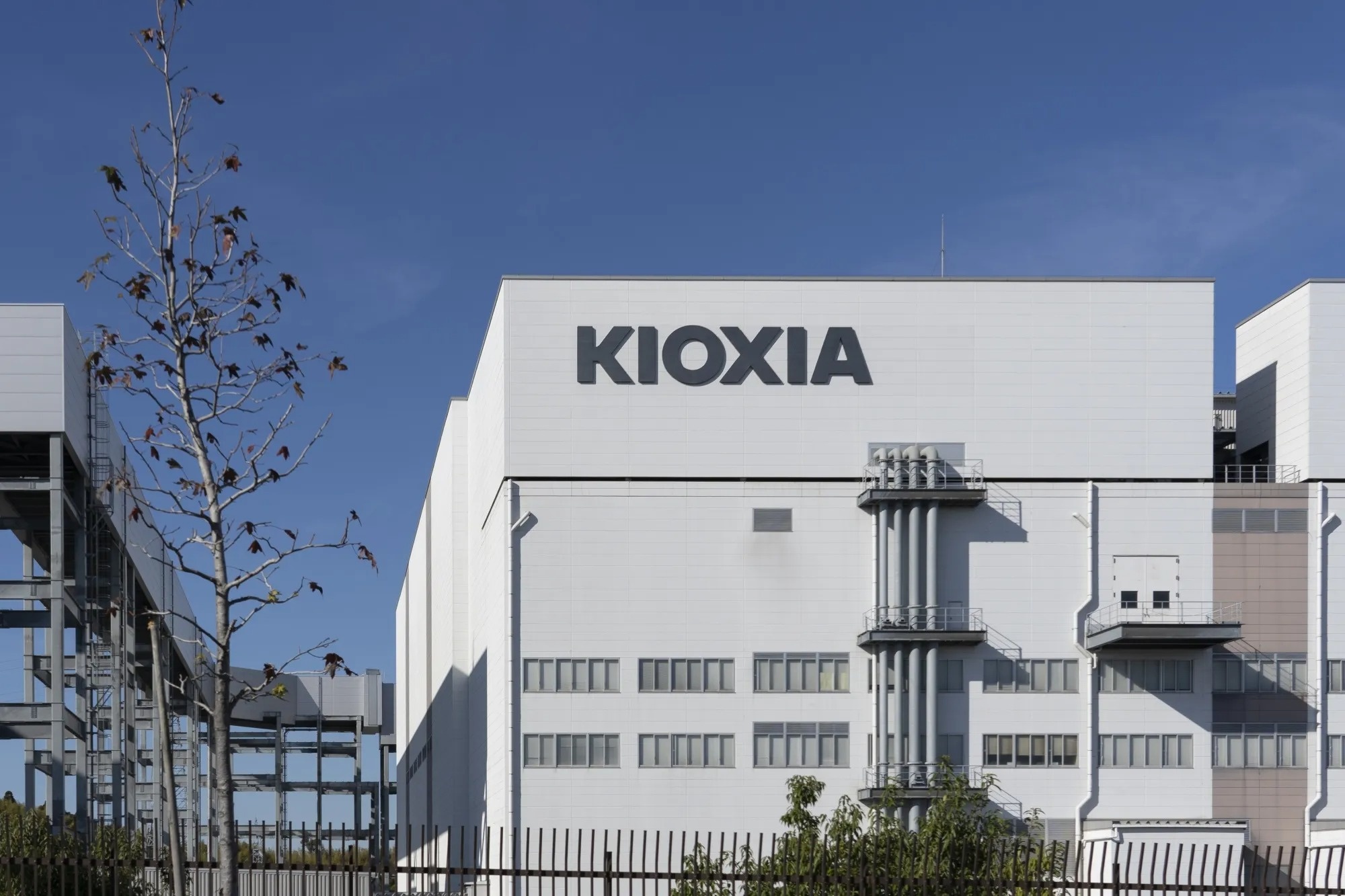 |
A Kioxia semiconductor factory in Japan. Photo: Bloomberg . |
According to Nikkei , competitors like Samsung are focusing their investments on DRAM, a technology highly sought after during the early stages of the AI boom. Therefore, Kioxia could benefit from this, as its competitor hasn't yet focused heavily on NAND.
Kioxia's challenge stems from market share. In the first quarter, the company ranked third globally in NAND revenue according to TrendForce data (13.9%). Samsung led with a market share of 31.6%.
Kioxia also doesn't have many customers in the data center segment. Furthermore, the demand for NAND memory for AI has only surged from around mid-2025, which is not yet sufficient to assess the effectiveness of the new technology.
"Samsung Electronics and SK Hynix have leveraged their supply capabilities to secure long-term contracts with customers, making it difficult for Kioxia to quickly gain market share."
"Japanese companies will have to convince customers in the data center sector by leveraging their internal technology," commented Shuhei Ochiai, a writer for Nikkei .
Source: https://znews.vn/kioxia-tu-tin-canh-tranh-voi-samsung-post1656228.html



![[Photo] General Secretary and President To Lam presides over a meeting on preparations for the review of one year of operation of the three-tiered government system.](https://vphoto.vietnam.vn/thumb/1200x675/vietnam/resource/IMAGE/2026/06/02/1780391821195_a1-bnd-4595-9717-jpg.webp)



































































Comment (0)