


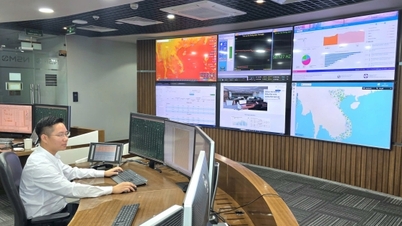
Inside the Beiwei Artificial Intelligence Innovation Community in Beijing – a key center for supporting and nurturing startup talent based on the OPC model – Photo: UCAS
Along with it comes the concept of "super-individuals" - individuals capable of applying AI and digital tools to perform tasks previously done by many people.
After years of implementing and promoting the "AI" strategy aimed at deeply integrating and applying artificial intelligence (AI) to all aspects of the economy and society, the concept of an one-person company (OPC) in China has gone beyond the simple definition of a business with a single owner, developing into a "1 N" model.
This model includes a founder who plays a core role, while "N" are artificial intelligence agents such as OpenClaw, Miaoda, etc., along with comprehensive digital tools that support everything from design, programming, product content writing, interface testing, operation, to data analysis and basic financial management.
Good policy support
As of June 2025, China will have over 7 million newly established OPCs, bringing the total to over 16 million units, accounting for more than a quarter of the country's total registered enterprises.
Speaking to the National Business Daily , Chai Daiquan, CEO of CIC, a Chinese market research and consulting firm, said that most AI-powered OPCs currently have annual revenue ceilings ranging from 5 to 20 million yuan (approximately $735,000 to $2.9 million).
These businesses typically require minimal tangible assets or large capital investments, rely heavily on knowledge, embrace innovative business models, and are founded primarily by individuals born after 1990 and 2000.
According to data from the China Institute of Information and Communication Research, over 62% of OPCs (Organizational Production Companies) that deeply apply AI tools have increased their work efficiency by 3-5 times compared to traditional small and micro-enterprises. Furthermore, OPCs incubated by the Dreame Startup Center (part of the Dreame Technology Group of China) take an average of only 12 days to become operational.
According to the Half-Moon Talk platform, among the high-performing OPCs, 92% utilize AI at a deep level to minimize operating costs. Many companies only spend a few hundred to a few thousand yuan on monthly operating expenses.
In fact, the rapid development of the OPC model is closely linked to significant policy changes in China. For example, the amended Chinese Enterprise Law, effective July 2024, abolished the regulation limiting each individual to establishing only one OPC. The new regulation allows individuals to open multiple businesses, and OPCs are also permitted to invest in other entities, creating a favorable legal basis for expansion.
The governments of many provinces and major cities have also issued specific support policies such as building OPC (Operations for Produce Centers) for startups, subsidizing the use of AI computing capabilities, waiving or reducing office rent, and providing housing for talented individuals.
Challenges with OPC
According to the Caixin financial platform, the target group for this model is primarily in their 30s and 40s, meaning they have professional experience and accumulated a certain amount of financial resources before starting their own business.
However, in reality, only about 20% of this group achieves stable profitability, about 40% face difficulties mainly due to limitations in customer access, and the remaining 40% have not yet officially started their business operations.
Many OPCs typically start in easily accessible areas such as content production and product development. These are all highly competitive markets, so competitive advantage depends on professional background, partner-finding skills, and the ability to maintain market appeal.
"For a one-person company, the biggest challenges are risk resilience and how to allocate personal resources," Yi Fu explained to the China Economic Daily . Yi Fu is the founder of the AI-powered job-finding app Career Genie, which has annual revenue of tens of millions of yuan.
According to Mr. Dịch, those starting out in the OPC model need to clearly define their area of expertise, focus on a specific market segment instead of developing products in a general direction, and know how to use AI to compensate for their limitations.
Besides market challenges, funding is also a major barrier. The core value of most OPCs lies in intangible assets such as individual capabilities, algorithms, data, software, digital assets, contracts, or customer relationships. In contrast, traditional credit systems primarily rely on tangible assets, standardized financial reporting, stable cash flow, and credit history as criteria for evaluation.
High credit risk
Despite their rapid growth, the majority of OPC businesses are still considered to have high credit risk because their core value primarily comes from algorithms, data, digital assets, or individual capabilities.
According to a survey by the China Association of Small and Medium Enterprises, the access to capital for OPCs in the science and technology sector, with their light asset model, is less than one-third that of traditional small and micro enterprises, and the average cost of raising capital is also 2-3% higher.
Source: https://tuoitre.vn/cong-ty-trach-nhiem-mot-minh-20260516234757848.htm

































































































Comment (0)