

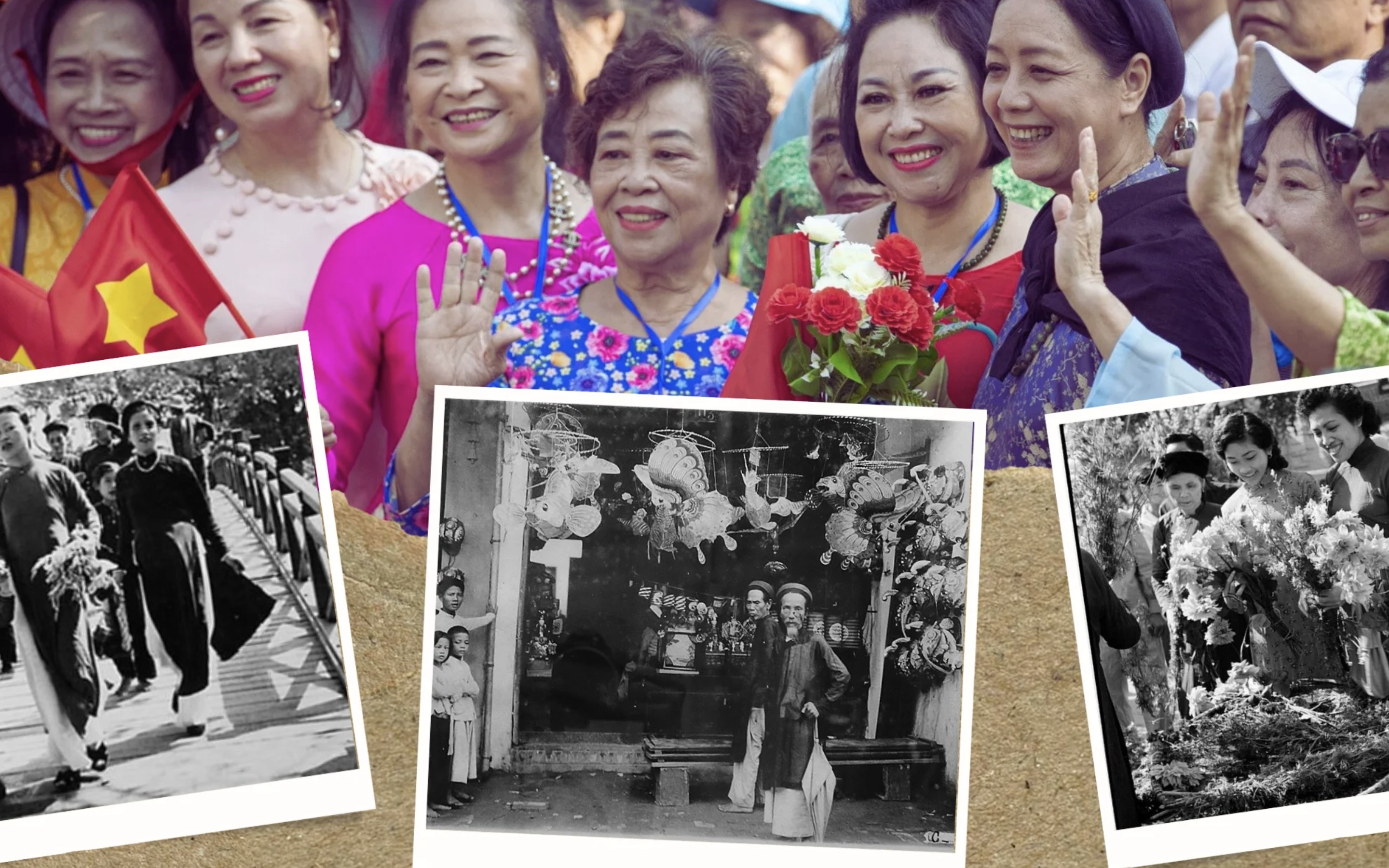


When discussing the lifestyle of Hanoians , many often quote the saying: "Even if it's not fragrant, it's still jasmine; even if not elegant, it's still a person of Thang An." Some cultural researchers believe this is the opening line of the ca trù song "Thanh Thang Long" by Nguyen Cong Tru (1778-1858). However, others argue that this line is a folk song from Thang Long and that Nguyen Cong Tru incorporated it into "Thanh Thang Long."
Many people also quote the saying: "A refined person has a refined voice / A bell rings softly even when struck against the city wall," or use the folk song from Lang village, "Thanks to refined people carrying their produce to the capital." Lang is a village on the banks of the To Lich River, west of the capital Thang Long, famous for its vegetable farming. Because the people of the capital are refined, the people of Lang who carry their vegetables to sell must also be refined.
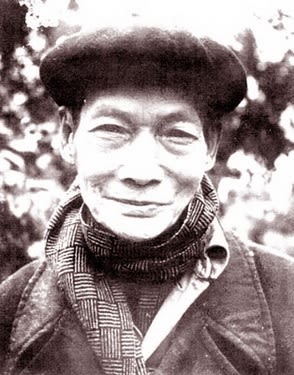
Hanoi Hoang Dao Thuy Cultural Center.
The cultural figure Hoang Dao Thuy (1900-1994) was born in Lu village on the To Lich River but lived on Hang Dao Street. He authored many books on the history, culture, and social life of Hanoi before 1954, including "Elegant Hanoi," published in 1991. He only titled the book after thorough research and careful study. Elegance, subtlety, and refinement are cultural lifestyles. This lifestyle transcends instinct, reaching a rational level, meaning it is conscious—conscious of oneself and the community.
In Samuel Baron's book "Description of the Kingdom of Tonqueen" (published in 1683), there is a passage describing the men of Thang Long: "It was rare to see them drinking until their faces were flushed red in the streets or lying around drunk." When visiting the sick, they didn't directly ask, "How are you?" but rather subtly inquired, "How many bowls of rice have you eaten lately?" Baron's father was Dutch, and his mother was from Thang Long. He lived in Thang Long for several decades, working for a long time for the British East India Company.
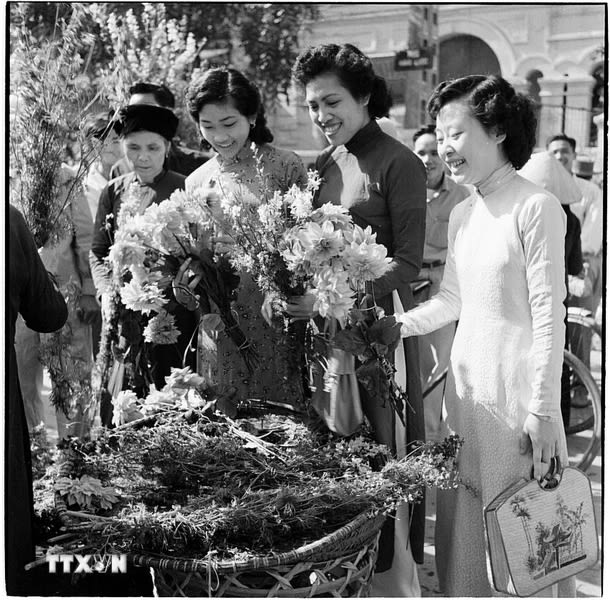
Young women in Hanoi shopping at the Tet flower market in the year of the Pig (1959). (Photo: VNA)
Thang Long was the capital for about 800 years, from the Ly to the Le dynasties, with a relatively small area and population. The capital housed the king, officials, and soldiers, and only a small portion of the population engaged in agriculture ; the majority were involved in trade, services, and handicrafts. Every day, people encountered officials and soldiers, so they were cautious and discreet in their speech to avoid bringing trouble upon themselves. This discreet lifestyle also influenced the clothing choices of women.
The book "In Tonkin" (Au Tonkin) is a collection of articles written by Paul Bonnetain, a reporter for "Le Figaro," about Tonkin and Hanoi in the late 19th century. In his article "Walking Through Hanoi," he describes the women's clothing: "We saw women wearing dull-colored cloaks on the outside, but underneath many long dresses that were very discreetly revealing; we counted as many as ten vibrant colors."
Jerome Richard was an English priest who lived in Thang Long for 18 years. He wrote the book "History of Nature, Civil and Political Affairs of Tonkin," published in 1778 (Histoire naturelle civile et politique du Tonkin).
Regarding the lifestyle in the capital city of Thang Long, he wrote: "following strict rituals and orderly customs," while outside the capital it was "more relaxed." Unlike villages far from the center of power where "the king's law is subordinate to village customs," the people of Thang Long were "close to the fire and felt the heat."
From the Ly Dynasty onwards, there were gold and silver shops, workshops producing metal agricultural tools, and the imperial court had the Bach Tac workshop producing various consumer goods to serve the administrative apparatus of the court.
Thăng Long, also known as Kẻ Chợ, was a place where trade was entirely handled by women. To sell their goods, they spoke skillfully but honestly, gently and persuasively, building trust with customers. This way of life didn't develop naturally; it evolved with the progress of society, subject to the regulation of laws, royal decrees, religion, and beliefs. These mandatory adjustments gradually became customs, creating moral standards for the community and society. However, the people of Thăng Long were aware of their pride in living in the capital city, and they also adapted to these changes.
Some argue that an elegant lifestyle was exclusive to the feudal intellectual class, but this is incorrect. A large proportion of those who passed the imperial examinations in the provinces came to Thang Long to become officials, and it was these officials who were "influenced by the Thang Long lifestyle."
Jerome Richard recounted a meal he was invited to by a wealthy man in the capital as follows: “The host was very refined and hospitable, greeting me with a polite smile at the door. He served me pork sausage, sliced very evenly, showing care and fairness. After the meal, the host gave me a white napkin to wipe my mouth and a basin of warm water to wash my hands.”
Thang Long is the capital city. From 1976 to the present day, it has been the capital of the Socialist Republic of Vietnam. As the capital city, it is the political nerve center, economic and cultural hub, so the lifestyle differs from that of people in agricultural regions.

In the "Dai Nam Thuc Luc," the official history of the Nguyen dynasty, the "Fourth Chronicle" section records Emperor Tu Duc's words about the lifestyle of the people of Hanoi. It can be summarized in six words: "Arrogant, extravagant, and open-minded." Tu Duc was an intelligent and knowledgeable emperor who reigned the longest among the Nguyen dynasty emperors (1848-1883), so his assessment is considered reliable.
Pride and arrogance are about upholding righteousness, hating evil, avoiding scheming, and possessing a sense of justice within that pride. During the Nguyen dynasty, some Hanoians passed the imperial examinations and became officials, but there were also many who held "pro-Le" sentiments and refused to share the same table with the Nguyen dynasty.
Following the example of Chu Van An, they returned to the city to open schools, such as the scholars Le Dinh Dien, Vu Thach, and Nguyen Huy Duc… Nguyen Sieu, who passed the second-highest level of the imperial examination and served as an official for a time, became disillusioned with the sycophancy and pursuit of fame and fortune in the bureaucracy, so he requested retirement and opened the Phuong Dinh school. These scholars imparted knowledge to their students, especially the character of intellectuals during that transitional period. Looking back at history, few people from the old quarter held official positions, and high-ranking officials were even rarer.
Not only were the men generous and compassionate, but the women of Thang Long-Hanoi were also like that. An old Hanoi folk song says, "Dong Thanh is like mother and father / If you are hungry and lack clothes, go to Dong Thanh." Dong Thanh Market dates back to the Ly Dynasty. During years of natural disasters and crop failures, people from impoverished areas flocked to Thang Long, where they were given food and money by merchants and shoppers.
During the reign of Emperor Tự Đức, Mrs. Lê Thị Mai built houses for students from the provinces to live in free of charge, and she also provided rice, paper, and pens for poor students; she was bestowed the title "Good and virtuous" by the Emperor. In 1927, several women formed the "Female Talents" theater group, performing the play "Trang Tử Cổ Bồn" at the Grand Theater to raise money to support people in the northern provinces affected by floods. Mrs. Cả Mọc (also known as Hoàng Thị Uyển) opened a free kindergarten, and when the dike broke, she called on women traders in the streets to contribute and then asked young people to deliver the aid. She also established a nursing home to care for the elderly who had no one to rely on. Touched by her compassion, in 1946, President Hồ Chí Minh invited her to the Presidential Palace for tea and expressed his hope that she would continue to show compassion for the poor and needy.

Being shrewd in business and sophisticated in entertainment is also a unique characteristic of the people of Hanoi. During the Le Dynasty, the village of Vong Thi cultivated various kinds of flowers, hence it was called "Vong Thi flower field." People came here not only to admire the flowers but also to drink the famous lotus wine of Thuy Khue village, enjoy ca tru (traditional Vietnamese singing), and reward singers with captivating songs. The book "Vu Trung Tuy But" by the Confucian scholar Pham Dinh Ho (1768-1839) is a record of Thang Long society during the "Le King and Trinh Lord" power struggle at the end of the 18th century.
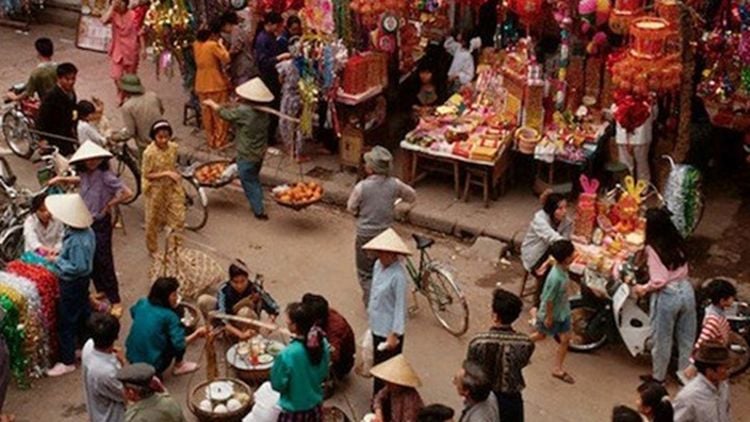
Traditional Tet markets in Hanoi.
Pham Dinh Ho exposed the wickedness of the officials in the court, praising the refined lifestyle of the people of Thang Long, who knew how to enjoy themselves, play, and behave appropriately. Regarding the hobby of flower appreciation, he wrote: "For the people of Thang Long, flower appreciation is not just an ordinary matter; it is a way of using flowers and plants to express the principles of human conduct. In other words, one can understand their moral principles simply by observing how they appreciate flowers. The way they appreciate flowers still contains the meaning of worldly teachings and heavenly relationships. Therefore, they use flower clusters and rocks to entrust their lofty aspirations."
In the 1930s, Hanoi girls initiated a modern lifestyle. Instead of parting their hair in the middle to appear conservative, they styled their hair to the side, wore shorts and swimsuits at the Quang Ba swimming pool, studied French, and kept diaries. Although it was a new way of life, in essence, modernity was a movement of resistance against the harshness and cruelty of the old society towards women.
The modern women's movement in Hanoi was the first in Vietnam and Southeast Asia to demand gender equality. Their purchase of luxury goods was understandable, as Thang Long-Hanoi had a middle class, and luxury was a way of showing off status, or perhaps influenced by the proverb, "Much money lasts a thousand years/Little money means you'll have to start over."
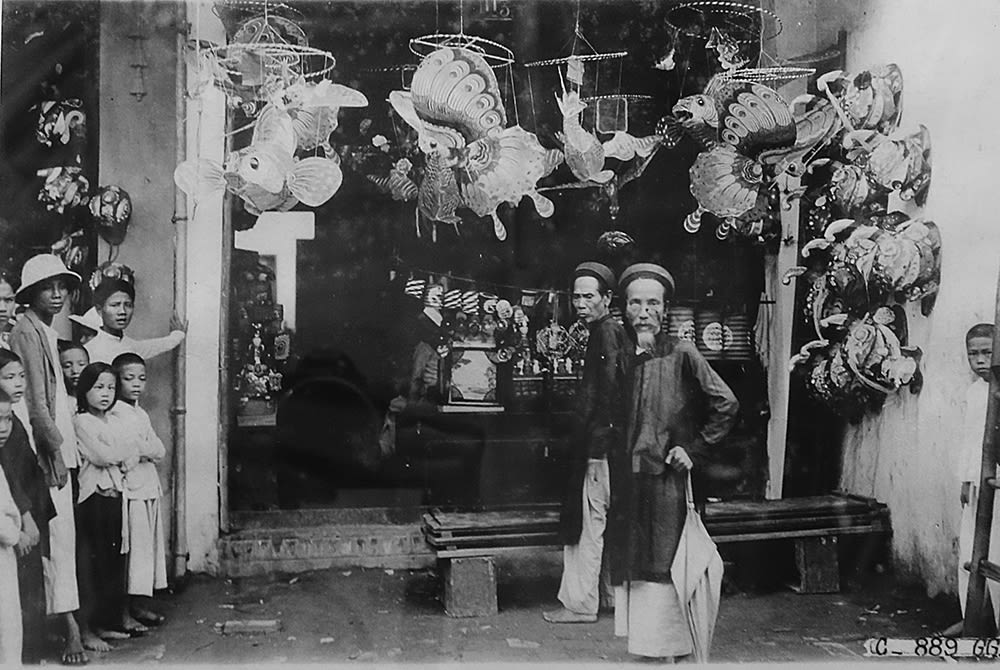
Hang Gai Street selling toys for the Mid-Autumn Festival in August 1926. (Photo: Vietnam Academy of Social Sciences)
Thang Long was a place where people from all four directions converged, and later generations followed the lifestyles of their predecessors. Some argue that French civilization and culture gave rise to elegance. While it's undeniable that foreign culture influenced the lifestyle, it only made elegance more pronounced. Lifestyle, manners, and character are not immutable values; they change to adapt to the economic and social conditions of Hanoi today, but these changes are rooted in the inherent character.
Nhandan.vn
Source: https://special.nhandan.vn/cot-cach-nguoi-Thang-Long-Ha-Noi/index.html

![[Photo] National Assembly Chairman Tran Thanh Man working with the Standing Committee of the Law and Justice Committee](https://vphoto.vietnam.vn/thumb/1200x675/vietnam/resource/IMAGE/2026/05/21/1779378929214_ndo_br_1-4610-jpg.webp)
![[Photo] General Secretary and President To Lam presides over a working session with the Central Policy and Strategy Committee on the development of the materials industry.](https://vphoto.vietnam.vn/thumb/1200x675/vietnam/resource/IMAGE/2026/05/21/1779359935432_a3-bnd-3129-1412-jpg.webp)



















![[Infographic] Stock market on May 21st: VN-Index falls 16.34 points, market liquidity decreases.](https://vphoto.vietnam.vn/thumb/402x226/vietnam/resource/IMAGE/2026/05/21/1779379204295_screenshot-2026-05-21-220948-jpg.webp)
















































Comment (0)