

The global energy shock caused by the US-Iran conflict is prompting some countries in Asia and Africa to increase nuclear power production, while also accelerating plans to develop atomic energy in countries that have never used this technology in both continents, according to AP .
Many countries are considering building nuclear power plants.
Currently, 31 countries and territories worldwide operate nuclear power plants, providing approximately 10% of global electricity production, according to the International Atomic Energy Agency (IAEA). The agency added that 40 other countries are considering or preparing to build nuclear power plants.
Asia, where most of the oil and natural gas from the Middle East is transported, is the first and most heavily impacted region by disruptions to fuel shipping routes, followed by Africa. The US and Europe are also under pressure as conflicts drive up energy prices.
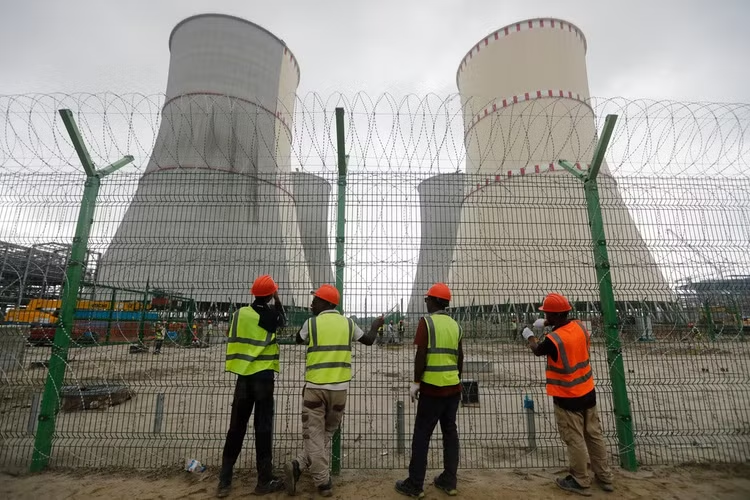
African and Asian countries with nuclear power plants are increasing production to meet short-term energy needs, while countries without nuclear power are accelerating long-term plans to protect against future fossil fuel shocks.
"Nuclear power is not an immediate solution to the current energy crisis. Developing atomic energy can take decades, especially for countries just starting out. However, long-term commitments to nuclear power made now are likely to shape the future energy structures of nations," commented Joshua Kurlantzick of the Council on Foreign Relations.
In Asia, the Iran conflict is prompting South Korea to increase its nuclear power output, while Taiwan (China) is debating restarting its decommissioned reactors. In Africa, plans for future reactor construction are becoming more urgent, with Kenya, Rwanda, and South Africa affirming their support for nuclear power.
Nuclear power utilizes the energy released when the nucleus of an atom, such as uranium, splits in a process called fission. Unlike fossil fuels, this process does not emit CO2, which contributes to climate change. However, it produces dangerous radioactive waste, which is why many countries are cautious about nuclear power.
Asia accelerates nuclear power development.
In Asia, where energy response measures include increased coal use and purchases of Russian crude oil, many countries with nuclear power plants are seeking to maximize the utilization of their existing reactors.
South Korea is increasing output at its nuclear power plants and accelerating maintenance on five reactors that are currently shut down, with a restart expected in May.
Japan is reversing its policies of shutting down nuclear power plants following the 2011 Fukushima disaster, when an earthquake and tsunami crippled the reactor cooling system.
Taiwan is considering a multi-year process to restart two reactors due to the current crisis, requiring thorough inspections, safety assessments, and verification of the control systems.
In Japan, since the US-Iran conflict erupted on February 27, Prime Minister Takaichi Sanae has signed a $40 billion reactor construction contract with the US, a nuclear fuel reprocessing agreement with France, and a nuclear cooperation commitment with Indonesia. Prior to this, Japan restarted the world's largest nuclear power plant, Kashiwazaki-Kariwa, scheduled for January 2026.
According to Michiyo Miyamoto of the Institute for Energy Economics and Finance Analysis (IEEFA), based in the United States, renewable energy sources such as solar and wind power are more cost-effective and energy-secure than nuclear power.
Although the Iran conflict has also boosted consumer and government interest in renewable energy globally and in Japan, record-high electricity prices coupled with the current crisis are leading to a gradual acceptance of nuclear power in Japan.
In South Asia, Bangladesh is rushing to commission new reactors built by Russia's Rosatom. Dhaka hopes these reactors will supply 300 megawatts to the national grid this summer, easing the current gas shortage.
The Philippines, which recently declared a national energy emergency, is also considering reactivating a nuclear power plant built after the 1973 oil crisis but never put into operation.
“I hope we have learned our lesson. The Iran conflict is providing the necessary impetus for nuclear power,” said Alvie Asuncion-Astronomo of the Philippine Institute for Nuclear Research.
Africa is interested in long-term nuclear energy plans.
Soaring energy prices and power shortages in Africa, caused by the Iran conflict, are leading to calls for nuclear cooperation and renewed interest in long-term atomic energy plans, which are currently underway in more than 20 of Africa's 54 countries.
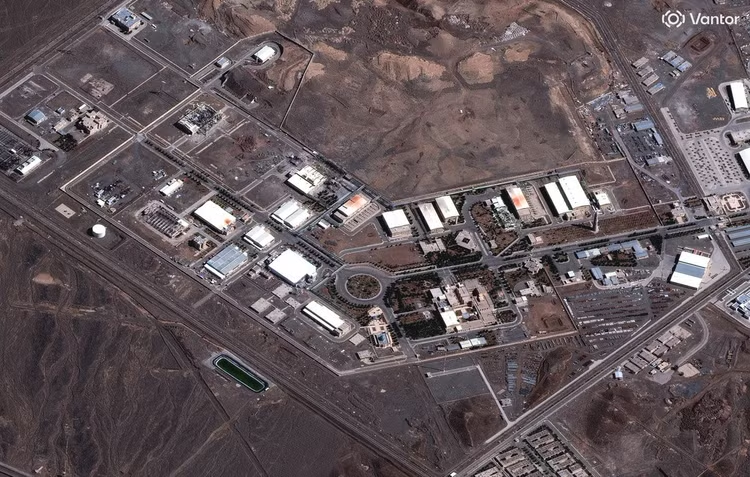
With Africa seen as a growth market for nuclear energy, nuclear-capitalizing nations—including the U.S., Russia, China, France, and South Korea—are introducing advanced technologies such as small modular reactors (SMRs) as a solution to energy shortages.
These modular reactors are a cheaper, more compact option compared to large-scale plants.
Supporters argue this is a faster option, but projects can still take years. For example, Kenya plans to bring its small modular reactor into operation in 2034 after starting the first phase in 2009.
Last month, Justus Wabuyabo of the Kenya Nuclear and Energy Authority stated that “nuclear energy is no longer a distant aspiration for African nations; it is a strategic necessity.”
At a summit organized by the International Atomic Energy Agency in March, Rwandan President Paul Kagame affirmed that Africa would be “one of the most important global markets” for small reactors in the coming years.
Small reactors, capable of providing a flexible, low-emission, base-scale power source, are seen as a solution to Africa's growing electricity demand, weak grids, and over-reliance on imported diesel fuel.
Similarly, Loyiso Tyabashe of the South African Nuclear Energy Corporation stated that SMR could “help South Africa achieve its strategic goal of becoming a leader in advanced nuclear technology.”
South Africa, the only country in Africa currently with nuclear power plants, aims to increase its share of nuclear power from around 5% currently to 16% by 2040.
Consider the risks of nuclear energy.
Risks such as reactor meltdowns and poor waste management persist, despite increasing concern. Nuclear energy could also serve as a stepping stone to the development of nuclear weapons.
Ayumi Fukakusa of Friends of the Earth Japan argues that "nuclear power is very risky" and will keep countries dependent on imported fuels such as enriched uranium.
"Because the nuclear industry takes years to develop, governments should focus on expanding renewable energy to ensure long-term energy security," said Rex Amancio of the Global Renewable Energy Alliance.
Rachel Bronson, a member of the atomic science group, also stated that nuclear power plants are vulnerable in conflict, citing recent cases where reactors were attacked during the US-Iran war and the Russia-Ukraine conflict.
“All of these factors are impacting how we think about energy security. Countries are now weighing these risks against other risks, most notably in Asia and Africa, of what would happen if gas and oil supplies were disrupted,” said Rachel Bronson.
>>> Readers are invited to watch the video: Middle East conflict threatens food security
Source: https://khoahocdoisong.vn/cuoc-chien-my-iran-thuc-day-ke-hoach-dien-hat-nhan-o-chau-a-chau-phi-post2149097124.html


![[Image] Close-up view of the interchange connecting the two expressways and Long Thanh Airport.](https://vphoto.vietnam.vn/thumb/1200x675/vietnam/resource/IMAGE/2026/05/25/1779703378210_ndo_br_z7863716673926-224453a31600126cce10622af6290afd-4549-jpg.webp)
![[Image] Hanoi's urban life under the challenge of a "scorching hot" environment](https://vphoto.vietnam.vn/thumb/1200x675/vietnam/resource/IMAGE/2026/05/25/1779706979265_nang-nong-t5-2026-minh-duy-7-4636-jpg.webp)













![[GALLERY] A completely different iPhone for the 20th anniversary edition](https://vphoto.vietnam.vn/thumb/402x226/vietnam/resource/IMAGE/2026/05/25/1779686871893_212-jpg.webp)

































































Comment (0)