

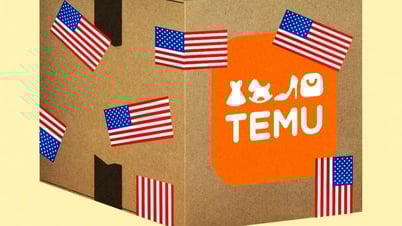
With its low prices, Temu entices consumers with the slogan "shop like a billionaire," but conversely, this approach could swallow up Vietnamese businesses.
Temu, a subsidiary of PDD Holdings (China) – the group that owns the e-commerce site Pinduoduo – has not officially announced its entry into Vietnam. However, users can download the app from mobile app stores and make purchases and payments on the platform using the Vietnamese version. Previously, other Chinese e-commerce platforms such as Taobao, 1688, and Shein have also entered the Vietnamese market.
These are all traditional Chinese e-commerce platforms where sellers have their own storefronts and shopping carts. Vietnamese businesspeople predict a massive influx of Chinese goods into the Vietnamese market.
According to Mr. Luan, Chinese e-commerce platforms often employ strategic moves to capture market share. For example, they support domestic products with free shipping or discount vouchers. Conversely, Vietnamese goods do not benefit from these policies. Furthermore, these platforms also charge higher fees to Vietnamese businesses.
Nguyen Duy Vi, a marketing expert and CEO of Buzi Agency, believes that domestic manufacturing businesses will face pressure from the low, competitive prices of imported products. However, many domestic companies cannot lower their prices to the level of foreign platforms due to higher production costs, labor, and taxes.
"This leads to the risk of losing customers, especially in the low and mid-range segments, where consumers are very price-sensitive," Mr. Vi said.
In fact, low prices were Pinduoduo's success in China, and its international version, Temu, inherited this with the slogan "shop like a billionaire." They explain that their products are competitive because they sell directly from the factory, eliminating intermediaries. In addition, their technological strength and logistics model also contribute to lower prices and customer satisfaction.
"This allows them to offer very cheap products, often much lower than domestic goods," said the CEO of Buzi Agency, suggesting that domestic consumers could benefit from this.
Besides low prices, according to Mr. Vi, platforms like Temu and Shein offer a huge and diverse inventory of products, from clothing and household goods to technology and beauty products. This gives consumers many choices, allowing them to follow international trends without having to wait through traditional channels.
However, this expert argues that low prices and product variety are only short-term benefits. In the long term, consumers may face risks regarding product quality.
"Many inexpensive items may not meet quality standards or have adequate warranties," Mr. Vi observed. The CEO of Buzi Agency also believes that reliance on foreign platforms can make it difficult to resolve issues that arise after purchase, such as complaints and product warranties.
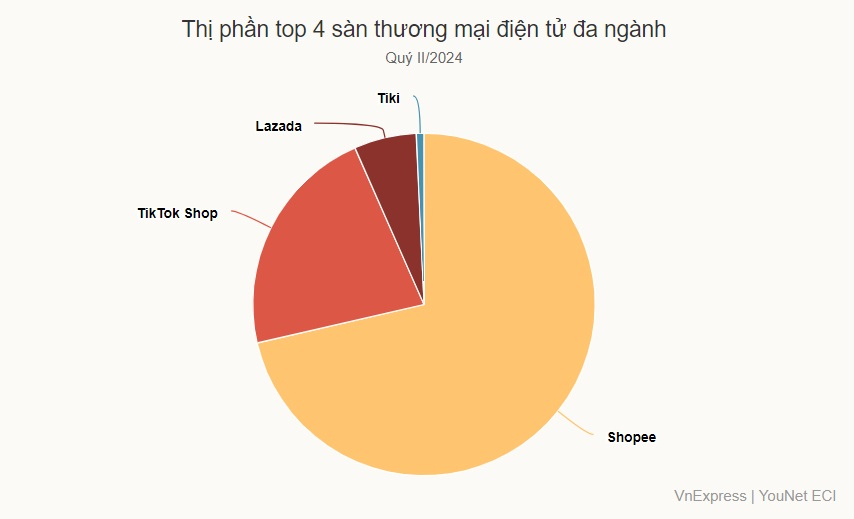
According to the latest data from YouNet ECI, Vietnamese consumers spent VND 87.37 trillion on shopping on the four main e-commerce platforms in the second quarter. Shopee dominated the market with 71.4%, followed by TikTok Shop with 22%, and Lazada with 5.9%. Domestic platforms such as Tiki, Chiaki, Sendo, Websosanh, and Adayroi, along with major players like Amazon Global, Alibaba, and Shein, competed for the remaining market share of less than 1%.
Given the current market landscape, Meet More CEO Nguyen Ngoc Luan acknowledges that small businesses have almost no choice and are forced to participate. Their solution is to diversify their operations across multiple channels and platforms, including traditional channels such as supermarkets and retail stores.
Ms. Huyen Trinh (Tan Binh District, Ho Chi Minh City), who sells household goods on platforms like Shopee, Lazada, and TikTok Shop, believes there's "no need to worry too much yet." While admitting to being quite wary of the information about Shein and Temu expanding their presence in Vietnam, Ms. Trinh doesn't see this as a major threat.
"Consumers might initially try it out of curiosity, but they will quickly realize the shortcomings and inconveniences of cross-border platforms compared to buying from local sellers," she said.
During that period, according to her, domestic retailers had time to adjust their strategies. "I will focus on after-sales customer service, moving away from selling cheap products to compete directly with them, and instead focusing on finding niche, unique, high-quality, and local products," she said.
Coolmate, a men's fashion brand that sells online on domestic e-commerce platforms, said, "Carefully observe the situation."
They stated that they remain optimistic that Temu and Shein will help the online shopping market grow, attract more consumers who enjoy online shopping, and expand e-commerce's market share in the retail market as a whole.
The company stated that it is focusing on building brand awareness and improving the customer experience for its apparel products. These are two factors they believe local businesses can leverage effectively to serve domestic customers.
According to Mr. Nguyen Ngoc Luan, the government needs to implement policies to restrict the sale of substandard products in the immediate future. In the long term, policies to protect domestic goods, especially agricultural products, need to be considered. For example, tax policies should be designed to differentiate between domestic and imported goods, in order to increase the competitiveness of domestic manufacturers.
The solution of imposing tariff barriers to protect small domestic producers has also been discussed recently. Previously, the National Assembly 's Finance and Budget Committee proposed collecting VAT on goods priced under 1 million VND sold through e-commerce platforms.
However, according to Mr. Nguyen Quang Dong, Director of the Institute for Policy and Development Studies (IPS), raising taxes too high or completely banning cross-border e-commerce platforms is not feasible. This is because Vietnam has deeply integrated into the global economy and participates in numerous free trade agreements.
Instead, Mr. Dong suggested that authorities should review and apply appropriate tax rates to goods that have not fully complied with their tax obligations. They could also use measures to combat unfair competition and comply with Vietnamese laws on personal data protection.
According to Tran Lam, an expert in online sales training and CEO of Julyhouse, to compete with cheap products from China, Vietnamese businesses need to invest in product quality or unique added value.
One strength of Chinese suppliers is their modern and low-cost logistics system. To compete, according to Mr. Lam, Vietnamese businesses need to optimize their supply chains, reduce transportation costs, and increase delivery speed. This can be achieved through cooperation with local and international logistics companies.
Mr. Nguyen Duy Vi advised businesses to take advantage of opportunities to expand into international markets through platforms such as Shopee, Lazada, or Temu and Shein. "Exporting specialized products such as agricultural products, handicrafts, and traditional fashion helps businesses diversify revenue streams and leverage the competitive advantages of Vietnamese goods in the international market," he said.
Experts also suggest that Vietnamese businesses need to increase digital transformation in inventory management, logistics, building smart digital marketing campaigns, or analyzing user behavior and personalizing experiences.
"If businesses know how to leverage technology, improve production processes, focus on localization and sustainable development, they can create a unique competitive advantage," he suggested.
Source























































![[Video] Sunset at Lap An Lagoon – Where the sun sets over the fishing nets](https://vphoto.vietnam.vn/thumb/1200x675/vietnam/resource/IMAGE/2026/05/31/1780192137701_beach-landscape-sea-water-nature-grass-745871-pxhere-com.jpeg)



































Comment (0)