

As is traditional in warfare, in the Russia-Ukraine conflict, Moscow remains a latecomer in the "controversial" race over suicide drones (UAVs).
However, since 2023, they have turned Kyiv's "strengths" into their own battlefield advantages, as well as developing a range of options and equipment to effectively counter attacks by Ukrainian suicide drones.
The "rabbit and tortoise" race
Since the outbreak of hostilities in 2022, Ukraine has been the most extensive user of various types of military UAVs, from large ones like the Bayraktar TB2 to smaller suicide drones like the Fire Scout and Phoenix Ghost. The majority of these were supplied by the US and the West.
Ukraine has also initiated the trend of using small suicide drones like FPVs, with numerous videos recorded on the battlefield demonstrating their high effectiveness.
However, Ukraine's adversary on the other side of the battlefield is Russia, a military superpower with a massive defense industry. Recognizing the effectiveness and potential of UAVs, especially suicide drones, Russia quickly learned from them and created a large number of attack UAVs – including FPVs – far superior to its adversary.
According to statistics from Lenta news agency, while the average number of Russian suicide drones used, verified by video, was around 200-300 per month in early 2023, this number rose to over 1,000 during the peak period at the end of the year, a 3-5 fold increase. Meanwhile, the number of drones in Ukraine is steadily decreasing amidst dwindling aid from the US and the West.
Russia's ability to produce a huge number of UAVs despite severe sanctions is thanks to its mastery and localization of technology.
UAVs are not only produced in factories; many small-scale workshops are also participating in the production chain with pre-existing design platforms. This is even more advantageous now that Russia has shifted its entire defense industry to wartime readiness to optimize resources and maximize production.
Considering only suicide drones or FPVs, from images published by Russian media, the plastic components are manufactured using 3D printers, and the engines and circuits are made in small workshops. This explains why Russia has been able to surpass Ukraine in the production and use of suicide drones in such a short time.
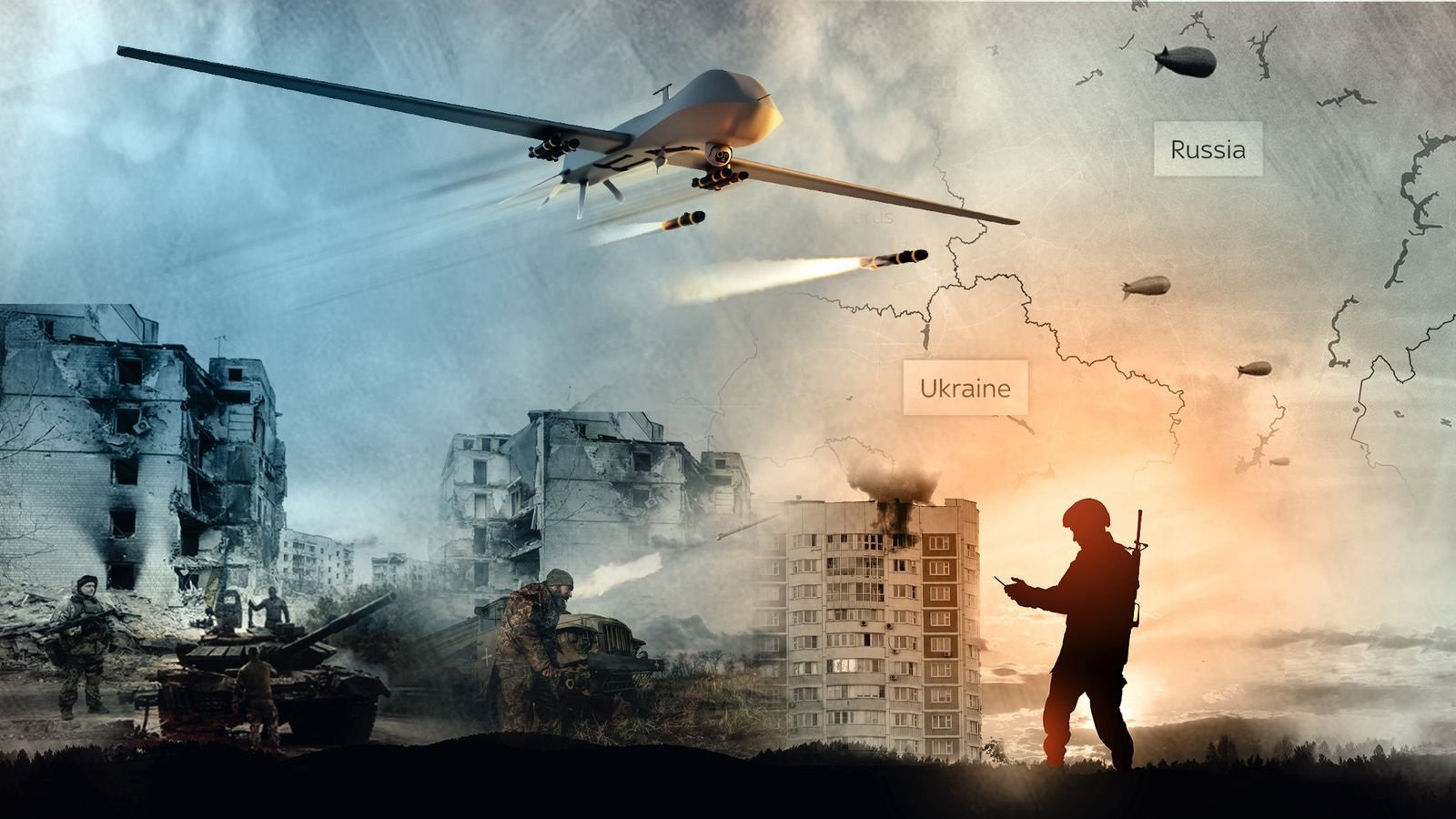
Suicide drones are playing an increasingly important role in the Russia-Ukraine conflict (Illustrative image: Skynews).
The "contradictory" arms race
True to the usual pattern of development, if an offensive weapon emerges, it will inevitably be countered by a weapon designed to counter it. This is the law of contradiction.
Regarding suicide drones, alongside the increase in number and improvement in quality, both sides – Russia and Ukraine – have developed countermeasures against them on the battlefield, ranging from simple methods like creating anti-UAV nets to the common "chicken coop" on top of tanks and armored vehicles.
The use of "chain armor" to protect military vehicles has been common for quite some time. In the past, they were used to protect vehicles from kinetic energy anti-tank projectiles.
Following the start of the special operations in Ukraine, problems arose in countering top-launch anti-tank missiles such as the Javelin, NLAW, and later suicide drones. Various protective nets were expanded to cover the vehicle's weak points in order to limit damage.
The high performance of Russia's Lancet suicide drone forced Ukraine to adopt the simplest solution: creating a net enclosure to enclose and protect the vehicle. The main difference between a suicide drone and an anti-tank guided missile (ATGM) or RPG is its low flight speed.
While the average flight speed of an ATGM or RPG is around 600-900 km/h, the speed of a suicide drone rarely exceeds 150-200 km/h. Furthermore, suicide drones are often constructed from lightweight materials or plastic, making high-strength metal mesh quite effective in intercepting them.
"FPVs are widely used by both sides on the Ukrainian battlefield. They are simple and effective weapons capable of attacking hidden infantry or striking vulnerable points in armored vehicles."
"This type of UAV is characterized by its high maneuverability and accuracy, especially if it is controlled by an experienced technician," Maxim Kondratyev, advisor at the Russian Academy of Engineering, explained in a conversation with Russia Today .
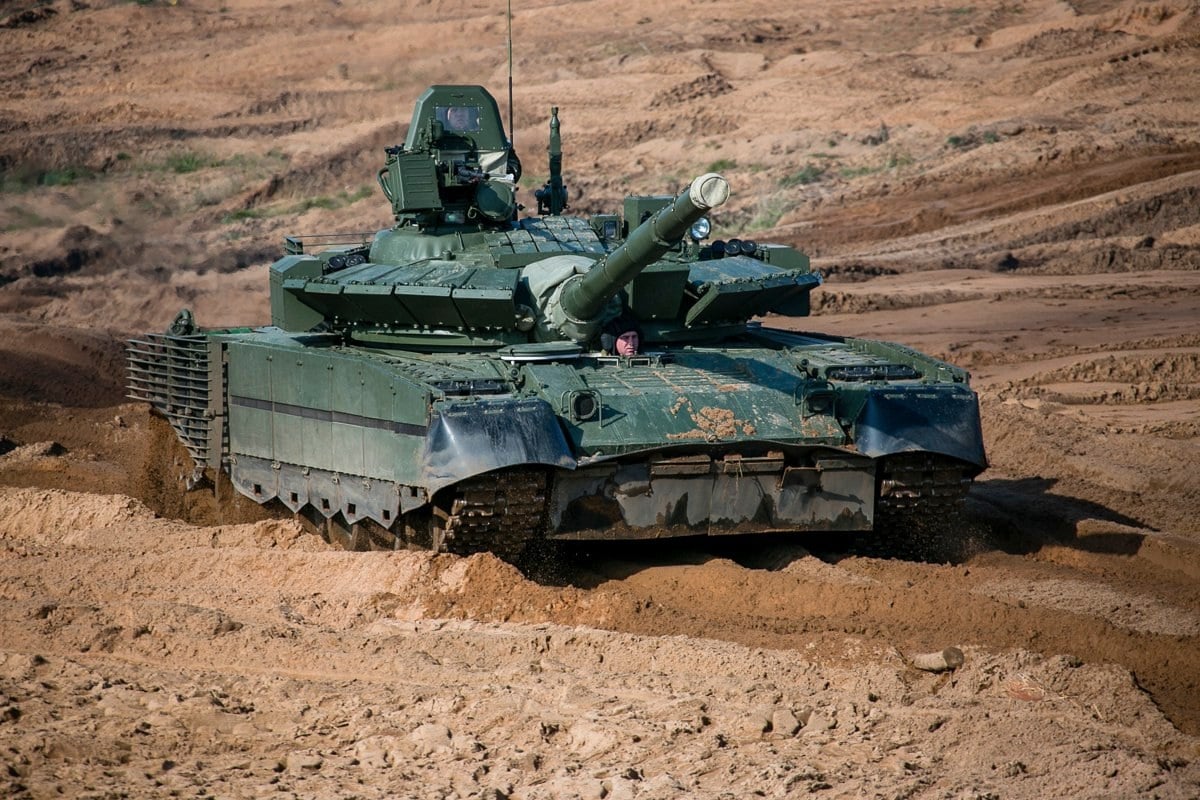
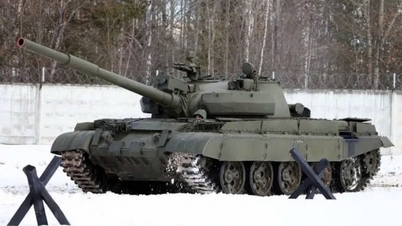
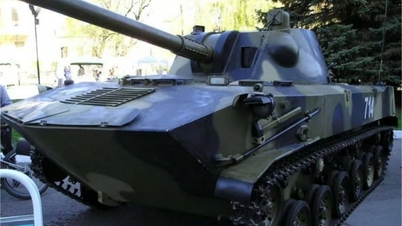
Russian T-80BVM tank (Photo: Wikipedia).
The Saniya "shield" protects Russian tanks.
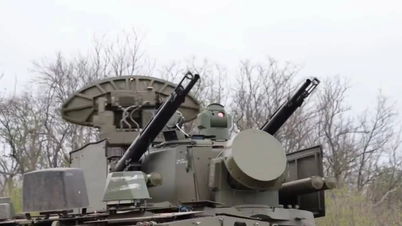
T-80BVM tanks belonging to the 9th Motorized Infantry Brigade of the 1st Army Corps, fighting in the Pervomaisky area near Avdiivka, are equipped with the Saniya system. Clips released by the Russian Ministry of Defense show that this system is installed on the tank's roof to create a "defense umbrella," providing protection from all sides.
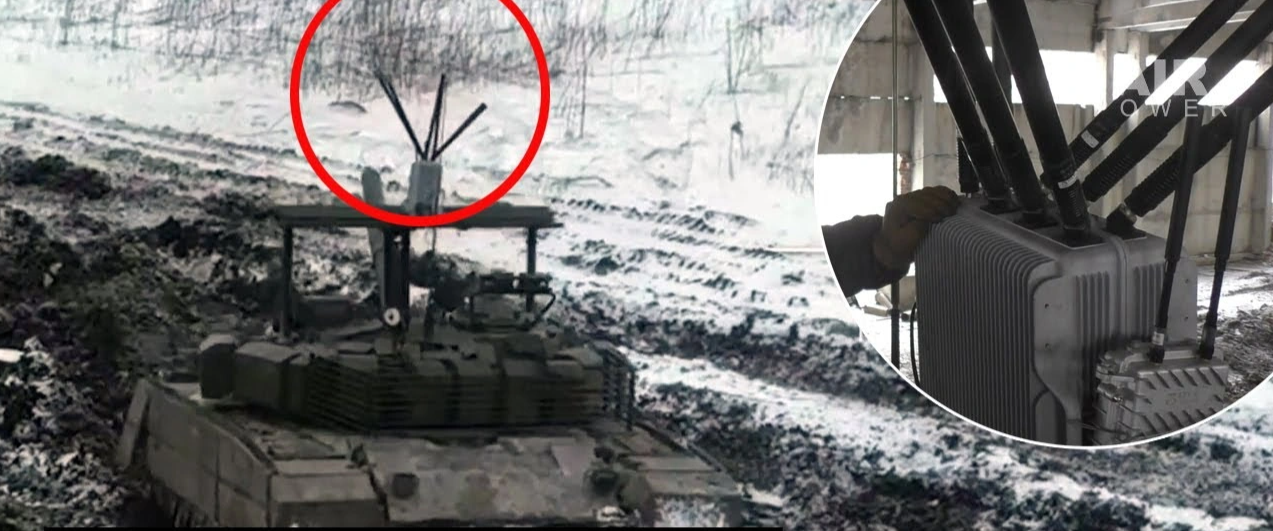
"As I understand it, Saniya is one of them. With successful tests, our army will need a large number of such systems to counter the enemy's arsenal of FPV-type UAVs," said military expert Yuri Knutov.
According to the military news site Topwar , the Saniya system – developed by the 3MX company in St. Petersburg – is designed to protect armored vehicles in special operations zones. Tests have been conducted on tanks since 2023.
This system creates a comprehensive electromagnetic shield for combat vehicles by detecting UAVs at a range of up to 1.5km, and suppressing and neutralizing them at a distance of 1km.
The Saniya system is capable of automatically scanning the surrounding area and identifying the presence of UAVs within its control zone. It can engage not only individual targets but also swarm attacks from enemy UAVs.
The suppression range depends on weather conditions, terrain, and the design characteristics of the enemy's suicide drone.
"Before development, the use of FPV drones was carefully analyzed. The operator adjusts the UAV along the vehicle's path and, as a rule, attacks the rear section where the engine is located. Therefore, the Saniya is installed at the rear of the vehicle. However, it provides comprehensive protection around the vehicle," Sergei Shandobylo shared.
It is certain that new types of suicide drones capable of penetrating Saniya's "defense zone" will emerge in the future. This means that the confrontation will continue as long as the war drags on.
Source
![[Photo] First session of the 14th Congress of the Vietnam Trade Union](https://vphoto.vietnam.vn/thumb/1200x675/vietnam/resource/IMAGE/2026/06/03/1780465947883_ndo_br_img-3852-jpg.webp)
![[Photo] General Secretary and President To Lam presides over a meeting with the Central Organizing Committee.](https://vphoto.vietnam.vn/thumb/1200x675/vietnam/resource/IMAGE/2026/06/03/1780482764658_a1-bnd-4741-3342-jpg.webp)

![[Photo] Secretary of the National Assembly Party Committee, Chairman of the National Assembly presides over the meeting of the Standing Committee and Executive Committee of the National Assembly Party Committee.](https://vphoto.vietnam.vn/thumb/1200x675/vietnam/resource/IMAGE/2026/06/03/1780480353201_ndo_br_bnd-2585-jpg.webp)




































![[Video] Sunset at Lap An Lagoon – Where the sun sets over the fishing nets](https://vphoto.vietnam.vn/thumb/1200x675/vietnam/resource/IMAGE/2026/05/31/1780192137701_beach-landscape-sea-water-nature-grass-745871-pxhere-com.jpeg)

























Comment (0)