

The rapid increase in satellites is making low Earth orbit increasingly crowded, raising the risk of collisions and putting pressure on data transmission infrastructure as radio spectrum becomes overloaded. In this context, laser communication technology is seen as a new connectivity direction for the next generation of space exploration.
Overload trajectory
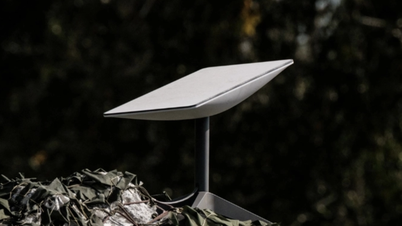
In recent years, the number of satellites orbiting Earth has increased at a very rapid pace. With the launch of the Starlink system in 2019, SpaceX now has over 10,200 operational satellites in orbit. The European Space Agency (ESA) predicts that by the end of the next decade, approximately 100,000 satellites could be operating simultaneously around Earth. Most current satellites use radio waves to transmit data to the ground. This is also the technology used for mobile phones, Wi-Fi, Bluetooth, and television.
However, radio waves only occupy a small fraction of the electromagnetic spectrum (the range of waves and radiations that exist in nature). The portion of the radio frequency spectrum that can be exploited for communication is limited and therefore must be managed and allocated by the International Telecommunication Union (ITU).
Barry Evans, a professor of satellite communications at the University of Surrey (UK), said that spectrum overload begins to occur when more and more satellite systems operate on the same frequency bands.
For example, Starlink and Eutelsat OneWeb both use the Ku-band (approximately 11-14 Gigahertz) to transmit data to the ground, increasing the risk of interference and signal overlap. Companies now have to coordinate spectrum sharing or adjust signal transmission times, but experts believe this is only a temporary solution.

Satellites operating at different altitudes can also cause signal interference. For example, when a ground station receives a signal from OneWeb at an altitude of about 1,200km, a Starlink satellite flying lower, around 500km, could cause temporary interference if it passes through the coverage area. This phenomenon is called In-Line Events. In the context of rapidly increasing data from space, radio waves are considered unlikely to adequately meet the long-term demands for high-resolution video transmission, sensor data, and global satellite internet.
Technical challenge
Faced with this pressure, the space industry is shifting to harnessing lasers for data transmission. Unlike radio waves, which propagate widely in space, lasers travel in very narrow beams, making them virtually immune to interference from other systems, thus increasing data transmission speeds and improving security.
Dalius Petrolionis, co-founder and CTO of Astrolight (Lithuania), said that many next-generation satellites now integrate laser links. In the Starlink network, data between satellites is already transmitted via laser in some space-based connections. However, laser communication from satellites to the ground remains a major technical challenge because lasers are very sensitive to atmospheric conditions. Clouds, fog, water vapor, or temperature fluctuations in the air can all distort the signal.
To overcome this limitation, companies are developing optical interference (AO) compensation systems, which allow the laser beam to self-adjust to atmospheric fluctuations in real time. These systems typically include wavefront sensors to measure signal distortion, distortion mirrors to correct the laser beam, and a high-speed control computer.
According to NASA, some systems even use two types of strain mirrors operating in parallel, where one mirror handles large, slow deformations, and the other handles small, fast oscillations. The controllers must make approximately 100-1,000 adjustments per second.
In a 5Gbps laser data transmission test, the AO system, comprising 137 control elements, reduced the data error rate to below 10⁻⁶, equivalent to less than 1 error per million bits of data, virtually eliminating any significant discrepancies.
In addition to signal distortion, laser transmission systems must also handle fluctuating light intensity due to atmospheric turbulence. Some laser transmission networks use artificial laser stars to create reference points, helping to accurately measure the level of atmospheric turbulence. Besides optical hardware, companies also apply AI and machine learning algorithms to reduce costs and speed up signal processing.
NASA recently successfully tested a laser communication system on the Orion spacecraft, part of the Artemis II program, transmitting over 100GB of data from near the Moon back to Earth. Meanwhile, Astrolight, a Lithuanian space technology company, is building its first optical ground station in Greenland with support from ESA and has launched three experimental laser transmitters into orbit.
Optical communication, also known as laser communication, uses infrared rays instead of traditional radio waves to send data between satellites or from satellites to the ground. This technology allows for higher data transmission speeds, lower power consumption, and virtually no signal interference.
Source: https://www.sggp.org.vn/cuoc-dua-truyen-du-lieu-bang-tia-laser-post854231.html









































































































Comment (0)