

Prices in Argentina, where inflation exceeds 100%, fluctuate daily, and the peso has depreciated to such an extent that people can't even fit pocket money in their pants pockets because there's too much of it.
Very few people know what $220,000 in cash looks like. But Ana (50 years old) knows very well. She brought a backpack full of her USD savings to buy land and build a house in Patagonia, Argentina, with no down payment and no installments. Inside the backpack were 22 stacks of $100 bills.
"Nobody here takes out bank loans. I saved for 20 years to buy that piece of land," the former kindergarten teacher told ABC News . In Argentina, the majority of people buy real estate with cash.
When asked about the safety of handling such large sums of cash, Ana said, "It's always risky."
According to ABC News , this is just one of the strange stories in an economy experiencing inflation exceeding 100% – the highest in 32 years. The biggest problem now is that nobody seems to care about the price of things anymore.
Prices here increase daily, to the point that by the end of the day, many people don't even know how much something costs. "You never buy things in one place. You compare prices at five or six different supermarkets. It's like a treasure hunt; you go here to buy eggs, there to buy laundry detergent. But in the end, you still end up buying it because you don't know if the price is expensive or cheap," said Guido Mazzei (39), a manager of rental apartments in Buenos Aires.
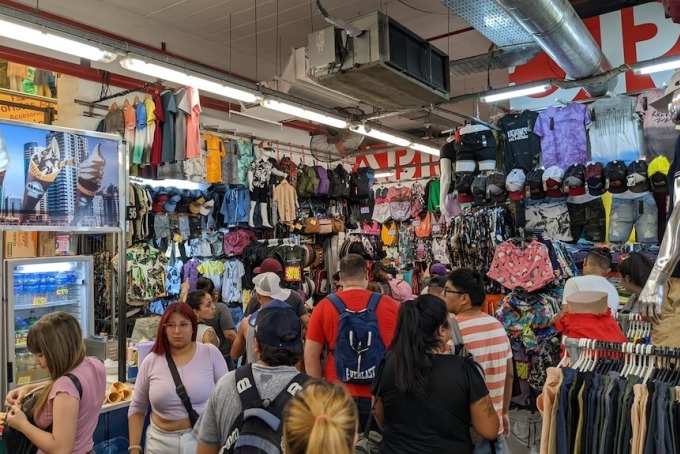
A crowded scene at a market in Argentina. Photo: ABC News
For the sellers, life isn't any easier. Every month, Rudy Rindlisbacher, the owner of a steel company in Trenque Lauquen, sits down with his son to discuss and adjust product prices.
"It's very complicated. Because there's no way to know how much the product will cost at the time of re-import. Large companies can hold onto the goods, not put them on the shelves until they know the re-import costs. But small businesses like ours have to sell continuously. We need to survive," he said.
Prior to the Great Depression of the 1930s, Argentina was among the top 10 countries with the highest GDP per capita in the world . However, since the 1950s, the country has been mired in recession and debt default.
For the past 50 years, Argentina has consistently struggled with rising prices. In the 1980s, inflation there reached an unimaginable 3,000%. Since 2008, the country has recorded inflation exceeding 30% annually.
Argentinians spend pesos as soon as they receive them. They don't trust banks and rarely use credit cards. And after years of inflation, they've also forgotten what prices should be. Millions of Argentinians have turned to the black market to circumvent government regulations on buying US dollars.
Inflation in Argentina shares the same causes as in the rest of the world: the conflict in Ukraine, supply chain tensions, and soaring public spending. However, many economists argue that the problem also lies within the country itself. It is spending more than it earns. Healthcare, education, energy, and public services are heavily subsidized or free. Therefore, to compensate for the shortfall, they are increasing the value of the peso.
It wasn't until 2022 that the country's Economy Minister, Sergio Massa, committed to not requiring the central bank to print more money for public spending. Earlier this week, the Central Bank of Argentina also raised its benchmark interest rate to 97% to combat inflation.
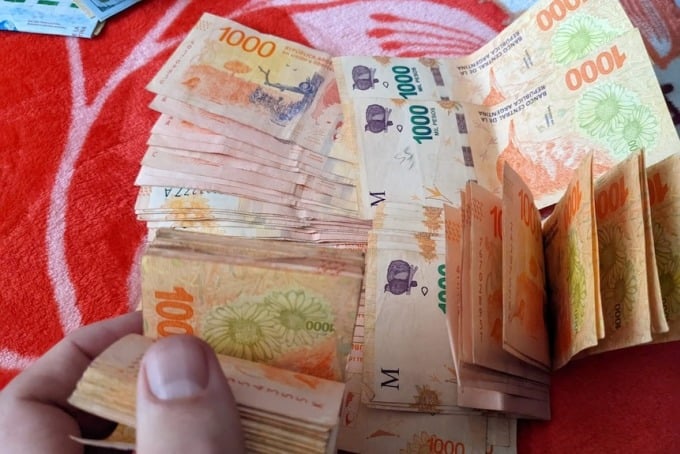
The 1,000 peso note is currently the highest denomination banknote in Argentina. Photo: ABC News
Analysts remain divided on how to address the problem in Argentina. But most agree that the country lacks political will. "Understanding the social aspect of this issue is crucial. Unfortunately, Argentina has such a long history of inflation that generations of people have come to accept 30% inflation as normal," commented Adam Fabry, an economics lecturer at the National University of Chilecito.
However, Benjamin Gedan, Director of the Argentina and Latin America Project at the Wilson Center for Research, believes that triple-digit inflation would be the benchmark for the economy. "It's true that Argentinians are used to high inflation, but that was around 20-30%. 100% like it is now really turning life upside down," he said.
Gedan said that restaurants in Buenos Aires are often packed, not because people are rich, but because they are 'quema la plata' (burning money). Many Argentinians are spending money as if the world is ending. They buy everything from towels to TVs on installment plans.
"Houses are bought with cash, paid in full at once. But smaller items are bought on monthly installments over many years," Guido said. The reason is that Argentinians believe the peso will depreciate and their final installments will be worth very little when converted to USD.
Rudy bought a Toyota HiLux 1.5 years ago for 4.5 million pesos. Now, its value has risen to 12 million pesos. "The best way to save money is to buy things," he said.
To combat inflation, Argentinians are hoarding US dollars. Many experts believe that Argentinians hold more US dollars than any other country in the world besides the United States. "It's not just wealthy businesses; taxi drivers and grocery store owners also hold US dollars," Gedan said.
These US dollar bills aren't kept in banks, because at the official exchange rate, they'd only be worth half. Argentinians keep them in old clothes, under mattresses, in walls, under floors, and in safes. The highest denomination banknote in Argentina – 1,000 pesos – is currently worth less than $2.40 on the black market. In February, the Central Bank of Argentina announced plans to launch a 2,000 peso note.
For Rudy, even fitting enough pesos into his pocket to spend for the day was a struggle. "A pile of money that's worth little," he complained.
In recent years, an increasing number of Argentinians have sought to emigrate abroad. "Most of my friends and relatives will be leaving Argentina. We are also applying for Italian citizenship. I want my children to grow up in a better place," said Vanesa Barrios, director of a mountaineering company in Mendoza.
However, not everyone has the means to go abroad. The group most severely affected by inflation is the poor. "They don't have unions, work in informal sectors, and can't negotiate wages. Inflation makes the money they earn evaporate in the blink of an eye," Gedan said.
Ha Thu (according to ABC News)
Source link


![[Photo] General Secretary and President To Lam presides over a meeting on preparations for the review of one year of operation of the three-tiered government system.](https://vphoto.vietnam.vn/thumb/1200x675/vietnam/resource/IMAGE/2026/06/02/1780391821195_a1-bnd-4595-9717-jpg.webp)




























































Comment (0)