

 |
| Farmer Bui Van Bay (right, residing in Hamlet 3, Dak Lua Commune) earns 70 million VND/sao/65 days of cultivation with his cantaloupe farming model. |
Nevertheless, the people of Dak Lua commune still deeply feel the changes in the land and people here, especially when local officials and authorities make efforts to focus on the grassroots.
Transformation in the flood-prone area
The Dak Lua area was once considered a flood-prone region. Local residents still vividly remember the historic floods of 1998, 2000, and 2001, which caused them considerable hardship. However, since then, floods have ceased, and the area known as the "flood-prone epicenter" of Dak Lua is now little known.
When not ravaged by floods, the farmers of Dak Lua end their practice of cultivating short-term crops that prioritize security and avoid flooding during harvest time... The people of Dak Lua confidently sow three rice crops per year, develop mulberry cultivation and silkworm farming, and grow various fruit trees.
In its upcoming breakthrough development tasks, Dak Lua commune consistently prioritizes improving the quality of its cadre, especially key officials, ensuring they possess strong political acumen, sufficient qualities, capabilities, and prestige commensurate with their responsibilities.
Secretary of the Party Committee, Chairman of the People's Council of Dak Lua Commune, Phan Van Tung
Farmer Nguyen Van Hung (residing in Hamlet 2, Dak Lua Commune) said: Before the irrigation system in the fields of Hamlet 2 was invested in, farmers only sowed 1-2 rice crops per year. Because they could not control the water supply for the rice plants during the dry season and drain the water during the rainy season, the yield only reached 4-5 tons/hectare/crop. Now that the irrigation system covers the fields, farmers not only cultivate 3 rice crops per year, but the yield consistently reaches 7-8 tons/hectare/crop.
Thanks to the investment in irrigation canals, roads, and electricity, not only Mr. Nguyen Van Hung's household but also farmers in Hamlet 1 and many other hamlets in Dak Lua commune have been able to sow rice three times a year, flexibly introducing mulberry trees, high-yield corn, sweet potatoes, and various vegetables into cultivation on high-lying fields according to the model: two rice crops and one vegetable crop per year, contributing to enriching soil nutrients and increasing land use value.
Farmer Hoang Van Them (residing in Hamlet 4, Dak Lua Commune) said: With 3 sao (approximately 0.3 hectares) of high-lying rice fields, he only sows one main rice crop, then grows mulberry trees to raise silkworms. Thanks to this, his 3 sao of land yields an income of over 150 million VND per year. This model is being widely applied by farmers in Dak Lua Commune, providing a more attractive income compared to growing rice in combination with other crops.
Dak Lua commune has over 250 hectares of land dedicated to mulberry cultivation and silkworm farming. Nguyen Duy Dong, Director of the Duy Dong Mulberry Production and Service Cooperative (Hamlet 1, Dak Lua commune), stated that the cooperative has 20 members and provides regular employment for over 40 workers. Thanks to the stable price of cocoons, starting from 155,000 VND/kg, the cooperative members and mulberry growers/silkworm farmers in the commune enjoy a relatively comfortable economic situation .
Focus on the grassroots, serve the people.
Dak Lua commune is located approximately 160km from the administrative center of Dong Nai province (towards National Highway 20) and about 140km (towards Dak Lua - Dang Ha). Despite its distance from the provincial administrative center, to facilitate administrative procedures, economic development, access to healthcare, education , and other social welfare policies for its residents, Dak Lua commune is focusing on implementing a "friendly government" model. This involves a strong shift in the working methods of the local government from "administrative orders" to "service, guidance, mobilization, and persuasion," ensuring that officials and the government are truly close to the people and serve them.
 |
| Many rice fields in Hamlet 1, Dak Lua Commune are beginning to be harvested. Photo: Doan Phu |
Chairman of the People's Committee of Dak Lua commune, Nguyen Thanh Hien, shared: "Commune officials and leaders always focus their efforts on caring for the grassroots, listening to the thoughts and aspirations of the people to act promptly, appropriately, effectively, and responsibly. As a result, officials are closer to the people, understand them better, and the people feel that, despite being far from the provincial administrative center, they all fully benefit from the policies and support programs of the central and local governments."
According to Phan Van Tung, Secretary of the Party Committee and Chairman of the People's Council of Dak Lua commune: "A 'friendly government' is about building a style that 'respects the people, is close to the people, understands the people, learns from the people, and is responsible to the people'; 'listens to what the people say,' 'speaks in a way the people understand,' 'guides the people in their work,' 'earns the people's trust,' and the motto 'sincere, proactive, cautious, persistent, tactful, and effective,' aiming for the satisfaction of the people with the team of officials and civil servants at the grassroots level..."
“Through implementing a people-centered government, we have grasped and recorded many heartfelt opinions from the people and grassroots organizations, such as: focusing on ensuring environmental hygiene, investing in clean water for daily life, overcoming flooding in low-lying areas, and investing budget funds in rural transportation in areas that are still facing difficulties…” - Phan Van Tung, Secretary of the Party Committee of the commune, cited as examples.
Dak Lua commune has 7 hamlets, a natural land area of approximately 415.1 km2, and a population of over 8,200 people, including 284 households and 1,311 people from ethnic minority groups. From 2020-2025, using budget funds and community contributions (totaling 401 billion VND), the infrastructure and transportation system in Dak Lua commune is being improved. Hamlet 7 (a remote and isolated area of the commune) is prioritized with over 200 billion VND from the budget for investment in transportation infrastructure, education, and healthcare.
From a remote, purely agricultural commune, Dak Lua commune has now undergone a positive shift in its economic structure, with agriculture accounting for 60%, trade and services 28%, and small-scale industries 12%.
According to Nguyen Thanh Hien, Chairman of the People's Committee of Dak Lua commune, the locality continues to promote the development of industry and small-scale handicrafts, focusing on the development of agricultural product processing, construction materials, mechanics, repair, etc. At the same time, it pays attention to, creates favorable conditions for, and encourages existing small-scale handicraft establishments to expand their production and business scale.
Doan Phu
Source: https://baodongnai.com.vn/dong-nai-cuoi-tuan/202508/dak-lua-xa-ma-gan-d9422f7/
![[Image] Hanoi's urban life under the challenge of a "scorching hot" environment](https://vphoto.vietnam.vn/thumb/1200x675/vietnam/resource/IMAGE/2026/05/25/1779706979265_nang-nong-t5-2026-minh-duy-7-4636-jpg.webp)
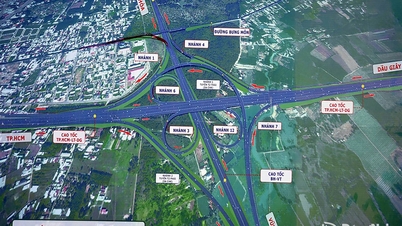
![[Image] Close-up view of the interchange connecting the two expressways and Long Thanh Airport.](https://vphoto.vietnam.vn/thumb/1200x675/vietnam/resource/IMAGE/2026/05/25/1779703378210_ndo_br_z7863716673926-224453a31600126cce10622af6290afd-4549-jpg.webp)




































































Comment (0)