

In Hai Phong , the Cat Ba langur, the world's most endangered species, has seen its population grow from 57 to 76 individuals, but it continues to be negatively impacted by tourism.
In mid-June, Mai Sy Luan, 41, a project officer for the Cat Ba langur conservation project, woke up at 4 am to go to Lan Ha Bay for a half-month field trip. He traveled by speedboat from Cat Beo pier in Cat Ba town, circling around the islands marked for langur sightings, such as Cua Dong, Ham Lon, and Nam Cat. "Every day I have to search for them, record their movements and habits. This work has been repeated for 14 years," Mr. Luan said.

Mr. Luan has been observing the Cat Ba langur population for 14 years. Photo: Xuan Hoa
The Cat Ba langur (Trachypithecus poliocephalus) is one of five primate species endemic to Vietnam, along with the white-buttocked langur, snub-nosed langur, grey-footed langur, and Oriental black-crested gibbon. This species is listed in the Vietnam Red Book and the IUCN Red List, classifying it as one of the most endangered primate species in the world.
Mr. Luan stated that there was once a view that the Cat Ba langur and the white-headed langur in southern China were most closely related. However, according to research by the Cat Ba langur conservation project and the Gottingen Primate Research Center in Germany, both species evolved from the Francois' langur (white-cheeked black langur). The Cat Ba langur diverged from the Francois' langur about half a million years earlier than the white-headed langur and is currently not found anywhere else in the world besides the Cat Ba archipelago.
The Cat Ba langur is quite large, with a body length of 47-53 cm and a tail nearly twice the length of its body, which helps it maintain balance when moving. The tuft of yellow fur on its head fades with age. The lifespan of a Cat Ba langur is approximately 25 years.
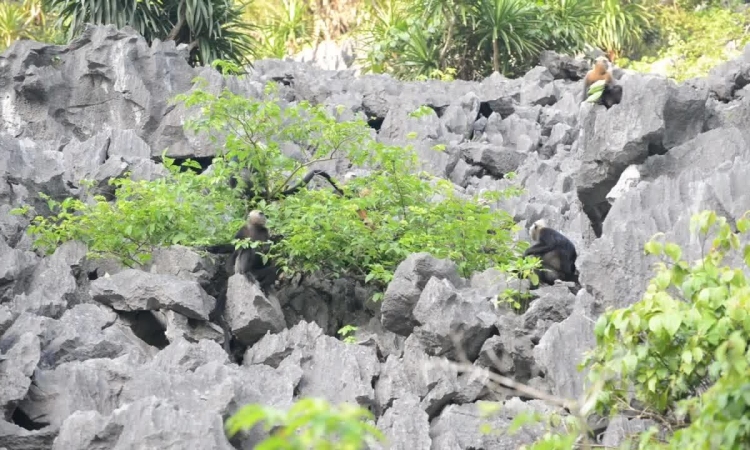
The langurs of Cat Ba Island in the Cua Dong area are eating leaves. Video : Neahga Leonard
Female langurs give birth to one offspring at a time, with a gestation period of six months. The young langurs have orange-yellow fur, which turns black after about two months. They are very attached to their mothers and only explore the world on their own when they feel safe and secure in a secluded area. When moving, the young langurs are carried by their mothers or other older members of the troop. At six years old, langurs are expelled from the troop. When they feel strong enough, male langurs will challenge the alpha male to become the leader.
After a life-or-death battle, if the new male wins, it will try to kill the offspring of the previous male. This is a natural behavior, but it also results in many offspring being born unable to reach adulthood.
Cat Ba langurs often climb tall trees or jagged, sharp limestone cliffs near the sea to forage for food. Their diet consists of leaves, forest fruits, and even many poisonous plants like the yam fruit. "They even use their tails to dip into the seawater to test for water when it's very sunny, dry, and the rocky mountains have no water left," Mr. Luan said.
When the weather is cool and shady, the langurs move to the limestone mountains near the sea to forage for leaves and fruits. Around 9 am, they head back into the forest, only returning to their caves to rest at night. That's why Mr. Luan's workday usually starts very early. "The cave entrances often have yellow streaks left by the langurs' urine. We use those traces to find them," Mr. Luan explained.
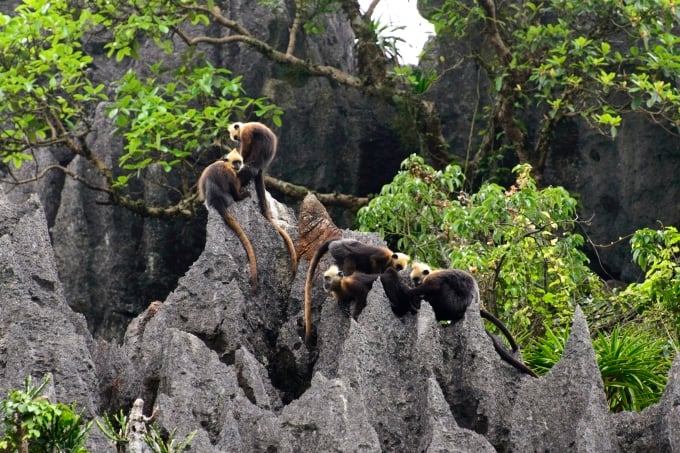
The Cat Ba langur troop in the Cua Dong area of Lan Ha Bay. Photo: Neahga Leonard
While the pack forages and plays, the alpha male stands on a high mountain peak to observe, occasionally letting out warning howls and growls. If it senses significant danger, the alpha male will alert the pack to retreat to a safe place.
Besides large groups, many male langurs live freely or gather in groups, wandering deep in the forest. At times, some males disappear for months before reappearing. "This makes counting very difficult. We have to make our own rules; any langur that doesn't appear for six months is removed from the count list," Mr. Luan said.
The langurs are also capable of sitting still in one place for a very long time, especially the alpha male. "Sometimes we've had to test our patience against them and had to admit defeat," Mr. Luan said, adding that because of the nature of his work, which often requires him to work alone, the langurs are his companions, helping him and his colleagues avoid feeling lonely.
"Those who go with us for the first time enjoy it. But in reality, the work is very hard and stressful. Sometimes the boat breaks down in the scorching sun for hours, other times we fall into the water. Phones and belongings fall into the sea all the time," Mr. Luan confided.
Through various scientific and meticulous counting methods, conservation project officers have determined with relative accuracy that the Cat Ba langur population currently stands at 76 individuals, an increase of 19 compared to five years ago.
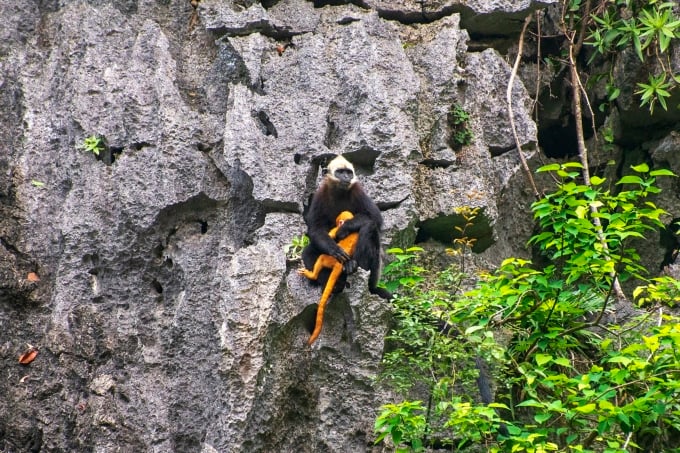
A baby langur with unique yellow fur in its mother's arms. Photo: Neahga Leonard
Cat Ba Island used to have thousands of langurs. However, the past habits of the local people, such as relying on the forest for sustenance and hunting animals, along with population growth on the island, have severely impacted and declined this population.
To prevent the extinction of the Cat Ba langur, in 2000, Muenster Zoo and the German Zoological Society for the Conservation of Species and Populations (ZGAP) funded and implemented a conservation project. At that time, there were only about 50 individuals left. Since 2019, Leipzig Zoo has taken over the responsibility of funding and managing the project.
Over the years, the project, together with Cat Ba National Park and local people, has strived to minimize human impact to ensure the growth and prevent the extinction of the langur species.
However, Neahga Leonard, Director of the Cat Ba Langur Conservation Project, said the langur population remains "fragile" due to its small size and fragmentation, as well as disturbances caused by human activity. The langurs, which have lived on Cat Ba Island in a specially protected area since 2006, are facing "constant and most severe attacks" from the increasing number of tourists coupled with poor tourism management.

The population of Cat Ba langurs is increasing by an average of about 3% per year.
"Tourist boats, with their accompanying noise and pollution, create extreme stress for the langur troops here," said Neahga Leonard, adding that the project has documented many langur troops having to abandon their burrows and safe habitats due to human noise.
Statistics from the People's Committee of Cat Hai District show that in 2022, more than 2.3 million tourists visited Cat Ba Island. This was 1.5 million in 2020 and over 2.8 million in 2019.
Le Tan
Source link







































































































Comment (0)