

Durian prices are fluctuating wildly, why?
In some provinces in the Mekong Delta, many farmers are currently harvesting durians themselves and selling them on the streets for 20,000-30,000 VND/kg because traders are not buying them. This is considered an unprecedentedly low price in recent years. At this time in Ho Chi Minh City, durians sold on sidewalks and from pushcarts at extremely cheap prices are also appearing everywhere. Meanwhile, according to Thanh Nien newspaper's investigation, although prices have decreased compared to the beginning of the year, many wholesalers and businesses are still buying durians at relatively high prices. Specifically, Grade A Ri6 durians in the Mekong Delta are priced at 40,000 VND/kg, and in the Eastern region at 45,000 VND/kg; Thai durians are priced at 80,000-85,000 VND/kg, and Musang King at around 90,000 VND/kg. As for products below export standards, prices vary widely. Thus, it can be seen that the price of durian meeting export standards has only decreased by about 20-30% compared to before, but the abundance of durian on the roadsides has caused many people to confuse export-grade goods with substandard or rejected goods. "To be honest, at the beginning of the year during the off-season, selecting export-grade durian was simpler. Now, in the peak season, with large production volumes, the selection process is stricter, which means there are more rejected goods. Currently, exports are still normal, only slowed down due to competition with Thai durian," said Nguyen Chi Tam, a wholesaler in Can Tho .
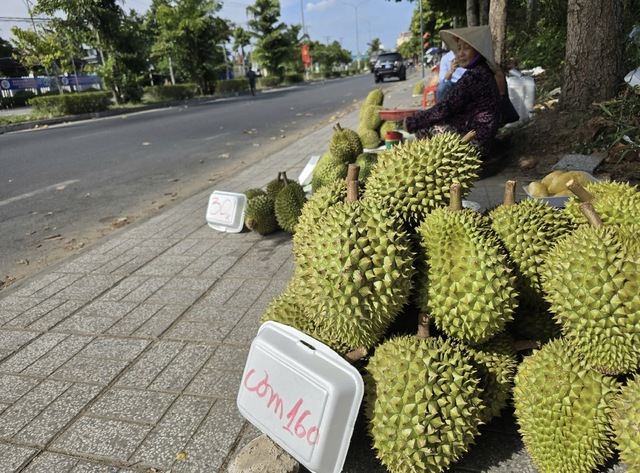
Durian fruit spills onto the streets, raising the challenge of sustainable development for this multi-billion dollar industry.
PHOTO: DUY TAN
Mr. Ly Thanh Vinh, a representative of a business in Vinh Long , said that the current price drop and price fluctuations are not unique to Vietnam. In Thailand, prices are also falling sharply as the harvest season approaches. There was even a livestream program to "rescue" durian that drew strong reactions from farmers there. The program aimed to drastically lower prices to stimulate demand, but farmers feared traders would use that price to manipulate prices. Subsequently, government representatives had to clarify that the durians in the "rescue" program were not export-standard products, and the prices shown were not indicative. "This story shows that durian price fluctuations are happening everywhere, and if we're not careful, we could easily fall into an 'information trap.' Price drops during peak harvest seasons are something we have to accept. To mitigate this risk, we need to expand markets and increase processing," Mr. Vinh analyzed.
According to experts, besides supply and demand, the current drop in durian prices is also due to quality, consumer preferences, and purchasing power. Mr. Dang Phuc Nguyen, General Secretary of the Vietnam Fruit and Vegetable Association (VINAFRUIT), analyzed: This year, Thai durian also had a bumper crop, resulting in low prices. The difficulty for durian growers in the Mekong Delta is the "competition" with Thailand, a natural and unavoidable issue. Thai Monthong durian has more flesh, so it sells better than the Ri6 variety, which is commonly grown in the Mekong Delta. "Just like in football, we may have to accept the reality of losing to the Thais in the first half and then catching up in the second half in the Eastern and Central Highlands regions. Of course, we must improve the soil, seeds, and shift strongly from quantity to quality and food safety. It's very important to note that in the past two years, the durian market in China hasn't exceeded $10 billion, not growing as strongly as expected. Therefore, aiming for $4 billion in durian exports this year must rely on continuously improving quality," Mr. Nguyen recommended.
Reorganize production, develop processing.
Professor Tran Van Hau, a leading Vietnamese expert on durian cultivation, analyzed: The problem of heavy metal residue in the soil, specifically cadmium, cannot be solved overnight, but it can be gradually improved over time by applying new cultivation techniques with cadmium-free fertilizers. This is also a difficult process and requires time. Regarding the issue of varieties, this is a matter that requires calmness and caution because consumer tastes change very quickly. Even in Thailand, there are many different varieties, not just Monthong, and Malaysia, besides the most famous Musang King, also has many others. "Many Malaysian experts have come to Vietnam, tried, and highly appreciated the Ri6 variety from Vietnam. The Ri6 variety has a short growing season of only 3 months compared to Monthong's 4 months. Farmers are also familiar with the techniques of caring for and managing off-season crops, resulting in high economic efficiency."
India is also a potential market because it doesn't produce durian. Recently, Vietnam has been quite successful in shifting the dragon fruit market from China to India. According to experts, Vietnam will continue to succeed with the "king of fruits" – durian – in India, especially as high-level leaders from both countries are meeting to strengthen cooperation.
"The story of consumer tastes is, firstly, diverse, and secondly, rapidly changing. Therefore, we shouldn't rush to follow the market, as it will lead to a vicious cycle, wasting a lot of time and money. A few years ago, many people rushed to plant Musang King durians and then cut them down because they found the fruit unripe, but that was because they didn't master the cultivation techniques. So, our problem is that we haven't organized the communication and promotion of the product well, and haven't sold the story of the uniqueness of Vietnamese durian. We must transform and change our thinking in that direction, not 'uniform' the variety or equalize culinary tastes," Professor Hau noted.
Dr. Doan Huu Tien, Director of the Center for Technology Transfer (Southern Fruit Research Institute), acknowledged: In recent times, durian cultivation has developed too rapidly, and authorities only have a general understanding of the area and production volume, lacking in-depth specifics. Sustainable development requires understanding the supply, production organization, and market. Over the past two years, this multi-billion dollar industry has faced numerous challenges, and only through sheer luck has it continuously broken records. Therefore, it is time to rebuild the industry's system systematically, from growing regions to traceability. To achieve this, cooperation between farmers and businesses is needed, along with collaboration with research institutes and universities to transfer advanced technologies, ensuring product quality and food safety according to international standards. Furthermore, it is crucial to encourage and support businesses to invest in and develop the processing industry for durian products. Currently, processing is limited to freezing and drying, while in reality, many delicious dishes can be made by mixing durian with other ingredients. Boosting the processing industry will reduce pressure on the sector during peak harvest seasons and prevent competition from other businesses.
According to experts, China imported $1.1 billion worth of frozen durian products in 2025 alone. Besides the Chinese market, durian is also very popular among Asian consumers, so the opportunity to expand market share in other countries is enormous.
Source: https://thanhnien.vn/dang-sau-viec-sau-rieng-tran-ra-le-duong-185260508193818041.htm

![[Photo] The heat at the fireworks display site on the opening night of the Da Nang International Fireworks Festival 2026](https://vphoto.vietnam.vn/thumb/1200x675/vietnam/resource/IMAGE/2026/05/27/1779889741485_ndo_br_z7872039145157-fecaba5112f39e8352544099d7ef4738-5140-jpg.webp)
![[Photo] The courage of new recruits of Brigade 144 on the training ground.](https://vphoto.vietnam.vn/thumb/1200x675/vietnam/resource/IMAGE/2026/05/27/1779881651341_anh-man-hinh-2026-05-27-luc-18-32-52.png)





















































![[Photo] The courage of new recruits of Brigade 144 on the training ground.](https://vphoto.vietnam.vn/thumb/402x226/vietnam/resource/IMAGE/2026/05/27/1779881651341_anh-man-hinh-2026-05-27-luc-18-32-52.png)

























Comment (0)