Reporter: Could you please explain why the price of gold has fluctuated so much in such a short period? How do factors such as political and military conflicts between countries around the world affect the price of gold?

Associate Professor, Dr. Phung Thanh Quang, Institute of Banking and Finance, National Economics University.
Associate Professor, Dr. Phung Thanh Quang: The sharp fluctuations in gold prices over a short period often reflect the convergence of multiple economic, financial, and geopolitical shocks occurring simultaneously. These can be summarized into three main groups of causes as follows:
Firstly, there's a surge in "safe haven" sentiment. Gold has long been considered a safe-haven asset. When the world experiences political tensions, military conflicts, or the risk of economic recession, money tends to flow out of risky assets like stocks and cryptocurrencies and into gold.
When negative news emerges globally, such as escalating conflicts, threats of sanctions, or expanding conflict zones, demand for gold surges rapidly, driving prices up quickly. Particularly in the current volatile and unpredictable global situation, many central banks have increased their gold purchases to reduce their dependence on the US dollar and mitigate the risk of political pressure.
Secondly, expectations regarding inflation, interest rates, and monetary policy are changing: Global geopolitical uncertainties increase inflation expectations, while high inflation weakens the value of fiat currency, thereby increasing the attractiveness of gold. In addition, the market is constantly adjusting its expectations regarding the interest rate trajectory of central banks. If investors believe that interest rates may fall or are unlikely to rise sharply, then gold—a non-interest-bearing asset—becomes more attractive.
Thirdly, speculation and algorithmic trading amplify volatility. In the context of a volatile global geopolitical landscape, large investment funds and automated trading systems react very quickly. When the price of gold surpasses key technical thresholds, automated buy and sell orders are triggered en masse, amplifying the price fluctuations in a short period.
PV: What advice would you give to people now that many are withdrawing their savings to buy gold?
Associate Professor, Dr. Phung Thanh Quang: The fact that people turn to gold as a safe haven to protect their assets during times of economic instability is a relatively common "cultural trait" among Vietnamese people. However, before deciding to invest in this precious metal, I believe the following aspects should be considered:
First, it's important to avoid the "herd mentality" and chasing high prices. When gold prices rise rapidly, the risk of a downward correction is also high. If people buy gold when prices are rising, they may buy at the peak and suffer losses when the market reverses.
Secondly, it's not advisable to withdraw all your savings to buy gold. Savings deposits have the advantages of being safe, generating stable interest, and being highly liquid. Converting everything to gold could cause people to lose a stable source of interest income, face difficulties when they need money urgently, and be exposed to price fluctuations when gold prices fall. If you decide to buy gold, you should use any temporarily surplus funds for the long term to ensure it doesn't affect your regular spending needs.
PV: What are your predictions for the price of gold in the near future?
Associate Professor, Dr. Phung Thanh Quang: Gold prices are highly sensitive to economic, political, and interest rate expectations. In the current volatile global environment, gold prices are projected to continue rising in the medium and long term, potentially reaching around $5,000-$6,300 per ounce by the end of 2026, driven by demand from central banks and investors seeking safe-haven assets. Record net buying from central banks, particularly in emerging markets like China, will continue to be a strong support level for global gold prices.
Currently, the foreign exchange reserves of many countries such as China, India, Brazil, etc., are undergoing a strategic shift: a significant increase in gold holdings while simultaneously reducing the proportion of US government bonds held. These factors contribute to maintaining the upward trend in gold prices in the medium and long term.
For the Vietnamese market, gold prices are likely to maintain an upward trend in the long term, due to the combined effects of global prices, exchange rates, and consumer sentiment. However, in the short term, correction scenarios are clear: Gold prices may adjust downwards due to profit-taking or the volatility may increase when the financial market experiences significant fluctuations.

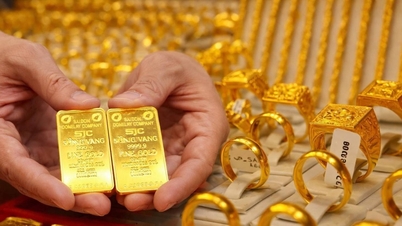
Customers buying gold at Bao Tin Manh Hai Gold, Silver and Gemstone Joint Stock Company. Photo: NGOC HAI
PV: Given the constant fluctuations in gold prices, what should gold buyers do to avoid losses when investing in gold, sir?
Associate Professor, Dr. Phung Thanh Quang: In reality, over the past period, many individual investors have fallen into the "fear of missing out" (FOMO) mentality, buying gold when prices have risen sharply and then suffering losses when the market corrects. To increase efficiency and limit risks when investing in gold, investors need to pay attention to the following issues:
First, investors need to clearly define their goals for holding gold. If buying gold for long-term accumulation, hedging against inflation, geopolitical instability, or financial system risks, then they need to accept holding it for the medium to long term and not be overly concerned about short-term price fluctuations. Conversely, if the goal is short-term speculation, investors need to understand that large price swings can generate quick profits but also carry the risk of significant losses.
Secondly, you shouldn't invest all your spare money in gold, especially when prices are high and market sentiment is euphoric. Buying at the peak often happens when investors buy based on rumors or fear of missing out (FOMO). Gold should only account for a reasonable proportion of your investment portfolio (e.g., 10-20% depending on your risk tolerance), alongside deposits, bonds, stocks, or other assets.
Third, it's necessary to monitor macroeconomic factors affecting gold prices such as interest rates of major central banks, especially the policies of the US Federal Reserve (Fed), global inflation trends, geopolitical tensions, and exchange rate trends. When real interest rates fall or uncertainty increases, gold usually benefits. However, the market often reacts to expectations rather than waiting for official events to occur.
Fourth, choosing the right form of gold investment is also crucial. Individual investors should carefully consider whether to invest in physical gold, branded gold bars, or financial products and derivatives related to gold. In addition, they should pay attention to the buy-sell spread, storage costs, and liquidity. Buying and selling through official, transparent channels will help limit legal and quality risks.
Fifth, diversify your asset portfolio. Instead of investing all your money in gold, allocate assets according to the principle of balance and diversify your investment portfolio to mitigate risks. For individual investors, gold should be considered a long-term investment channel, not a short-term trading channel, due to the high risk and significant buy-sell price difference.
In Vietnam, the difference between the buying and selling price can sometimes reach several million dong per tael (approximately 37.5 grams). If investors buy when the market is heating up too quickly, they may face the risk of losses due to this large price difference.
Source: https://baolangson.vn/dau-tu-vao-vang-mot-cach-khon-ngoan-hieu-qua-5078303.html


![[Image] Hanoi's urban life under the challenge of a "scorching hot" environment](https://vphoto.vietnam.vn/thumb/1200x675/vietnam/resource/IMAGE/2026/05/25/1779706979265_nang-nong-t5-2026-minh-duy-7-4636-jpg.webp)

![[Image] Close-up view of the interchange connecting the two expressways and Long Thanh Airport.](https://vphoto.vietnam.vn/thumb/1200x675/vietnam/resource/IMAGE/2026/05/25/1779703378210_ndo_br_z7863716673926-224453a31600126cce10622af6290afd-4549-jpg.webp)
























































































Comment (0)