

The grading of essay exams also affects fairness.
The newly issued directive from the Prime Minister regarding the high school graduation exam has pointed out one of the limitations and shortcomings in the organization of the exam in recent years: the grading of essay questions in some localities has not ensured proper differentiation, affecting fairness for candidates nationwide.
Therefore, for this year's exam, the Prime Minister requested that the grading of essay-based subjects be carried out strictly according to the scoring rubric and guidelines, ensuring differentiation and fairness; and creating favorable conditions for schools in teaching, learning, and reviewing for students.
Previously, at the training conference on organizing and conducting the 2026 exams organized by the Ministry of Education and Training in April, Colonel Nguyen Anh Tuan, Deputy Director of the Internal Political Security Department (A03) of the Ministry of Public Security , stated that in recent years, public opinion has continued to raise suspicions about unusually high essay exam scores in some localities and questioned whether there was laxity in the grading process.
Deputy Minister of Education and Training Pham Ngoc Thuong also acknowledged that in recent years, some localities have caused public concern when announcing exam results. For example, in some places, many students scored 9 or 9.5 in the literature exam, while he himself, having studied literature in high school, understands that achieving a score of 7 or 8 in literature is very difficult…
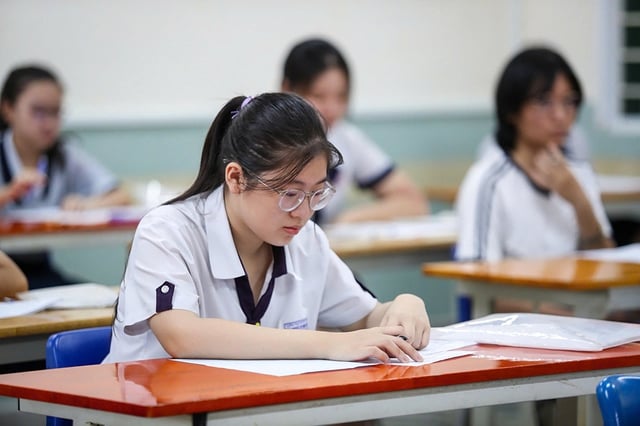
Candidates take the Literature exam in the 2025 high school graduation exam. This is the only essay-based subject in this exam.
PHOTO: NHAT THINH
Despite requesting reports and explanations from localities with "unusually high" Vietnamese language exam scores in previous years regarding the strategies used in preparing for the subject, the Ministry of Education and Training leadership deemed the explanations "not entirely convincing" and stated that they would intensify inspections and monitoring of this issue in this year's exam.
Records show that in 2024, the scores in Literature increased dramatically, second only to Civics , a subject previously considered a "rain of perfect scores" in the old exam program. Out of 1 million candidates, over 90,000 achieved a score of 9 or higher in Literature. This "flood of high scores" in Literature also contributed to the unusually high number of valedictorians in the C00 group, with 19 candidates.
Should cross-checking be implemented?
Following the aforementioned statements and concerns, some opinions suggest that the Ministry of Education and Training should organize cross-marking of the only essay-based exam to prevent teachers from potentially giving lenient marks to students in their locality. In particular, the exam results are still used by most universities for university admissions.
However, historically, the practice of cross-checking exam papers for the high school graduation exam has been applied and has also caused public outcry due to negative aspects of this grading method. Specifically, cross-checking of essay exams was implemented from the 2009 exam and continued until 2011. At the time of its implementation, the Ministry of Education and Training assessed that cross-checking had significantly contributed to ensuring the accuracy and objectivity of the grading process, while also limiting negative aspects in the grading of essay exams in previous years' graduation exams. This is reflected in the results of the re-evaluation of essay exams in the high school graduation exams of 2008, 2009, and 2010. The number of re-evaluated papers with a discrepancy of 1.0 point or more in 2008 (before cross-checking) accounted for 38.80%, while in 2009 it only accounted for 4.93%, and in 2010 it accounted for 3.96%...
However, in 2009, some provinces in the Southwestern region raised concerns about the "too strict" grading of the literature exam, leading to unreasonably low results in some provinces. In 2010, after learning from experience and considering discussions at the exam and admissions conference, the Ministry of Education and Training made adjustments: assigning inspectors from a third-party provincial education department (not the department that submitted the exam papers, nor the department currently grading) to inspect 5-10% of the exam papers from the grading committee to propose timely adjustments to limit the tendency to grade incorrectly according to the answer key or score rubric, or to grade inconsistently among examiners.
In 2011, a document outlining grading guidelines from 11 provinces in the Mekong Delta leaked, causing a public uproar. This document revealed that these provinces had agreed to be more lenient in grading the essay-based subjects of the high school graduation exam. Not only for Literature, but the 11 provincial education departments met and agreed to create their own grading guidelines, based on the Ministry of Education and Training's answer key, for all essay-based subjects in both the high school and continuing education systems.
When the scandal broke, the exam results had already been announced. After much deliberation, the Ministry of Education and Training finally chose to recognize the exam results of all these provinces and cities to avoid affecting the candidates.
Following this controversy, the Ministry of Education and Training abolished cross-marking and introduced a solution of multiple-choice exams to replace essay-based exams, with machine grading to reduce human intervention. Literature remains the only subject still tested in essay format to this day.
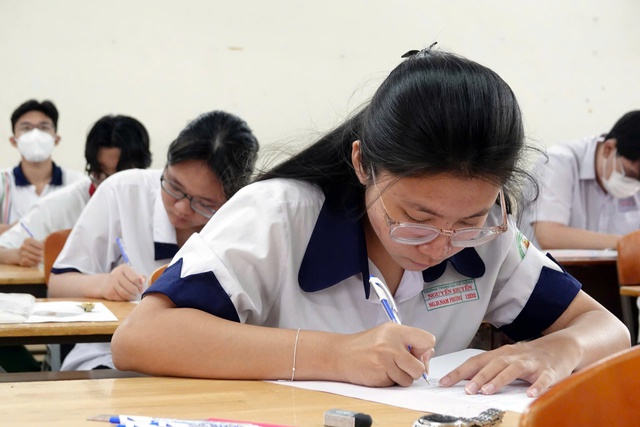
The regulations and guidelines for organizing the high school graduation exam this year basically retain the same grading rules for essay-based subjects as in previous years.
Photo: Dao Ngoc Thach
What approach should be taken in grading and answering literature exams?
Associate Professor Bui Manh Hung, Principal Coordinator of the 2018 General Education Curriculum Development Board, also believes that this year the Ministry of Education and Training needs to have appropriate solutions for organizing exam grading to limit the situation where many localities give excessively high scores, far exceeding the quality of the candidates' papers.
Regarding the answer key for the Literature subject, Associate Professor Hung commented that the answer key for the 2025 high school graduation exam in Literature (the first year of testing under the 2018 curriculum) still follows a closed-ended model, or to put it more cautiously, a "semi-open" model. According to him, a standard open-ended answer key needs to meet two requirements: firstly, it must be open in content and clear in criteria. Open in content means that the essay does not require every point and every piece of evidence to be correct; it accepts multiple interpretations and approaches, as long as they are reasonable and well-founded. Secondly, it must be clear in criteria (rubric), meaning that grading is based on the ability to identify the issue, construct arguments, provide evidence, and express ideas…
Mr. Hung commented: "The recent graduation exam answer key was designed to ensure uniform grading, but it limits students' creativity and diverse writing styles. In the long run, this approach affects teaching and learning. Education risks becoming a process of molding students into a single way of thinking."
Based on international experience, Associate Professor Hung suggested developing a rubric to serve as the basis for open-ended answers. Writing instruction in the classroom should be implemented accordingly. Students will be given the opportunity to understand and master these grading criteria for practice...
"Of course, grading students' essays according to a system of criteria requires high-level skills from the examiners. Teachers need to be thoroughly trained before participating in grading and need to organize sample grading sessions based on the criteria to minimize discrepancies between provinces and between examiners," Associate Professor Bui Manh Hung shared.
Tighten regulations on re-evaluation of exam results.
The regulations and guidelines for organizing the high school graduation exam this year essentially maintain the same grading rules for essay-based subjects as in previous years. Accordingly, grading teams will jointly grade at least 10 papers to provide feedback to examiners, after which the exam papers will be graded in two independent rounds by two examiners from different teams. The regulations also clearly specify how to handle discrepancies in scores (at specific levels) between the two examiners on the same exam paper.
This year, the Ministry of Education and Training has clarified the regulations regarding the drawing of exam papers for grading essay exams and stipulated: "It is not permissible to complete the first round of grading all exam papers before organizing the second round." The Ministry also tightened regulations on re-grading. Previously, the regulations stipulated that direct dialogue between the initial graders and the re-grading graders was only permitted if the re-grading score differed from the initial score by 0.5 points or more.
However, regulations effective this year stipulate that if the score after review differs from the initially announced score by 0.25 points or more, the score may be adjusted, whether it's an increase or decrease. Furthermore, a direct dialogue must be held between the initial examiners and the review examiners in all cases of score adjustment (with minutes recorded). Any signs of misconduct must be reported to the review committee leadership for appropriate action.
Source: https://thanhnien.vn/de-han-che-cham-chat-cham-long-mon-van-thi-tot-nghiep-185260520220720533.htm
![[Photo] National Assembly Chairman Tran Thanh Man working with the Standing Committee of the Law and Justice Committee](https://vphoto.vietnam.vn/thumb/1200x675/vietnam/resource/IMAGE/2026/05/21/1779378929214_ndo_br_1-4610-jpg.webp)

![[Photo] General Secretary and President To Lam presides over a working session with the Central Policy and Strategy Committee on the development of the materials industry.](https://vphoto.vietnam.vn/thumb/1200x675/vietnam/resource/IMAGE/2026/05/21/1779359935432_a3-bnd-3129-1412-jpg.webp)















































































Comment (0)