

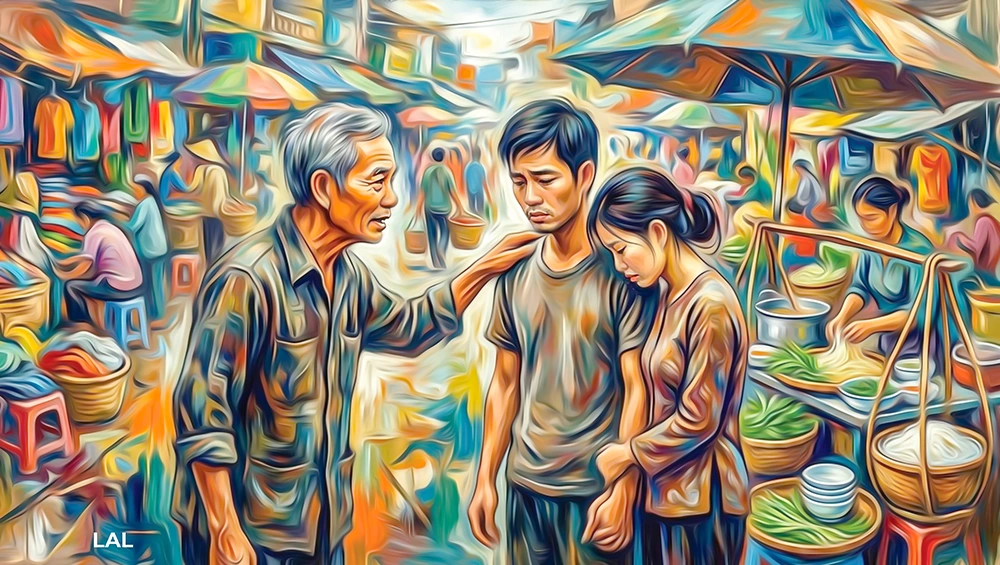
Hạnh's life was as sad as a traditional Vietnamese folk song. Hạnh had heard it many times, many people around her had said so. But if you asked why sadness was compared to a folk song, few could answer. Perhaps it was because folk songs are slow, because the melodies linger on as if unwilling to end, because each word uttered seemed to carry a lingering, unnameable sorrow.
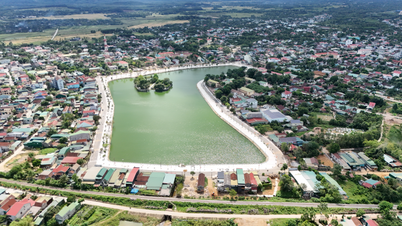
Hanh lived in a place with a strange name: Sweet Village. In the past, this place grew sugarcane. There was so much sugarcane that any family with a little capital would build a sugar-making furnace. The sugar had to be sweet, hence the name. Sweet Village nestled against a mountain. The mountain provided mushrooms, medicinal herbs, firewood, and other medicinal plants. The mountain was also a place where young men and women would meet.
Hạnh doesn't know when Ngọt village was founded. As she grew up, the village was already there, a part of her life. When Hạnh was little, the road to school ran along an irrigation canal. On the other side were sugarcane and rice fields. The small, yellow-painted school, with its old flame tree that blazed red every summer, was Hạnh's most beautiful memory. The sounds of laughter and fluttering white uniforms after school filled the air. Back then, Hạnh never imagined her life would later be intertwined with sadness.
Beautiful memories often fade quickly. When Hanh was in 10th grade, her father died in a construction accident. It rained on the day of the funeral. Hanh's mother collapsed to the ground, weeping until she had no more tears left. From then on, Hanh dropped out of school to help her mother with all sorts of jobs to support her younger siblings. Carrying rice, cutting sugarcane, weeding for hire – anything to get rice for the pot. At eighteen, Hanh got married. Her husband was Phong, her childhood friend. They addressed each other informally, using "you" and "me" (in a casual, informal way), and even after the wedding, they hadn't changed their way of addressing each other.
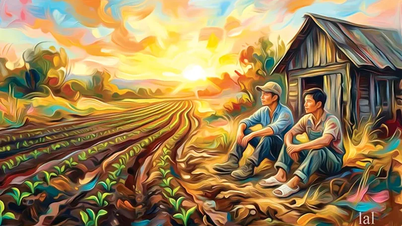
Actually, Hanh used to have different dreams. She used to think she would pass the university entrance exam and go to the city to study and build a career. But family circumstances pushed the city too far away. Far not just because of the dozens or hundreds of kilometers, but because of the distance of fate. So, a village boy marries a village girl. Have children, live on, like everyone else.
Phong worked as a forest foraging for medicinal herbs. It was a dangerous job, but Phong chose it because it allowed him to earn money faster than his family's fish farming. Sometimes he wouldn't return for a whole week, bringing money with him – sometimes not much, but often quite a lot. Then one day, Phong went into the forest and didn't come home. It was a stormy day. The rain poured down, and the wind howled as if it wanted to tear the mountains apart. People found Phong at the bottom of a deep ravine. He probably slipped and fell when the road collapsed. At that time, Hạnh was twenty-two years old.
After Phong's death, Hanh's father-in-law, Mr. Phan, asked Hanh to work at the family's fish farm. He renovated the house outside the farm for her, telling her to live there peacefully. The fish pond was at the end of the village, surrounded by tamarind trees, providing a cool and shady environment. Hanh felt sheltered by the love of her family, as if it were compensating for the loss of her father.
Mr. Phan also treated Hanh like his own daughter, as he had no other relatives and Hanh was the only remaining family link after his only son passed away. But Hanh's youth was still there, and he hoped she could find happiness and overcome her past sorrows.
Then Linh appeared. Linh came from Central Vietnam to help Mr. Phan with the technical aspects of caring for the koi fish. Linh was young, quick-witted, and always smiling. Since Linh arrived, the fish farm seemed brighter. Since Linh came, Hanh learned to look in the mirror longer and to comb her hair more neatly. They fell in love.
Mr. Phan simply observed in silence. He hoped Hanh would have a happier life, but he also feared losing another loved one. He also needed time to see if Linh was truly the one who could bring Hanh happiness.
And then Hanh left. That night, the sky was full of stars. Hanh opened the door very quietly. Linh was waiting at the edge of the village. Mr. Phan stood in the shadows watching her go. It was like watching another farewell to a loved one in his life, after his wife and son. He went to the pond and scattered food for the fish. He went back inside and found the letter. He picked it up and sighed softly.
***
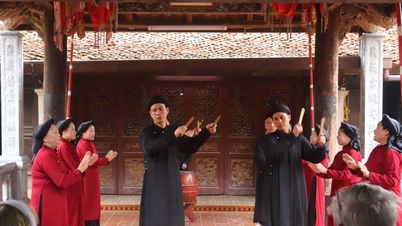
Mr. Phan sat listlessly for many nights, gazing at the dimly lit road. Somewhere in the village, the sounds of traditional folk songs still echoed. Mr. Phan waited for dawn, but the night was long and drawn out. In that darkness, old memories resurfaced one after another, uninvited. He remembered Phong as a child, a thin, sun-tanned boy, who at only ten years old would follow him to the fish pond. The boy was clumsy, often spilling food, and despite being scolded repeatedly, he would still smile.
Outside, the roosters were beginning to crow early. The night mist blanketed the fish pond. Mr. Phan resolutely stood up, put on his coat, and locked the door. The road leading out of Ngọt village appeared in the dim light. During the day, the road was unremarkable, still lined with winding trees, and each house still had its own bamboo fence. But for him, it was the road that had taken his closest relatives far away from him.
Arriving at the bus station, he asked for directions. People pointed the way. A bus headed towards the town. He boarded and sat in the back row. Through the window, the countryside receded, sugarcane and rice fields passing by. The bus stopped on a small street. Mr. Phan saw Hanh busy with her early morning noodle stall. She was thin, but her eyes no longer looked as sad as before. Linh stood beside her, constantly helping Hanh, looking awkward when she saw him.
Hạnh froze.
- Dad…
Just one word, and his throat tightened. He nodded, as if that alone was enough to confirm that the family bonds had never been broken.
Mr. Phan spoke first. His voice was hoarse, but slow:
- I didn't come to scold you. I was just worried that you might leave with a guilty conscience, which is why you didn't tell me. So I came here to explain everything to you and Linh...
Hanh bowed her head. Tears fell.
I'm sorry...
He shook his head.
- There's nothing to apologize for. I just wanted to say that if you and Linh need work, the fish farm is still there. The house is still there. But if you don't come back, I won't blame you.
Linh bowed her head very low.
Thank you, sir.
Mr. Phan looked at the young man. He saw in Linh the clear-headedness to choose a job that suited the circumstances. He breathed a sigh of relief, as if a heavy burden had been lifted from his chest. Hanh burst into tears.
On the bus ride home, he sat watching the scenery flash by. His heart felt empty, but no longer heavy. He knew he had just lost another loved one. But he also knew that this loss was to preserve something more important: the happiness of a young woman who had experienced so much misfortune.
Evening falls in Ngọt village. He returns to the fish farm. He scatters food into the pond. The fish splash, sending water flying. From afar, the sound of traditional Vietnamese folk music echoes again...
Short story: Khue Viet Truong
Source: https://baocantho.com.vn/dem-ay-troi-day-sao-a200407.html



![[Photo] General Secretary and President To Lam presides over a working session with the Central Policy and Strategy Committee on the development of the materials industry.](https://vphoto.vietnam.vn/thumb/1200x675/vietnam/resource/IMAGE/2026/05/21/1779359935432_a3-bnd-3129-1412-jpg.webp)




































































Comment (0)