

The doctor at the local hospital diagnosed me with an overactive bladder of unknown cause and recommended that I go to a higher-level facility for bladder pressure measurement.
What is this method, and how does it work? (Nguyen Van Trung, 56 years old, Vinh Long )
Reply:
Urodynamic monitoring, or urodynamic testing, is a test used to assess bladder function. This test measures the bladder's ability to hold and expel urine. It also helps check for leakage or incomplete emptying of the bladder.
Bladder pressure measurement is often performed when patients have urinary disorders, especially urinary incontinence; or urinary tract diseases in women due to age, pregnancy, childbirth and menopause, and in men with prostate disease, neurological or spinal problems.
Symptoms include urine leakage when coughing, sneezing, laughing, or exercising; frequent, sudden urge to urinate; nocturia (urination at night); incomplete bladder emptying; and recurrent urinary tract infections.
The test results can help your doctor determine the cause of your urinary symptoms and recommend the best course of treatment.
Patients need to refrain from urinating for one hour before the urodynamic test, but no fasting or dietary restrictions are required. The procedure takes approximately 30-45 minutes, is painless, only slightly uncomfortable. Patients can drive home immediately after the test is completed.
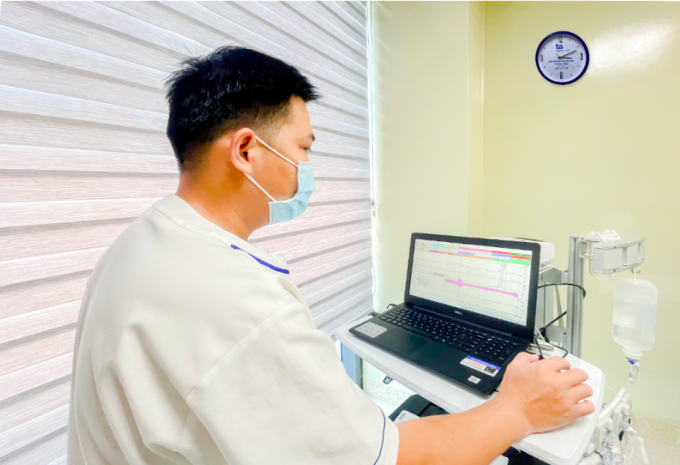
Urodynamic testing at Tam Anh General Hospital, Ho Chi Minh City. Photo: Anh Thu
To perform the test, the patient urinates in a special toilet bowl to measure the rate at which the bladder expels urine. The patient may also have an ultrasound after urination to assess the amount of residual urine.
The nurse inserts a sensor catheter into the bladder (through the urethra) to measure the pressure in the bladder as it fills with saline solution. Another sensor catheter is also inserted into the rectum (anus).
During this process, the patient is asked about bladder sensation and performs actions that trigger the problems they are experiencing, such as coughing or straining, to let healthcare staff know when their bladder is full.
Finally, the patient urinates again while the two sensors remain in the bladder and rectum, then the sensors are removed, completing the test.
Dr. Le Phuc Lien
Head of the Female Urology Unit, Center for Urology - Nephrology - Andrology
Tam Anh General Hospital, Ho Chi Minh City
Source link




![[Photo] General Secretary and President To Lam meets with National Assembly delegates from ethnic minorities.](https://vphoto.vietnam.vn/thumb/1200x675/vietnam/resource/IMAGE/2026/04/20/1776696701056_a1-bnd-8331-3342-jpg.webp)
![[Image] National Assembly discusses the implementation of the socio-economic development plan.](https://vphoto.vietnam.vn/thumb/1200x675/vietnam/resource/IMAGE/2026/04/20/1776696707422_ndo_br_img-20260420-185419-jpg.webp)
































































































Comment (0)