

After a period of crisis and reduced production in 2023, starting in March 2024, many textile and garment businesses in the province have received new orders. Some businesses even have enough orders to last until the end of the year. This is a positive sign, creating momentum for businesses to restore production and laying an important foundation for new development goals.

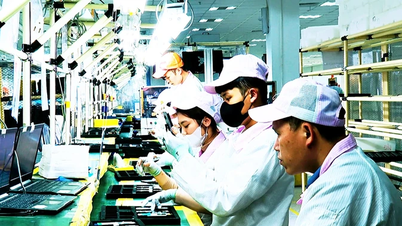
Workers at Hoa Tho Garment Company in Dong Ha produce products for export to the US market - Photo: ML
For more than half a month now, the atmosphere at the production workshops of Hoa Tho Garment Company in Dong Ha has been bustling and busy. The company's 1,200 workers are working at full capacity to complete the first two orders of the year.
According to Mr. Hoang Quang Trung, Chairman of the Trade Union of Hoa Tho Garment Company - Dong Ha, these two orders are for export to the US market. These are the largest orders the company has received in the last 5 years.
To ensure sufficient products for this order, all company workers will continuously produce from the beginning of March until the end of September 2024. In 2023, amidst the global economic crisis, the company's orders were mostly small-scale, meaning workers could only produce for 1-2 months before finishing them. Therefore, workers would quickly switch to working on another order, significantly impacting productivity.
In addition, the company also had to add or modify some machinery and equipment to suit the products of each order, which increased costs.
"The unique characteristic of the garment industry is that each worker is responsible for a specific stage of production. When they receive long-term orders, they become familiar with the process, repeatedly performing certain technical operations, resulting in higher labor productivity. Currently, the average income for workers is 7.2 million VND per person per month, but this could increase to 8-9 million VND per person per month in the future," Mr. Trung shared.
In Hai Lang district, these days, workers at the Phong Phu - Quang Tri Export Garment Factory in the Dien Sanh Industrial Cluster are also busy starting their shifts.
According to Mr. Le Nguyen Y, Chairman of the factory's grassroots trade union, the factory currently has "fully booked" orders to cover production until the end of the year. Based on the total number of products from these orders, the company needs to produce 180,000 - 220,000 products each month; however, the factory's workforce is currently only producing about 160,000 products.
The company currently has 850 workers and needs to recruit 300 more to meet production demands, but so far they haven't been able to recruit enough. "Currently, most of the company's workers are from Hai Lang district, so we hope that the recruitment information will reach a wider audience in the province to recruit more workers and meet production needs," Mr. Y shared.
According to the Provincial People's Committee's assessment, in 2023, the province had over 13 active garment enterprises employing nearly 6,000 workers; in addition, there were over 50 garment processing facilities with over 1,200 workers. Garment businesses have contributed to job creation, increased local budget revenue, and promoted the socio-economic development of the province.
In 2024, economic experts predict many positive signs for the recovery of the textile and garment industry, especially in traditional export markets. Vietnam is considered a safe destination, with continued domestic macroeconomic stability and projected higher growth than in 2023, creating new impetus for more orders to return to Vietnam.
However, because the majority of textile and garment businesses in the province still operate on a processing basis, lacking control over raw materials and design; and because supporting industries for this sector are underdeveloped, businesses face difficulties in supplying raw materials, auxiliary materials, equipment, and spare parts; and because there is a lack of incentive to attract investment and labor for the development of the textile and garment industry, thus failing to take advantage of the opportunities and potential offered by free trade agreements. Meanwhile, the global market remains highly volatile and unpredictable, and many challenges remain, so complacency is necessary. Solutions to enhance resilience and competitiveness in the market must continue.
According to Mr. Pham Van Trung, Head of the Industrial Management Department of the Department of Industry and Trade, to support textile and garment businesses in the area, the department is planning to organize a conference to meet and exchange directly with representatives of businesses operating in this field in order to understand their aspirations, difficulties, obstacles, and development orientations.
In implementing Decision No. 1643/QD-TTg of the Prime Minister approving the Strategy for the Development of Vietnam's Textile, Garment and Footwear Industry until 2030, with a vision to 2035, in the province, the Department will strengthen support for garment businesses in accessing potential customers through trade fairs, exhibitions, and investment promotion activities.
Promote the dissemination and raise awareness among businesses about the impact of free trade agreements in order to mitigate risks and maximize the benefits these agreements offer.
Strengthening the dissemination and consultation of international trade law, with a focus on rules of origin, trade defense, and sustainable development strategies for the textile and garment industry in foreign markets, will enable businesses to proactively develop business strategies and prepare the necessary equipment, management capabilities, and production capacity to achieve the highest productivity and quality, thus continuing to "catch the wave" of new orders.
Mai Lam
Source

![[Photo] Prime Minister Pham Minh Chinh presides over a meeting on private sector economic development.](/_next/image?url=https%3A%2F%2Fvphoto.vietnam.vn%2Fthumb%2F1200x675%2Fvietnam%2Fresource%2FIMAGE%2F2025%2F12%2F20%2F1766237501876_thiet-ke-chua-co-ten-40-png.webp&w=3840&q=75)














































































Comment (0)