

According to Minister Nguyen Manh Hung, innovation means businesses focus on digital transformation to become digital businesses, while the government focuses on building institutions to accept disruptive new technologies.


Minister Nguyen Manh Hung
Innovation must always begin with awareness and mindset. To better understand innovation, this concept will be discussed from several different perspectives.
The Japanese have referred to Society 5.0. Society 1.0 was hunting and nomadic. Society 2.0 was agriculture and settled farming. Society 3.0 was industrial society. Society 4.0 was information society. Society 5.0 is smart society. Now, everything, every field, needs to be smart. Innovation in businesses can be understood as using technology, primarily digital technology, to automate and smarten the entire production and business process, from management to production and sales. With this approach, the most important keyword is: Smarter and continuously smarter in all activities, and the most important tool to help this process is technology, especially digital technology, Industry 4.0.
A revolution is happening, and then the future will no longer lie on the extended path of the past. Innovation is happening right now. Old infrastructure, old ways of doing things, old knowledge, old products, old business models are no longer suitable. We need new infrastructure, new ways of doing things, new knowledge, new products, new business models.

Many things simply reverse the process. Previously, the focus was on avoiding mistakes; now, mistakes are made faster and more cheaply. Previously, learning came before doing; now, doing comes before learning, because the new thing isn't yet available, so learning is impossible, only experimentation. Previously, the focus was on getting the job done first and then finding the right people; now, the focus is on finding the right people first before deciding what to do, because the new task requires people who share a passion for discovery . Previously, the strength of a business lay in its large workforce; now, the strength lies in a smaller workforce to react quickly and move swiftly. With this approach, the most important thing for CEOs is to find new approaches in all aspects of their company's production and business operations.
A successful company, often at the top, frequently collapses when disruptive new technologies emerge. The typical collapse process is as follows: Step 1: Successful companies develop the first disruptive technologies. Step 2: Marketing teams gauge the reaction of key customers to the new technology, and if they don't receive support, as existing products remain effective and familiar, the successful companies shift their focus to developing technologies that maintain and improve existing products, enhancing performance and increasing revenue and profits. Step 4: New companies are established based on the disruptive new technology and must explore new markets and customers, often those in the lower tiers, through trial and error. From this, a series of new, impactful applications and products are developed. Step 5: These new companies enter the market and move towards higher-end segments. Step 6: Successful companies enter the market too late and are unable to retain their core customers, leading to a shift in market dynamics.
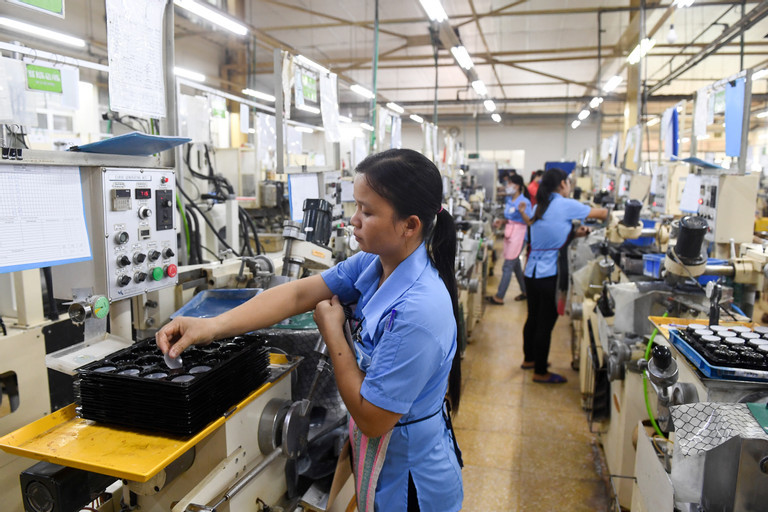
Photo: Hoang Ha
Thus, innovation often creates opportunities for new companies with disruptive new technologies. From this perspective, large and successful companies have fatal flaws, creating opportunities for new, small companies, opportunities for unknown companies to rise to the top, but which must rely on disruptive new technologies, and move from new markets to overthrow existing traditional markets. 
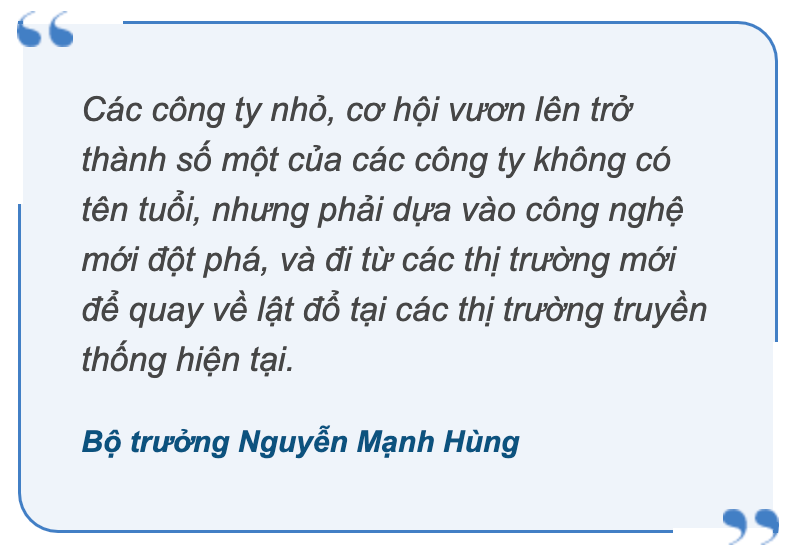
So, are there ways for large, successful companies to handle this situation? Basically, there are three approaches. First, promote emerging technologies and markets, so they become large enough and fast enough to contribute to company growth. Second, wait until the new market and technology are more clearly defined and enter when they are large enough and attractive enough. Third, entrust the commercialization of the disruptive technology to new, small enough departments whose business performance depends solely on the new technology and market. However, these new departments must operate according to new processes and values to solve new problems. Studies show that the third approach is more promising. The first is less likely to succeed because new technologies and markets don't create explosive growth in the short term. The second approach is too late. From this perspective, large, successful companies still have the opportunity to survive and grow, but they must split themselves into two independent organizations with two different operating methods and two different cultures. And that is not an easy task.
Innovation demands change, but the very mechanisms, processes, and values through which a company creates value and achieves success are the enemies of change. An organization's capabilities comprise three elements: resources, processes, and values. All three, when a company is large and successful, tend to be persistent. Therefore, an organization's capabilities also determine its shortcomings. The task for CEOs is to resolve this conflict when innovation is required. CEOs have three options: First, acquire a company with processes and values that align with the new mission. Second, attempt to change the existing processes and values of the organization. Third, create an independent department and develop new processes and values to meet the new requirements. From this perspective, large, successful companies face a significant challenge when it comes to innovation.
What does innovation look like from the perspective of the digital economy?
The digital economy encompasses economic activities that utilize digital information and knowledge as primary factors of production; use the internet and information networks as operational spaces; and employ ICT, i.e., telecommunications and information technology, to increase labor productivity and optimize the economy. Simply put, it's an economy connected to digital technology. The digital economy is a long-term evolutionary process, a national-level digital transformation. To varying degrees, every sector, every business, and every individual can utilize digital technology to improve their work, even achieving breakthroughs to fundamentally change the quality of their work.

The fastest way to accelerate the digital economy is to use digital technology to change the way we produce and work. Using cameras to reduce the need for security guards is an example of the digital economy. Automatically watering plants when the soil is dry is also an example of the digital economy. Using electronic documents instead of paper documents is also a way to digitize the economy. Who will do this? It's the digital technology businesses. Therefore, we must start digital technology startups and develop Vietnamese digital technology businesses. We must use digital technology to solve Vietnamese problems, Vietnamese challenges, and from this Vietnamese cradle, these technology businesses will go global. Technology is created to solve problems; wherever there is a problem, there is technology, there is a solution. Problems exist everywhere, perhaps even in our daily work, and each of us can start a technology business to solve our own problems. A nationwide revolution in digital technology startups and the popularization of digital technology will help Vietnam digitize its economy very quickly.
Digital technology will give rise to new business models, new challenges, or replace old business models. For example, Uber challenges taxis. Fintech challenges traditional banks. Mobile Money, a payment system for small-value goods, will solve the problem of cashless payments for 100% of the population, but it also challenges banks. The question for the government is whether it dares to accept these new business models. If it dares to accept them but is the last to do so, it won't be of much value.
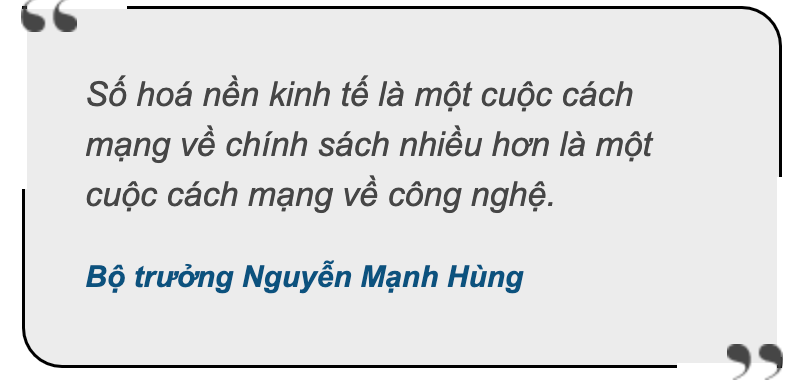
Therefore, many people say that the digitalization of the economy is more of a policy revolution than a technological revolution. First, we must accept new business models and new technologies that fundamentally change industries, often involving disruptive innovation. If we accept the new, new technologies from around the world will come, global talent will return, new industries will emerge, and Vietnam will become a cradle for producing exportable digital technology products. But this acceptance must be early, earlier than others. Following behind or alongside others will not give us a chance to change Vietnam's ranking. When we accept the new, we may lose some things. But we don't have too much to lose; that is our opportunity.
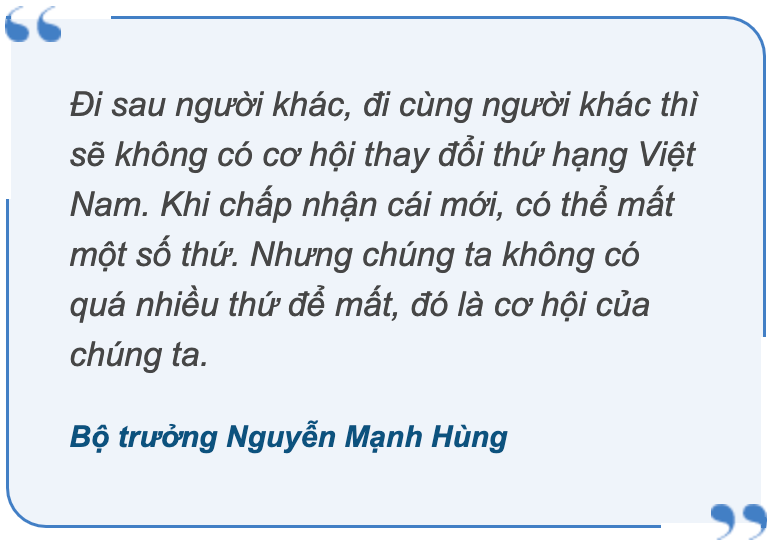
Thus, from the perspective of the digital economy, or digital transformation, innovation means: Businesses focus on digital transformation to become digital businesses, while the government focuses on building institutions to accept new business models and disruptive new technologies.
The challenges of innovation are always immense. But the opportunities for developing countries like ours are even greater. This is also an opportunity for Vietnam to change its ranking and become a developed country by 2045. Each business has its own approach to innovation to develop its own enterprise and contribute to the development of the country.
Vietnamnet.vn
![[Image] Nearly 125,000 Hanoi students completed the Literature exam for the 10th grade entrance exam.](https://vphoto.vietnam.vn/thumb/1200x675/vietnam/resource/IMAGE/2026/05/30/1780117233041_ndo_br_thiet-ke-chua-co-ten-2-png.webp)


































































































Comment (0)