

In her article "President Ho Chi Minh and the Liberation of the South and the Unification of the Country," Associate Professor Dr. Tran Thi Minh Tuyet emphasizes: "In Ho Chi Minh's thought , national independence is a sacred and inviolable right, but true independence must necessarily be linked to unity and territorial integrity. This is a matter of principle, so in President Ho Chi Minh, the will to protect national independence always went hand in hand with the will to fight for national unification."
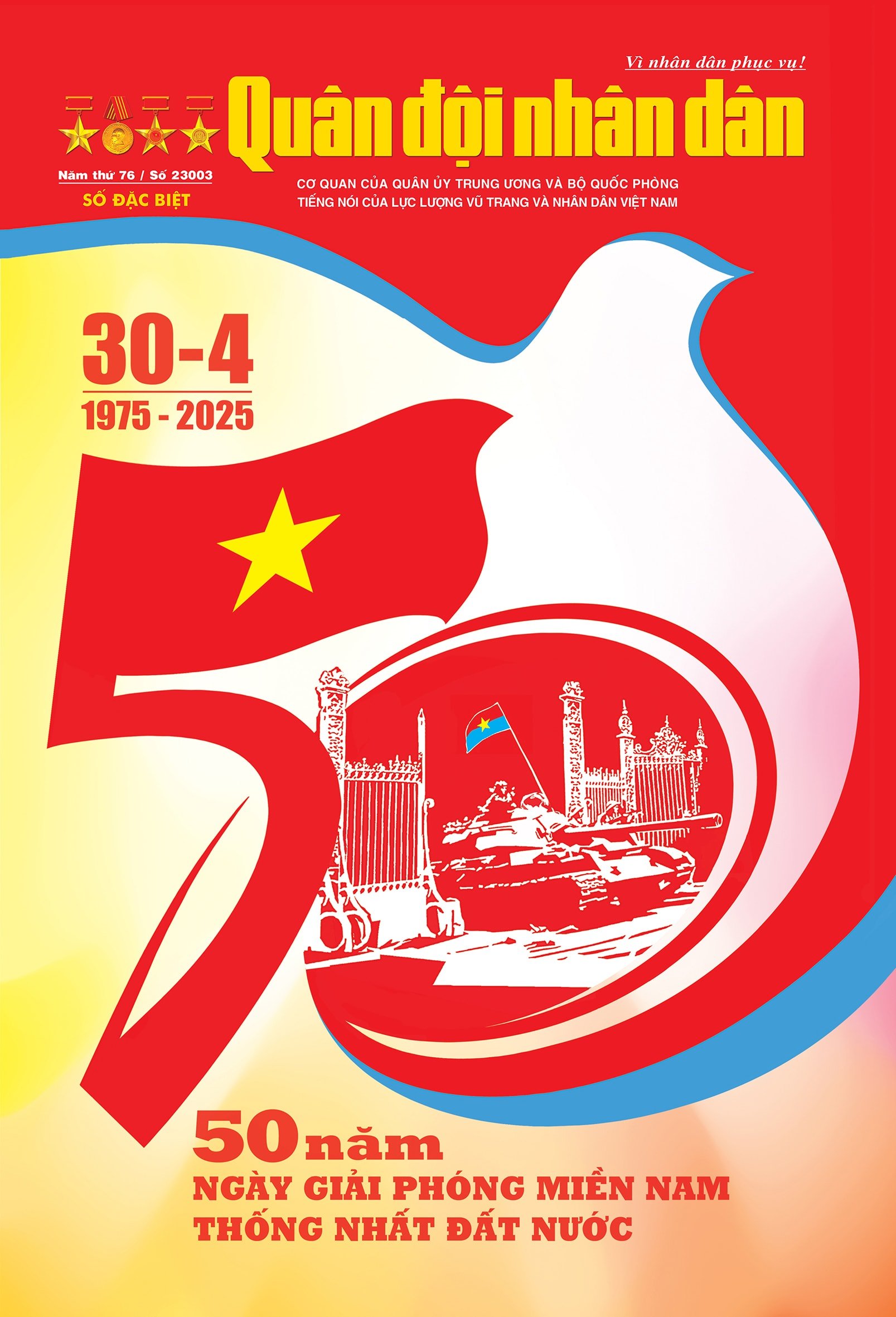
Assessing the significance and lessons of the Victory of April 30, 1975, this publication introduces the article "The Great Victory of Spring 1975 - Lessons for the Cause of Building the Army, Strengthening National Defense, and Protecting the Fatherland in the New Situation" by General, Dr. Phan Van Giang, Member of the Politburo , Deputy Secretary of the Central Military Commission, and Minister of National Defense . According to Minister Phan Van Giang, in the current context, the lessons of the Great Victory of Spring 1975 remain valuable and need to be continuously studied, inherited, and creatively applied to the practical aspects of building the Army, strengthening national defense, and protecting the Fatherland in the new situation.
 |
Referring to the need to leverage national strength alongside the strength of the times to enhance Vietnam's position, Ms. Ton Nu Thi Ninh (Chairwoman of the Ho Chi Minh City Peace and Development Fund) stated: The negotiation and signing process of the Paris Agreement in 1973 left us with many profound lessons of great significance in the current situation, including the lesson of promoting national unity and international solidarity.
The special issue is dominated by stories and memories recounted by those involved. One such story is "The Story of the 11 Girls of the Perfume River," about the night of February 11, 1968, when 11 guns, burning with hatred, fired accurate volleys at the enemy formation, taking down 25 leading soldiers and holding back an entire battalion of American troops.
Readers are familiar with the image of the heroic self-sacrifice of People's Armed Forces Hero Doan Duc Thai (271st Regiment) in the article "Determined to die by the eighth barrier". As the demolition team successively breached seven layers of enemy barricades, upon reaching the eighth, Doan Duc Thai decided to cling to the explosive charge to prevent it from rolling down the slope, then used his hand to pull the trigger. The flash of fire from the 1-meter-long explosive cleared the barricade, allowing his comrades to charge forward, while his body dissolved into the earth...
"Entering the Independence Palace with his shirt still stained with blood" is the image of Political Commissar Nguyen Huu Cu of Battalion 1, 203rd Tank Brigade. He recounts instances of being wounded but still fighting alongside his comrades; and the memories surrounding a black-and-white photograph taken of him by a foreign journalist on April 30, 1975, at the Independence Palace. It shows a gaunt, haggard face, with traces of blood still visible on his head and arm.
In "The Epic of the Suicide Ferry," People's Armed Forces Hero Nguyen Dang Che, former Head of the Ben Thuy Ferry, recounts the final days of 1972 when he and four comrades volunteered for a suicide ferry mission to defuse 48 magnetic bombs beneath the Lam River. The departure ceremony was also a "living funeral" held for him and his comrades...
Colonel Nguyen Van Trinh, former Deputy Brigade Commander and Chief of Staff of the 550th Engineering Brigade, recounted his participation in three offensive battles to liberate urban areas at all three levels. His combat career included numerous injuries, but he did not apply for the war invalid status, following the advice of a superior officer: "We are commanders, and as long as we can command the troops, we shouldn't worry about minor injuries."
Associate Professor, Dr. Pham Thanh Hung wrote an article titled "The First Night of Peace, Hanoi Doesn't Sleep!". The author was a student who enlisted in the 308th Division in 1973. Due to injuries, he was discharged and returned to university to continue his studies. More than 10 wounded soldiers from the Literature class shared a room in the dormitory to help each other. On the night of April 30, 1975, the entire "wounded soldiers' room" helped each other walk to Hoan Kiem Lake to celebrate the victory. "The road from the dormitory to Hoan Kiem Lake was 12km long, but at that moment, it still felt short to us. The wounded soldiers, using crutches, trudged along with the group, not needing to be carried. They had carried backpacks, waded through streams, climbed mountains, and crossed the Truong Son Mountains for thousands of kilometers just to have this stretch of road to celebrate the victory. A few kilometers on paved road was nothing compared to that."
The publication also highlights the significant contributions of a team that simultaneously wielded pens and fought with weapons. These include writer and martyr Dương Thị Xuân Quý – a symbol of noble ideals; and journalist Trần Mai Hưởng, who captured the historic photograph "Liberation Army tanks entering the Independence Palace on the afternoon of April 30, 1975"... In the article "Thạch Kim, Thạch Nhọn," readers learn about the real-life inspiration for the character in the poem "To You, Young Volunteer" by poet Phạm Tiến Duật. Besides the memory of almost being disciplined on the Đồng Lộc battlefield for "daring to lie and say Thạch Kim was Thạch Nhọn," former volunteer Lê Thị Nhị also recounts her visit to Hanoi to see poet Phạm Tiến Duật while he was in the hospital; when Phạm Tiến Duật passed away, she packed her bags and went to Hanoi, standing among the mourners with tears in her eyes. Her heart ached as she bid farewell to a close friend, a part of her heroic youth's memories...
This special edition also includes notes, interviews, essays, photographs, and documents from authors who are generals, experts, writers, journalists, and musicians; as well as collaborative articles from authors both domestically and internationally.
The special edition of the People's Army Newspaper, comprising 100 pages, features rich content and a beautiful presentation. Priced at 4,200 VND, it will be published on April 28, 2025. Readers are invited to purchase it at post offices or newspaper distribution agents nationwide.
People's Army
* Please visit the Culture section to view related news and articles.
Source: https://baodaknong.vn/don-doc-bao-quan-doi-nhan-dan-so-dac-biet-so-23003-phat-hanh-ngay-28-4-2025-250506.html















































Comment (0)