

From March 1st, 2025, the Lang Son Provincial Police officially assumed the function of state management regarding drug addiction treatment and post-treatment management. Despite this new responsibility, officers and soldiers quickly overcame difficulties, adapted to the task, and implemented it. Simultaneously, they learned from existing civil servants, officials, and contract workers to ensure that the management, education , care, and treatment of trainees were not interrupted, thus maintaining the effectiveness of the treatment and the trainees' psychological well-being.
Upon initial enrollment, the facility had 380 trainees. On November 14th, an additional 127 trainees were admitted, and many have since completed their rehabilitation program and reintegrated into the community. The facility currently houses 323 trainees, the majority of whom are of working age.
Lieutenant Colonel Dinh Van Hanh, Deputy Head of the Lang Son Provincial Drug Rehabilitation Center, said: "In the early days of receiving the patients, we faced many difficulties, including a shortage of staff, facilities built in 2011, healthcare issues, and a large number of trainees suffering from underlying medical conditions, weak health, and low morale, requiring examinations, detoxification, and withdrawal treatment before starting therapeutic work..."
Furthermore, trainees still follow old habits, with many exhibiting non-compliance, even resistance, procrastination, laziness, and factionalism. Trainees with HIV/AIDS, who require ARV treatment, lack separate living quarters and therefore continue to live together, posing a high risk of transmission.
Lieutenant Colonel Vu Van Cuong, Deputy Head of the facility in charge of healthcare, said: “I, along with two female nurses from the Provincial Police Clinic, were assigned here. Initially, we were quite unfamiliar with the environment, but we quickly adapted and performed our duties well. I advised the unit's leadership to propose to higher authorities the provision of additional medical equipment and supplies, and supplementary medication to ensure the fulfillment of assigned functions and tasks; and I coordinated with the Cao Loc Regional Health Center to conduct health check-ups and screenings for all trainees.”
To stabilize the situation, the facility quickly established new rules and regulations regarding etiquette, signals, time, order, internal affairs, meals, accommodation, and prohibited behaviors; resolutely documented violations by trainees using mobile phones and alcohol, organized training sessions for trainees on rules and regulations, and tightened discipline and order.
NTNN trainee, born in 1995, shared: “My second time entering the rehabilitation center was also when the police officers took over. We felt a greater sense of seriousness and systematic approach, from the new regulations to the evaluation of learning outcomes, rewards, and disciplinary actions. This helped trainees significantly change their attitudes and perceptions, voluntarily comply with the rules and regulations, and determinedly quit drugs so that they could reintegrate into society and rebuild their lives.”
After stabilizing its organization, the facility prepared for trainees nearing completion of their addiction treatment program to reintegrate into the community. At the end of July, the facility collaborated with the Employment Service Center (under the Department of Internal Affairs) to provide legal and policy counseling, vocational training advice, and job placement services for 40 trainees preparing for community reintegration.
This is the first program since the Drug Crime Investigation Police Department and the Center signed a cooperation agreement. Trainees are educated on the Party's guidelines, policies, and the State's laws on drug prevention and control; they are also advised and introduced to jobs suitable to their health, educational level, professional skills, and age.
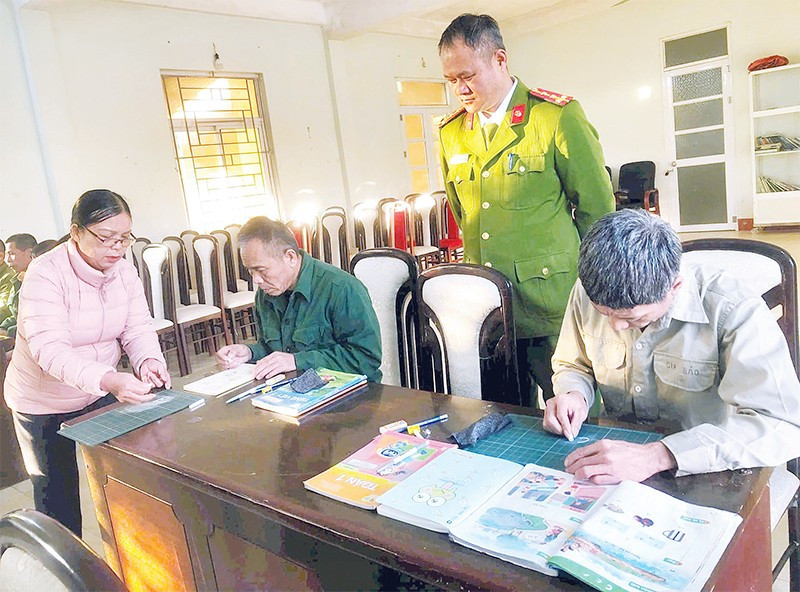
In accordance with the Ministry of Public Security's Decision on the training and development program for drug addicts and the Provincial Police's plan to improve the cultural level of trainees undergoing rehabilitation, in mid-November, the facility, in coordination with Tan Doan Primary School, organized the opening of a literacy class. This class equips trainees with the most basic cultural knowledge, such as reading and writing Vietnamese, performing basic calculations, cultivating a learning mindset, reinforcing discipline, and helping trainees regain their cognitive abilities.
NVC trainee, born in 1977, said after completing the course: “Before, I only finished the second grade. After three months, I know how to write my name and do addition and subtraction. Besides working and receiving therapy at the wooden mat weaving workshop, the class time is my most relaxed time.”
In addition to effectively managing withdrawal symptoms, rehabilitation, and providing labor therapy and ensuring safety and security, the Provincial Drug Rehabilitation Center also excels in basic professional work, preventing violations of the law early and proactively. The center distributes forms for reporting crimes and violations of regulations both inside and outside the facility.
As a result, from 60 pieces of information about drug addicts and drug users in the community and 42 pieces of information about individuals organizing the illegal buying, selling, and use of drugs, the facility promptly reported and proposed to the leaders of the Drug Crime Investigation Department of the Provincial Police to exchange information and transfer files and documents to professional teams and commune police for verification, handling, and prosecution of 20 individuals.
Source: https://nhandan.vn/dong-hanh-kien-tao-tuong-lai-cung-hoc-vien-cai-nghien-ma-tuy-post931635.html


![[Photo] Prime Minister Pham Minh Chinh attends the Conference on the Implementation of Tasks for 2026 of the Industry and Trade Sector](/_next/image?url=https%3A%2F%2Fvphoto.vietnam.vn%2Fthumb%2F1200x675%2Fvietnam%2Fresource%2FIMAGE%2F2025%2F12%2F19%2F1766159500458_ndo_br_shared31-jpg.webp&w=3840&q=75)







![[Photo] Prime Minister Pham Minh Chinh attends the Conference on the Implementation of Tasks for 2026 of the Industry and Trade Sector](https://vphoto.vietnam.vn/thumb/402x226/vietnam/resource/IMAGE/2025/12/19/1766159500458_ndo_br_shared31-jpg.webp)



















































Comment (0)