

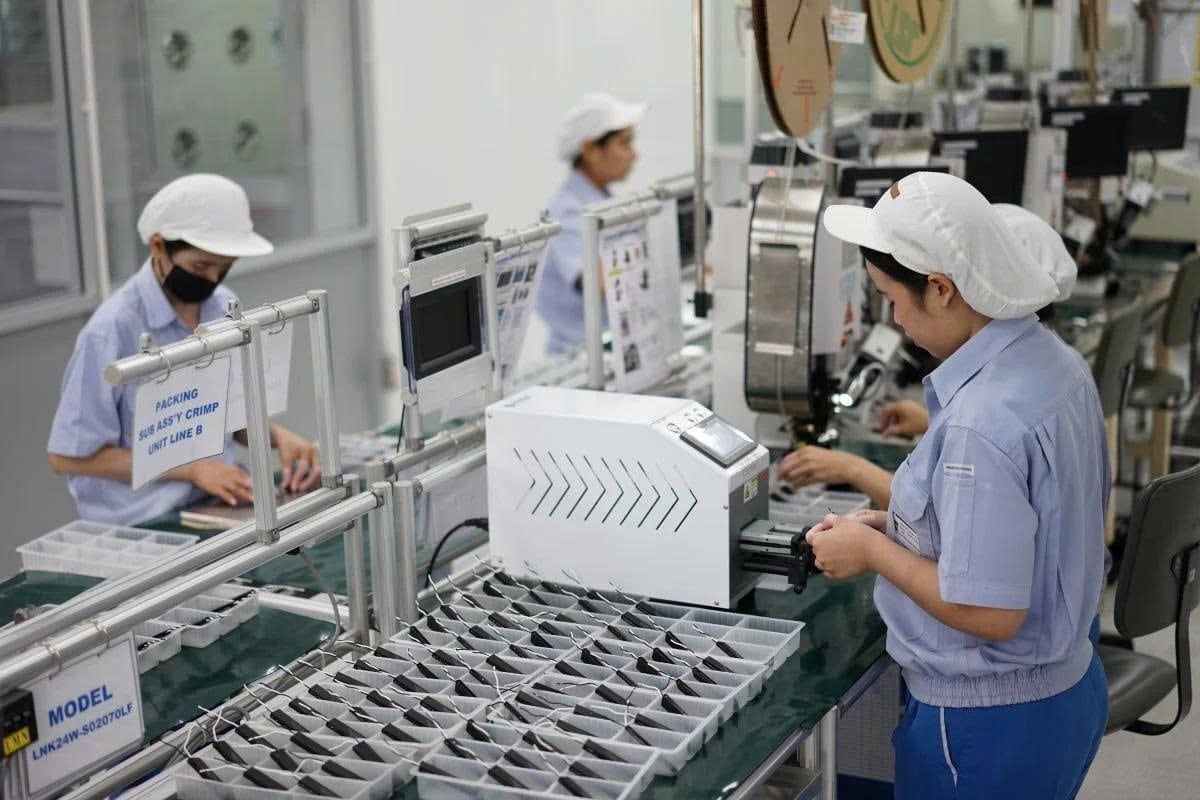
Ideal destination
For decades, Japanese "mid-sized" companies built their businesses on a stable domestic market. Now, facing a declining population, labor shortages, and slowing domestic growth, many Japanese companies are looking overseas. Southeast Asia has become an attractive destination.
The Business Times cited a survey by the Japan External Trade Organization (JETRO), which found that nearly 44% of companies affiliated with Japan currently operating in Asia and Oceania plan to expand their operations. Yusuke Ojima, Head of Southeast Asia at Nihon M&A Center Holdings, commented that countries in this region are attracting attention in Japan's wave of "capital exports."
Southeast Asia (a market of approximately 700 million consumers) remains highly attractive due to its many growth drivers that Japan currently lacks, such as a growing population, strong digital adoption, rapid urbanization, an increasingly affluent middle class, and growing demand for finished goods from Japan.
Meanwhile, Southeast Asian economies have benefited from Japan's continued FDI, which has led to technology transfer and skills uplift across the region.
“I think Southeast Asia continues to stand out for a few pretty clear reasons. The region has a convergence of growing consumer demand, the ability to diversify supply chains, and relatively strong regional connectivity,” Yusuke Ojima told Business Times .
According to data from the ASEAN Secretariat, bilateral trade between Japan and Southeast Asia is expected to reach approximately US$236 billion in 2024. In addition, Japanese FDI into the region has increased by 20% from 2023 to 2024, reaching US$17.5 billion.
Although official trade figures for 2025 are not yet finalized, Mr. Ojima predicts investment momentum will remain strong amid growing interest from Japanese corporations in Southeast Asia. Through investments, joint ventures, and strategic mergers/acquisitions, Japanese "mid-sized" companies are targeting markets such as Vietnam, Malaysia, and Thailand to drive regional growth.
"Mid-sized" companies (often referred to as Chuken Kigyo), or small and medium-sized enterprises (Chusho Kigyo), form the backbone of the Japanese economy, accounting for approximately 99% of all businesses and about 55% of the total value added in the country's manufacturing sector, according to Worldfolio. Many of them specialize in the B2B sector (companies providing products/services to other companies/organizations), dominating global segments in advanced manufacturing, components, materials, and automation.
Multi-market strategy
Another major attraction for Japanese companies is that Southeast Asia is not a homogeneous market, but rather a collection of highly diverse economies with different strengths and roles. Therefore, companies can structure their regional footprint according to their strategic priorities.
Business Times cites that Singapore is often used as a regional headquarters while markets such as Vietnam, Thailand, Indonesia, and Malaysia serve as manufacturing hubs. This structural flexibility is increasingly valuable in today's uncertain economic environment, as businesses strive to balance cost efficiency with supply chain resilience.
Japanese chemical and biotechnology group Kaneka, with its regional headquarters in Singapore, continues to expand its reach across Southeast Asia by leveraging its diversified business segments.
In Vietnam, the group operates three plants focused on the production and marketing of medical equipment, spices, and PVC compounds. In Thailand, Kaneka's two plants produce and market expandable plastics and PVC compounds. Meanwhile, its food production division in Indonesia focuses on the production and marketing of processed oil products.
The Japanese engineering giant Kraftia manages its energy construction business in Southeast Asia through its regional headquarters in Singapore. With operations in Vietnam, Thailand, and Indonesia, Kraftia provides turnkey design and construction services to support its clients' regional expansion.
Source: https://baodanang.vn/dong-nam-a-diem-den-hap-dan-voi-cong-ty-nhat-ban-3338478.html
![[Image] Nearly 125,000 Hanoi students completed the Literature exam for the 10th grade entrance exam.](https://vphoto.vietnam.vn/thumb/1200x675/vietnam/resource/IMAGE/2026/05/30/1780117233041_ndo_br_thiet-ke-chua-co-ten-2-png.webp)



























































































Comment (0)