

The "backbone" of science and technology: digital transformation.
The resolution clearly states that developing human resources and fostering culture truly becomes the spiritual foundation, intrinsic strength, and a tremendous driving force for the rapid and sustainable development of the country. This once again affirms the importance of training high-quality human resources in the new era. The importance of high-quality human resources has also been emphasized by the Party and Government in many different documents and policies. For example, Resolution No. 71-NQ/TW of the Politburo on breakthroughs in education and training development, issued in August 2025, emphasizes the goal that by 2030, the percentage of people studying basic sciences, engineering, and technology will reach at least 35%. This is a fundamental orientation to create human resources in science and technology, which is the "backbone" of the national digital transformation and innovation process.

Vingroup will train 20,000 talented individuals at VinUni University and provide them with practical experience within the group's ecosystem.
PHOTO: VG
Assessing the role of human resources, Mr. Vu Hoang Lien, a science and technology expert and Chairman of the Vietnam Internet Association, said that from a classical socio-economic theory perspective, the workforce is inseparable from the productive forces. In the context of Vietnam defining a new growth model with science and technology and digital transformation as its main drivers, the role of human resources becomes even more crucial, especially high-quality human resources. Previously, Vietnam started as a purely agricultural country, gradually developing industry but still on a small scale, so the workforce was mainly large in number and unskilled; now, to develop science and technology, a high-quality workforce is essential.
"To become a developed country, a high-income country, Vietnam has determined that it must develop a knowledge-based economy, science and technology, and innovation. And for science and technology in general to develop, with a focus on semiconductor chips, artificial intelligence (AI), and knowledge, it is especially important to have a suitable workforce. It can be said that a high-quality workforce is essential for developing high-tech, core technologies, and depth for the economy; this will pave the way for other technology sectors and act as a leverage for many economic fields in general. In other words, a high-quality workforce will be the leverage to create breakthroughs in the development of science and technology in particular and the Vietnamese economy in general. In the past, the government has had programs to promote the training of high-quality human resources, but it is still insufficient and needs to be further strengthened to meet the development needs of the new era," Mr. Vu Hoang Lien shared.
Tasks and fundamental solutions for building and training human resources.
The goal by 2030 is to build and train human resources, especially high-quality human resources, to meet the requirements of Vietnam becoming a developing country with modern industry and high middle income. The task is to fundamentally reform the mechanisms and policies for finance and investment in education and training. State budget expenditure on education and training should reach at least 20% of total state budget expenditure, with investment expenditure reaching at least 5% of total state budget expenditure and expenditure on higher education reaching at least 3% of total state budget expenditure. The principle of developing and implementing a new National Target Program on modernization and improvement of the quality of education and training for the period 2026-2035 should be agreed upon; prioritizing investment in higher education…
Resolution No. 71-NQ/TW of the Politburo on breakthroughs in the development of education and training.
According to Dr. Duong Nhu Hung, Head of the Industrial Management Department at Ho Chi Minh City University of Technology, Vietnam's GDP growth in recent years has been primarily based on capital and labor, not productivity. While this extensive growth approach may create a large scale, its impact on the economy is not substantial and it's difficult to achieve long-term sustainability. For example, if a garment worker previously produced 100 shirts per day, now with the help of machinery, they can produce 200 shirts per day – this is only an increase in quantity. Currently, these activities create jobs for millions of workers; but in just 10-20 years, with the rapid development of robots, those millions of workers could be completely replaced in an instant. Therefore, to become a developed country with a high average income, Vietnam must focus on qualitative growth rather than quantitative growth. There, labor productivity must be increased through a knowledge-based approach, focusing on depth rather than simply changing equipment and machinery. Therefore, Vietnam must take control of education and training, developing high-quality human resources to meet the demands of development under the new growth model.
Businesses are actively involved in human resource training.
From the perspective of government incentive policies, a number of businesses have recently taken the initiative to participate in training high-quality human resources. Four days ago, Vingroup announced the launch of a large-scale practical AI training program for employees and talents, officially enrolling its first cohort at VinUni University early this year. The program will continue to expand and continuously enroll subsequent cohorts, aiming to train up to 20,000 students within the next two years. Students will not only receive free training but also a monthly allowance of 8 million VND throughout their studies. Through VinUni University and technology companies within its ecosystem, Vingroup will build a streamlined, efficient, and practical training program that focuses on solving real-world problems, ensuring that each student, upon completion of the course, will possess the necessary skills to continue developing and contributing more to society. This is just one of the latest programs implemented through VinUni University, a school founded by Vingroup in 2018 that has become a leading provider of high-quality human resources for the entire country.
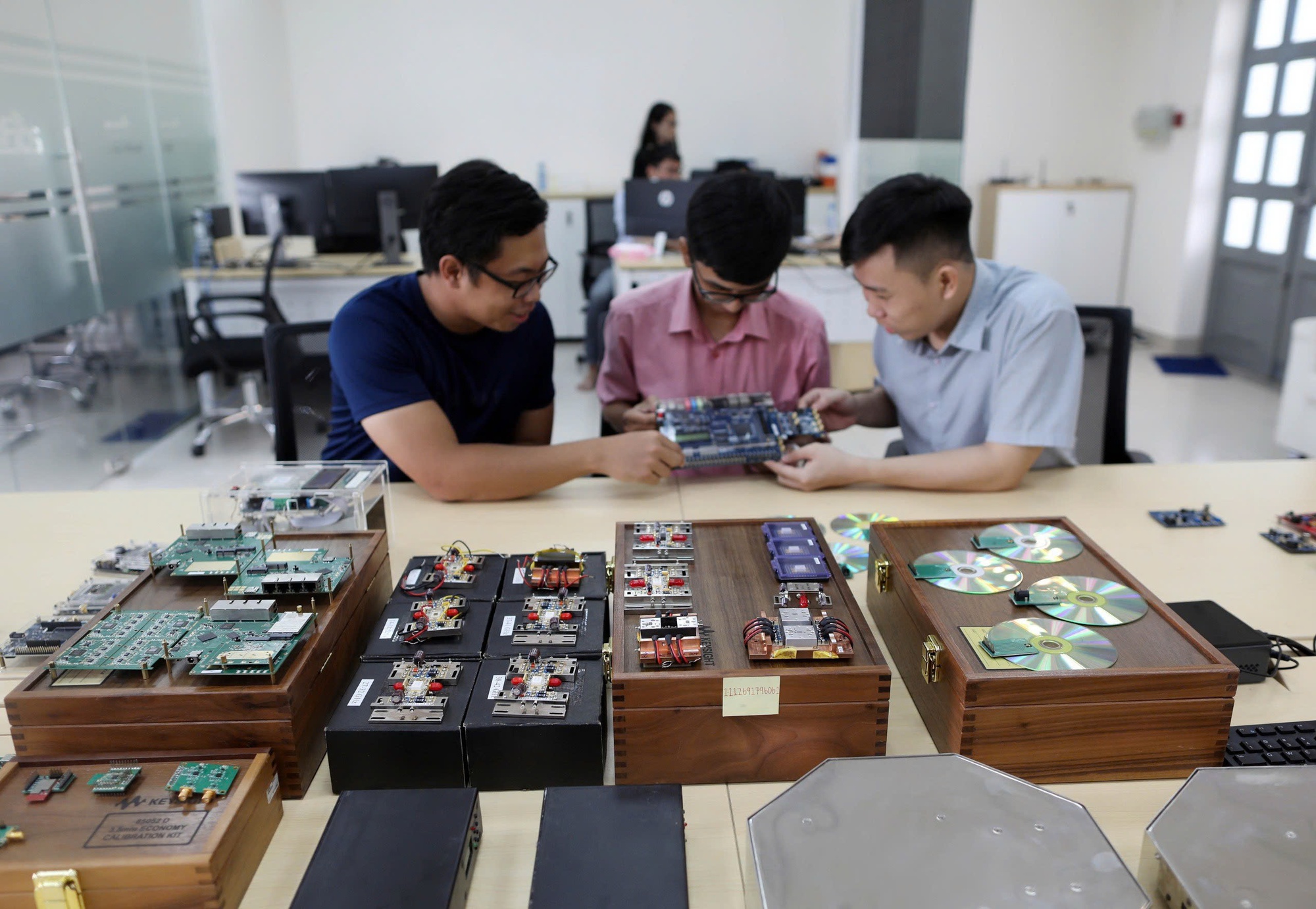
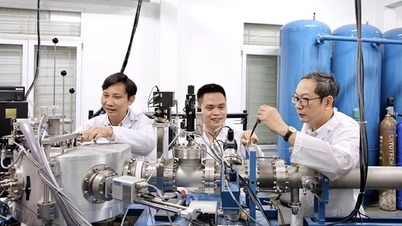
Training and developing high-quality human resources creates the "backbone" of the science and technology sector. Pictured is the microchip and high-frequency system laboratory at Ho Chi Minh City University of Technology.
PHOTO: NGOC DUONG
One of the earliest businesses to enter the field of training is FPT Group. Twenty years ago, the Group established FPT University, a pioneer in Vietnam in training in information technology fields, from AI, information security, software engineering, semiconductor integrated circuit design, with programs closely aligned with business needs and international standards. Also participating in promoting human resource training for science and technology is CMC Group, with CMC University since 2022, positioned as a university of technology and innovation, aiming to train high-quality human resources to serve digital transformation and the digital economy; collaborating on research and academics in cutting-edge fields such as AI, Big Data, integrated circuits - semiconductors, AI applications…
We need to open up mechanisms to allow officials such as university lecturers to participate more deeply in the activities of external business organizations. Knowledge from universities will flow more into the business community, and businesses will absorb the practical experience directly from the training and teaching process in universities. This is the potential to increase the knowledge content and labor productivity of future generations.
Dr. Duong Nhu Hung , Head of the Department of Industrial Management, Ho Chi Minh City University of Technology
Numerous other businesses are also collaborating to promote training. For example, VNG Group continuously cooperates with major universities to jointly improve the quality of training and teaching, support available resources to create learning and application opportunities for students, and empower students at different stages. In 2025, VNG Group and the Vietnam National University Ho Chi Minh City officially launched the Saigon AI Hub at VNG Campus. This is the first open AI research space in Ho Chi Minh City, focusing on solving socio-economic development problems through AI, especially in key areas such as healthcare, education, and transportation. VNG also collaborated with the University of Information Technology (Vietnam National University Ho Chi Minh City) to organize the 2025 Co-training Project for the course "Developing Game Programming Skills for Practical Application" at VNG Campus. This is a pioneering training model that "brings the classroom into the enterprise," where learning and practical activities are conducted right at VNG Campus, helping students access the corporate work environment, project implementation processes, and teamwork methods in game development…
According to Mr. Le Hong Minh, Chairman of the Board of Directors of VNG, for the corporation, training is not just about imparting knowledge but also about linking it to output and the long-term development of the industry. Therefore, in the coming time, the company will continue to seek ways to expand this model, as well as gradually build a support platform so that students can go from finished products to commercialization, contributing to promoting the development of the city's game creation industry.
Similarly, the collaboration between businesses such as Coteccons, Thanh Thanh Cong - Bien Hoa, Tetra Pak Vietnam, Nestlé Vietnam, Asia Commercial Bank (ACB), Dien Quang, etc., and the Vietnam National University Ho Chi Minh City to prioritize the development of high-quality human resources through training programs, internships, student recruitment, research, and technology transfer will also contribute to meeting the strong development needs in science and technology fields nationwide.
Building both the supply and demand for high-quality human resources.
According to Dr. Duong Nhu Hung, promoting innovation and science and technology brings about new demands that workers must face: from digital skills and green skills to the ability to adapt to new technologies and labor models. Workers are not only implementers, but also a crucial component in creating the competitiveness of businesses, as well as the entire economy. For businesses to build innovative operating models and for the country to achieve rapid and sustainable growth, investing in people, training high-quality human resources, and creating an environment that retains and attracts talent are the "keys". In terms of thinking, this policy has been clearly emphasized in resolutions issued by the Party and Government in recent years; however, in practice, many obstacles remain.
He cited examples: The government encourages all industries, businesses, and economic sectors to apply AI, but implementation at the grassroots level faces bottlenecks. Some sectors require clear verification in bidding processes for AI products, while the verification system is lacking. Universities wanting to invest in high-tech products to support teaching and learning also face many difficulties. Similarly, linking businesses and universities, creating opportunities for lecturers to participate deeply in business leadership to enhance practical skills, also encounters many obstacles. Therefore, a comprehensive review is needed to remove all institutional bottlenecks so that all industries have sufficient space for creativity, innovation, and keeping pace with global development; simultaneously, a national-scale "Digital Literacy Program" should be developed, providing training in science and technology and AI applications for all workers in all industries. In the long term, a strategy is needed to train and attract human resources, to attract talented people from abroad to return and contribute to the country in the new era; especially to attract skilled and talented people into the public sector's administrative apparatus.
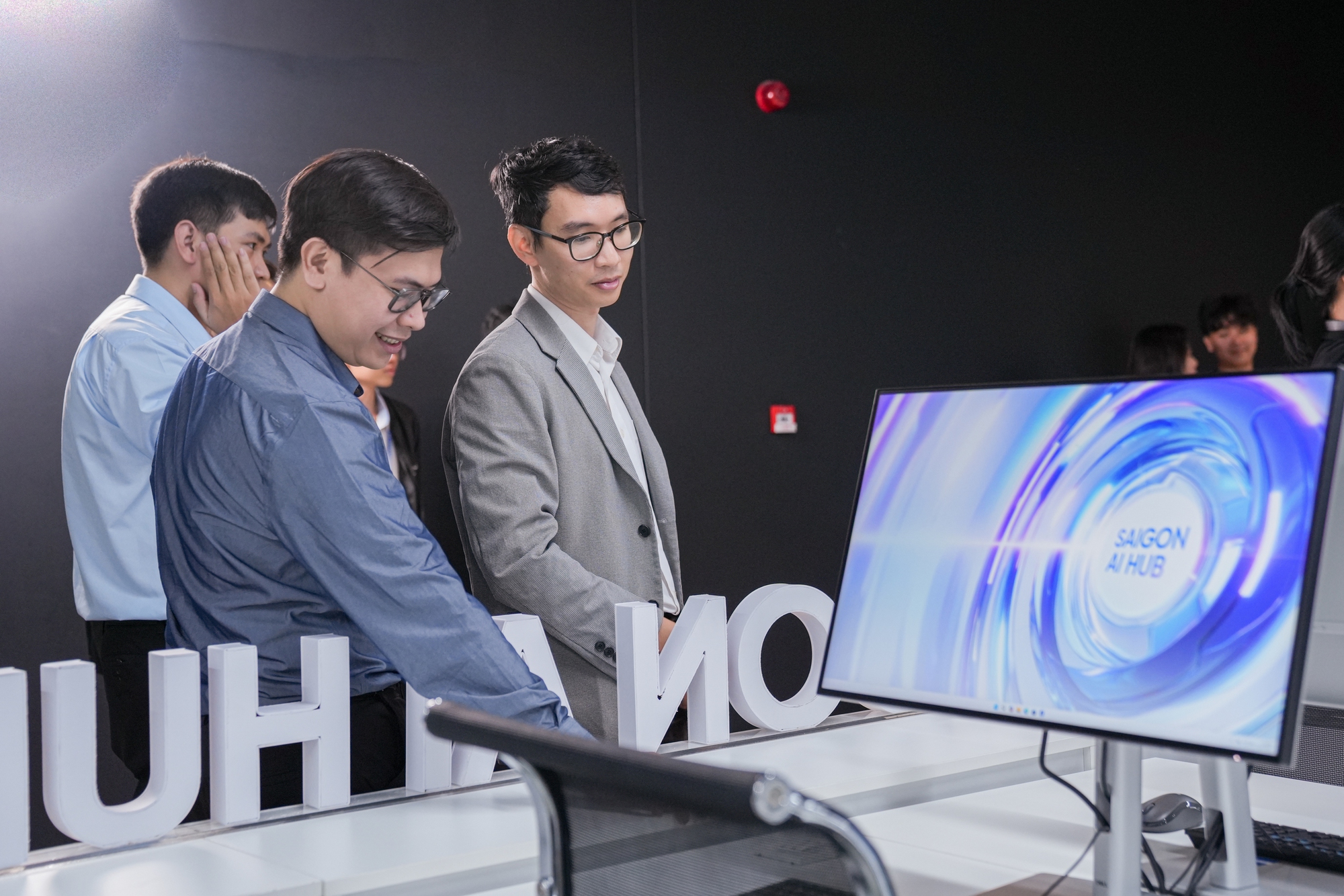
Saigon AI Hub - the first open AI research space in Ho Chi Minh City, established by VNG in collaboration with the Vietnam National University Ho Chi Minh City.
PHOTO: CONTRIBUTOR
Meanwhile, Mr. Vu Hoang Lien also recommended that Vietnam needs to consider the effective use of high-quality human resources and balance it with other resources of society. If only the input training is prioritized, but there is a shortage of graduates, graduates will not have jobs in their field, will not receive adequate salaries, and will not be valued, then this will gradually negatively impact the input, causing the number of trainees to decrease. Conversely, if the output is smooth, and high-quality personnel are rewarded, valued, and their creativity is fostered, then recruitment and training will increase significantly. He emphasized: The State needs a policy to truly develop the labor market, such as institutional recognition, thereby allowing the market to function naturally, creating a closed process based on supply and demand in the economy. A developed human resources market also mobilizes the combined strength of the entire population.
"We shouldn't be hesitant to think that talking about the market means fearing that the workforce will be undervalued. That's a one-sided view. Human resources are a special commodity with high consumer value. If there's a 'market,' it will perfect the process from supply, exchange, and transfer of personnel to the right users, increasing the value of human resources. If we only promote supply without demand, it will negatively impact the supply and the human resource training process. Encouraging businesses to participate in this process along with schools and training centers will create a closed supply and demand chain, developing sustainable human resources for the economy," Mr. Vu Hoang Lien emphasized.
Source: https://thanhnien.vn/dot-pha-nguon-nhan-luc-trong-ky-nguyen-so-185260131210838424.htm

![[Image] Hanoi's urban life under the challenge of a "scorching hot" environment](https://vphoto.vietnam.vn/thumb/1200x675/vietnam/resource/IMAGE/2026/05/25/1779706979265_nang-nong-t5-2026-minh-duy-7-4636-jpg.webp)


![[Image] Close-up view of the interchange connecting the two expressways and Long Thanh Airport.](https://vphoto.vietnam.vn/thumb/1200x675/vietnam/resource/IMAGE/2026/05/25/1779703378210_ndo_br_z7863716673926-224453a31600126cce10622af6290afd-4549-jpg.webp)

















































































Comment (0)