

According to the Ministry of Planning and Investment , in the first nine months of 2023, 75,800 businesses nationwide temporarily suspended operations, an increase of 21.2% compared to the same period in 2022; 46,100 businesses ceased operations pending dissolution procedures, an increase of 26.9%; and 13,200 businesses completed dissolution procedures, a decrease of 4.3%. On average, 15,000 businesses withdrew from the market each month, mostly small and medium-sized enterprises (SMEs).
Even with price reductions of tens of billions of dong, it's still difficult to sell.
This explains why, while many foreign businesses and corporations are hunting for large land plots to develop industrial parks or seeking large areas within existing parks to expand production, many small businesses and household enterprises are constantly putting their business premises, factories, and warehouses up for sale due to production stoppages or the inability to find tenants. In particular, according to experts, due to inevitable demand and supply chain competition, the increasing number of large factory complexes has led to a dwindling market for smaller warehouses and factories.
Touring the outskirts of Ho Chi Minh City, we observed many medium and small-sized factory buildings being advertised at prices 20% to 40% lower than two years ago. For example, Mr. H. is selling a factory complex of nearly 2,000 m², including 450 m² of residential land and over 1,500 m² of other area in Duc Hoa district, Long An province, for 16 billion VND. Previously, he refused to sell when many people offered 20-22 billion VND because his business was doing well. Now, due to business difficulties and loan repayment deadlines, he has decided to close the factory and put it up for sale to pay off bank debts, as he can no longer bear the monthly interest payments of 120 million VND.
Another property in Duc Hoa district, with an area of 5,400 m² (including 4,000 m² of factory space and the rest being agricultural land), is being offered for sale at 23 billion VND, 12 billion VND lower than two years ago but still negotiable. According to the real estate agent, this factory is located near an industrial park and already has business licenses for various industries: textile dyeing, seafood processing, fertilizer production, etc.; it also has full fire safety permits, making it very convenient to use as a satellite warehouse.
Facing similar difficulties, the leader of a plastic manufacturing company in Duc Hoa district stated that they will sell their entire factory, including the business license for the recycled plastic industry, covering an area of 7,400 m² , for approximately 18-19 billion VND. This recycling factory has a capacity of 100,000 tons per year and already has environmental permits. The buyer can start production immediately without needing to reapply, as environmental permits in the plastic industry are difficult to obtain, and the process is lengthy and costly.
"In this industry, environmental standards are very strict, and violations can easily lead to inspections and audits… While product sales are becoming increasingly difficult, we decided to close down and sell the factory at a loss to recover our capital," this person said.
According to reporters from the Nguoi Lao Dong newspaper, many warehouses and factories in the outskirts of Ho Chi Minh City are being offered for sale at low prices, but finding buyers is proving difficult amidst the current economic downturn.
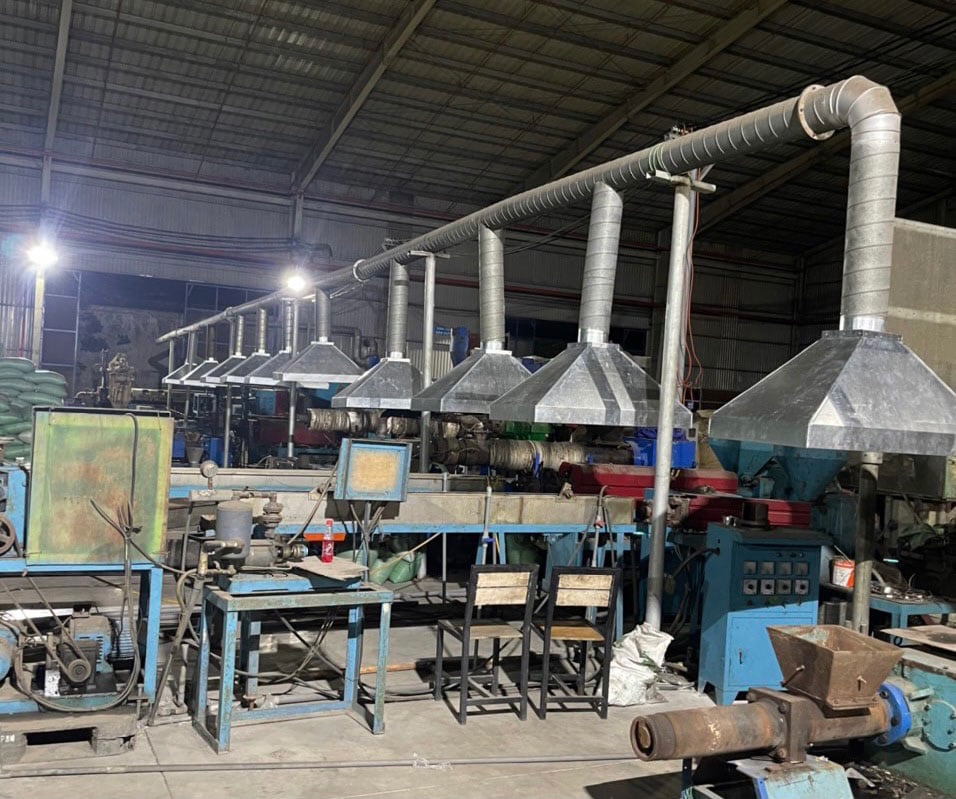
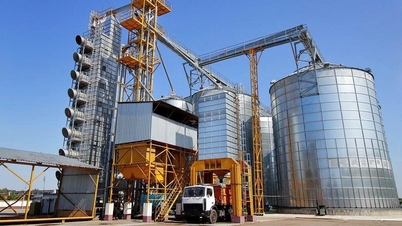
A factory complex in Long An province is being offered for sale.
Is the low price due to a lack of legal basis?
Commenting on this situation, Mr. Tran Khanh Quang, General Director of Viet An Hoa Real Estate Company, said that the sharp decline in export activities since the beginning of the year has greatly affected small and medium-sized enterprises (SMEs). Because these businesses mostly process goods for large enterprises, lacking control over both input and output, they are the most vulnerable when the market is difficult.
"With no more orders, owners of processing facilities have had to cut jobs, close down, or sell their factories. That's why we've seen quite a few small factories for sale recently. However, most of these factories were built illegally, on agricultural land, or with incorrect zoning... making them even more difficult to sell, and prices have dropped significantly compared to regular real estate," Mr. Quang analyzed.
Sharing the same view, Mr. Nguyen Hong Hai, General Director of VNO Company, believes that after the COVID-19 pandemic, especially after incidents related to fires, explosions, and labor safety, factory and production facility constructions, in addition to legal requirements, must comply with many standards regarding land use (distance from residential areas, conformity with planning for production and business land, etc.), fire safety, and environmental protection. Factories built spontaneously in the past are now subject to very thorough inspections, making it impossible to continue operations and forcing the previous owners to close down or put them up for sale.
According to Mr. Hai, the price of small-scale factory real estate has fallen to its lowest level ever. This presents an opportunity for those who need to do business and have the capacity to develop small, satellite factories during this period. However, it is necessary to consider the legal, environmental, and fire safety risks, as mentioned earlier.
They mainly rent large factory spaces.
John Campbell, Deputy Director and Head of Industrial Services at Savills Vietnam, noted that recent large-scale factory leasing deals in Vietnam indicate a shift in the market, with businesses and investors primarily seeking large, ready-built factory spaces instead of renting or purchasing smaller facilities as before.
Source: https://nld.com.vn/kinh-te/dua-nhau-rao-ban-nha-xuong-co-nho-20231113211915977.htm
![[Photo] General Secretary and President To Lam presides over a meeting on preparations for the review of one year of operation of the three-tiered government system.](https://vphoto.vietnam.vn/thumb/1200x675/vietnam/resource/IMAGE/2026/06/02/1780391821195_a1-bnd-4595-9717-jpg.webp)










































































Comment (0)