


Purchasing market-ready eels at an eel purchasing center in Can Tho City.
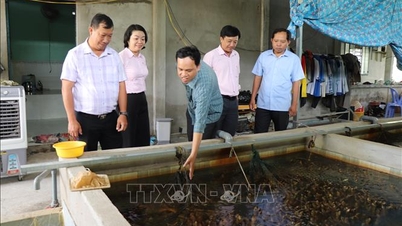
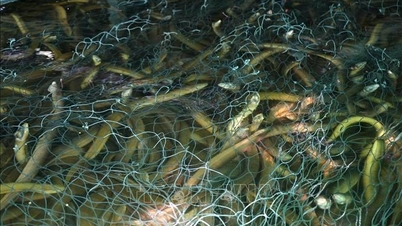
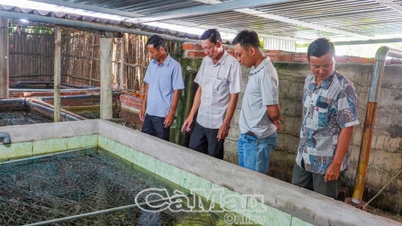
Looking back at the years 2019-2021, when the price of eel meat peaked at 200,000-220,000 VND/kg, people rushed to invest in mudless eel farming models with the belief in attractive profits. This spontaneous, unplanned development led to a situation of oversupply, pushing current selling prices down to a disastrous level of only 37,000-40,000 VND/kg. At this price, eel farmers not only lose all their hard work but also suffer heavy losses in capital, as the average production cost is 40,000-45,000 VND/kg.
The precarious situation faced by farmers reflects a critical flaw: production prioritizes quantity over market fluctuations. Farmers are willing to expand their farming areas despite warnings about output risks and the potential depletion of groundwater resources due to widespread well drilling for eel farming. Meanwhile, standardizing production processes according to good agricultural practices to meet export requirements has not received adequate attention. Without guaranteed product purchase contracts from businesses, all efforts to increase production only exacerbate oversupply and market gluts, turning overflowing eel ponds into a burden of debt instead of a source of income.
This bleak picture isn't limited to eels. The economic deadlock in agriculture is also evident in the story of more than a dozen households in Lao Ven hamlet, Lieu Tu commune, Can Tho city, where over 600 tons of snakehead fish, ready for harvest, are still struggling to find buyers. The inability to sell overgrown fish puts farmers at risk of heavy losses, similar to the situation with overgrown eels, which increases feed, electricity, and water costs while the quality of the meat gradually decreases. This shows a common scenario repeating itself across many aquaculture species in the Mekong Delta: farmers still maintain an impulsive production mindset: they stock when prices are high, and disregard planned farming areas for immediate profit.
The lack of linkage between producers and consumers has made agricultural products in the Mekong Delta unsustainable against even the smallest fluctuations. When production is not integrated with processing and preservation, agricultural products are confined to the domestic market with limited purchasing power, making them vulnerable to price manipulation during peak harvest seasons. To address this fundamental problem, a major reform of agricultural economic thinking is needed. The most urgent recommendation is for all levels of government and relevant agencies to seriously implement planning, management of farming areas, and scientific control of production based on accurate market demand forecasts, rather than relying solely on statistical reports.
Furthermore, building a sustainable supply chain between farmers, cooperatives, and processing businesses must become a mandatory requirement. Farmers need support to access international standards, thereby expanding export opportunities to many potential markets and bringing higher added value to agricultural products. In particular, there needs to be proactive investment in infrastructure for preservation and deep processing to escape the pressure of consuming fresh produce, preventing the heartbreaking cycle of "bumper harvest, plummeting prices." Only when proactive production is established on a foundation of strong linkages and standardized quality can we truly help farmers take control of their own livelihoods.
KHANH TRUNG
Source: https://baocantho.com.vn/dung-cho-giai-cuu-a203337.html
![[Photo] National Assembly Chairman Tran Thanh Man working with the Standing Committee of the National Assembly's Delegation Affairs Committee.](https://vphoto.vietnam.vn/thumb/1200x675/vietnam/resource/IMAGE/2026/05/20/1779294340023_ndo_br_1-1691-jpg.webp)
![[Image] "Journey of Hope" promotes the organ and tissue donation movement in Vietnam.](https://vphoto.vietnam.vn/thumb/1200x675/vietnam/resource/IMAGE/2026/05/20/1779294400833_1-8910-jpg.webp)
![[Photo] General Secretary and President To Lam works with the Party Committee of the Ministry of Health on the work of Vietnamese traditional medicine.](https://vphoto.vietnam.vn/thumb/1200x675/vietnam/resource/IMAGE/2026/05/20/1779294323718_a1-bnd-2978-3319-jpg.webp)






















































Comment (0)