


The small-wheeled vehicle helps Ms. Loan support her entire family.
Generous wheelbarrow
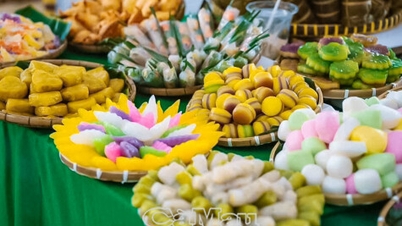
Every day, around 10 a.m., a bicycle loaded with baskets of traditional Vietnamese cakes parks under the Xà No bridge, becoming a popular meeting place for many; if they don't see it, something feels missing. The soft, smooth cakes are skillfully steamed and cooked – there are various types like leaf cakes, beef cakes, banana cakes, steamed rice cakes, rice flour cakes, pork skin cakes, and more. This cake cart belongs to Ms. Nguyễn Thị Loan from Area 2, Vị Tân Ward.
Ms. Le Thi Chinh from Vi Thuy commune, Can Tho city, was buying cakes and chatting cheerfully: "This lady must be selling them out of passion. They're so cheap! I bought them elsewhere for twenty or thirty thousand dong, but here they're only ten thousand dong. The taste is exactly like when my mother used to make them for me back in my hometown."
When someone praised the bánh mì stall as having the best bánh mì here, Ms. Loan smiled gently and said, "There are many women selling bánh mì in the market who are very skilled; if I said it was the best, people would laugh at me."
They may not be the most delicious, but the attractively arranged cakes show that she has put her heart and soul into each one. Every day, she wakes up at midnight, diligently mixing the batter and steaming the cakes until morning, so they are ready to sell.
She recounted that when she was a child, 500 dong was a precious amount to buy sticky rice or cakes. She had 12 siblings, so they rarely had money to buy cakes. Therefore, since she started selling cakes, she has always sold them cheaply. Even when the price of sugar, flour, and dried coconut goes up, her boxes of cakes remain as full as ever. A box containing various types of cakes – leaf cakes, steamed rice cakes, glutinous rice cakes, and banana cakes – she sells for 5,000 dong, or 10,000 dong for a dozen of each type (14 pieces). She sells leaf cakes and pork skin cakes for 50,000 dong per kilogram. Because she sells them so cheaply, even though her bicycle carries nearly 30kg of cakes, she only earns a little over a million dong, making a profit of around 200,000 dong per day.
Nestled amidst the bustling city streets, this food cart carries the weight of several lives. Thanks to it, she was able to raise two children, teach them trades, and support the entire family. Her eldest son learned car repair, while her younger son inherited his mother's dexterity and chose to become a chef. Both work far from home, helping her financially to some extent.
Support the whole family.
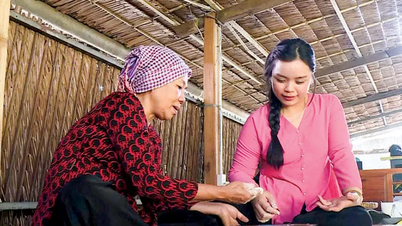
She came to baking as a means of livelihood, and it was also a matter of chance. "Back then, I got married very young and only knew how to bake the basics. When I got married, the neighbors around the village were skilled bakers, and I kept serving at weddings and gatherings, so I got the hang of it. When I found the cakes edible, I started selling them. I've been selling them for over 20 years now," Loan recalled.
In the first few years of her "startup," she carried her basket of cakes on foot to sell them, but gradually, as she made more cakes, she bought a bicycle. That old bicycle has since accompanied her everywhere, witnessing many changes in this land.
She lives a simple life, but every steamed bun she makes is perfectly smooth, beautiful, and delicious to satisfy her. She encapsulates the flavors of her homeland in each bun, leaving a lasting impression on many who try them. At 51, she says her limbs are weaker than before, but when it comes to making buns—grinding flour, kneading dough, steaming—she forgets her fatigue, focusing only on making each traditional bun as skillfully, chewily, and richly flavorful as possible.
Her bánh mì cart has become a familiar sight on Tran Hung Dao Street, Vi Tan Ward. Day after day, the cart quietly sits there, amidst the bustling crowds, carrying with it the hardships, joys, sorrows, and dreams of making a living, preserving family traditions, and maintaining the generous spirit of the beloved people of the Mekong Delta...
Text and photos: HOANG NGUYEN
Source: https://baocantho.com.vn/giu-net-hao-sang-giu-nep-nha-qua-tung-chiec-banh-que-a204997.html


















































































Comment (0)