

Concerns about keeping the passion for the craft alive.
Having spent more than half her life surrounded by the sounds of flour mills and the smell of burning wood, Mrs. Phan Kim Ngan (Bay Muon) is a renowned pastry chef in the Son Island countryside. Born into a family with a long tradition of pastry making, her skill was ingrained in her from childhood. Mrs. Bay Muon confided: “Almost all women in the Mekong Delta know how to make pastries, but to make them delicious and unique also depends on talent. This is a family tradition, so I’ve become so skilled that I can tell what’s missing with just one bite and adjust accordingly. Especially now that tourism is involved, you have to always listen to your customers to ensure the pastries you make are as perfect as possible.”
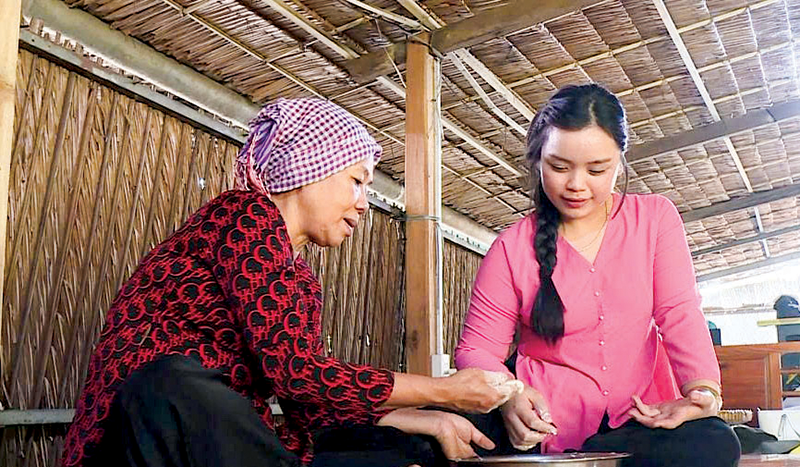
Mrs. Bay Muon "taught hands-on" guidance, passing on her love of the craft and the secrets of making traditional cakes to her daughter-in-law, Ms. Nhu Tuyet. Photo: VAN CANH
Mrs. Bay Muon's dedication has transformed her small kitchen into a captivating stop for countless tourists visiting Son Island. However, time spares no one. Even the most skilled hands gradually weaken with age. The greatest concern of this artisan is how to keep the flame of her craft alive, how to ensure that future generations remain passionate about stone mortars, wood-fired stoves, and charcoal ovens.
And then, that sorrow was resolved in a simple way when the person who shared her burden was her daughter-in-law.
Family traditions are passed down through traditional folk cakes.
The continuation didn't begin with grand plans, but stemmed from deep family affection. Deeply moved by her mother-in-law's tireless efforts from dawn till dusk, Nguyen Thi Kieu Nhu Tuyet, Mrs. Bay Muon's daughter-in-law, decided to learn the craft to ease the burden on the small kitchen. This filial piety kindled a new spark for the family's traditional baking business.
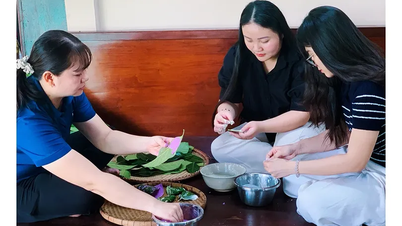
Ms. Tuyet recalled the early days: "When I saw my mother-in-law making jackfruit leaf cakes, her hands molded the dough into the leaves so evenly and beautifully. I was clumsy and couldn't do it, so I kept messing up. Then, gradually, I molded them evenly like my mother-in-law." The journey of keeping the craft alive is not only filled with sweet memories, but also with nights spent up to 2 a.m. meticulously preparing ingredients, hands reddened by the heat of the steamer, and the times she sadly had to discard batches of cakes because of "undercooked or overcooked" cakes.
Traditional Vietnamese cake-making cannot be measured by mechanical methods. It largely relies on the subtlety of the senses: touch to gauge the texture, hearing to hear the bubbling of the boiling water, and sight to know when the cake is perfectly cooked. Mrs. Bay Muon chose a hands-on approach, meticulously guiding her daughter-in-law through this journey of cherishing every grain of rice and every coconut.
The initial pressures and awkwardness of the daughter-in-law gradually gave way to passion. The stove not only emitted heat but also became a catalyst for nurturing her love for traditional values. “Learning the craft of traditional baking takes a lot of time to gain experience. At first, some cakes were too hard, others too soft and not crispy enough. It was hard work, a bit difficult, but I never thought about giving up,” Ms. Nhu Tuyet confided.
The moment Mrs. Bay Muon nodded in satisfaction at her daughter-in-law's batch of cakes was also the moment the thread of heritage between the two generations was tightened. Watching her daughter-in-law nimbly knead the dough, Mrs. Bay Muon couldn't hide her joy: "Nowadays, few young people are willing to cook; most prefer to buy ready-made cakes. But luckily, my daughter-in-law is eager to learn and willing to do it. You have to make many mistakes to gain experience. Now I just pass on the recipe; the rest is up to my daughter-in-law to figure out."
Joy shone in Ms. Nhu Tuyet's eyes when she finished her perfect cake: "When I made a cake that was beautiful, evenly shaped, and delicious, and my mother-in-law praised it, I was so happy. It felt like a great achievement. In the future, I will try my best to make the cakes as delicious as possible, just like my mother-in-law's special flavor."
The sweet reward for all their hard work is the genuine smiles of the customers from afar. Having just made and enjoyed a batch of freshly baked cakes, Ms. Le Thi Hong, a tourist from Hanoi, excitedly said: “Making cakes is very enjoyable, and they taste incredibly delicious because the cakes have a rich, creamy coconut flavor. Not only are they delicious, but seeing the mother and daughter meticulously gathered around the fire, I felt the warmth and soul of the Southern Vietnamese countryside.”
A small cake, yet it encapsulates the essence of the land and the warmth of the people of the Mekong Delta. As long as the fire in the hearth of the countryside continues to burn brightly, and the younger generation cherishes the sweat of their grandparents, the soul of Southern Vietnam will live on forever.
HANG MO
Source: https://baocantho.com.vn/lua-am-truyen-tay-noi-chai-bep-xu-con-a203746.html

![[Photo] General Secretary and President To Lam presides over a working session with the Central Policy and Strategy Committee on the development of the materials industry.](https://vphoto.vietnam.vn/thumb/1200x675/vietnam/resource/IMAGE/2026/05/21/1779359935432_a3-bnd-3129-1412-jpg.webp)

![[Photo] National Assembly Chairman Tran Thanh Man working with the Standing Committee of the Law and Justice Committee](https://vphoto.vietnam.vn/thumb/1200x675/vietnam/resource/IMAGE/2026/05/21/1779378929214_ndo_br_1-4610-jpg.webp)





























































Comment (0)