

 |
| Comrade Le Van Bao, Member of the Standing Committee of the Provincial Party Committee, Vice Chairman of the Provincial People's Committee, and Deputy Head of the Standing Committee of the Provincial Civil Defense Command - Photo: Phan Khiem |
PV: Comrade, 2025 is considered a year with complex and unusual natural disasters, with the largest number of typhoons in the East Sea ever recorded. How do you assess the impact of natural disasters on Quang Tri province?
Comrade Le Van Bao: 2025 is considered a year with very complex and unusual natural disasters, especially the activity of typhoons and tropical depressions in the East Sea, with the largest number ever recorded. In Quang Tri, natural disasters in 2025 will be extremely complex and frequent, with many extreme types, creating immense pressure on prevention and response efforts. This situation demands proactiveness, flexibility, and close coordination among all levels of government and relevant agencies.
The consequences of natural disasters in 2025 resulted in heavy human losses, with 24 deaths, 7 missing persons, and 24 injured. Economically , the total estimated damage was approximately 2,532 billion VND. The most severely affected sectors were agriculture, aquaculture, and essential infrastructure such as irrigation systems, transportation networks, schools, healthcare facilities, and people's homes.
These damage figures show that, under the impact of climate change, extreme weather patterns no longer follow normal rules, creating immense pressure on forecasting and response efforts at the local level.
 |
| Comrade Nguyen Van Phuong, Secretary of the Provincial Party Committee, and Comrade Le Hong Vinh, Deputy Secretary of the Provincial Party Committee and Chairman of the Provincial People's Committee, inspect the implementation of the "Quang Trung Campaign" to rapidly build and repair houses for households affected by natural disasters - Photo: PK |
PV: Comrade, judging from the report summarizing the disaster prevention and control work in 2025, it's clear that the province's advisory and leadership work has made very decisive progress. Could you share more specific details about how the leadership apparatus operates during the most complex periods of natural disasters? Also, how has the province implemented the organization, preparation, and capacity building for response at the grassroots level to ensure the "four on-the-spot" principle is put into practice?
Comrade Le Van Bao: In 2025, especially during Typhoon Bualoi in October, the advisory and operational guidance work was carried out with the spirit of "proactive, decisive, and early response from afar." The Provincial People's Committee issued more than 50 official dispatches, and the Provincial Civil Defense Command issued over 100 directive documents to promptly manage the response, establishing a 24/7 duty roster to receive information and forecast emerging situations right from the grassroots level.
A crucial point is the direct presence of provincial leaders in critical areas through inter-agency task forces, enabling close on-site supervision and timely handling of emergencies. The close coordination between the Department of Agriculture and Environment and the armed forces helped the province effectively control the situation, organize timely evacuations, and minimize casualties despite the severity of the natural disaster.
Regarding preparedness at the local level, following the administrative boundary merger, the Provincial People's Committee issued a decision on disaster response plans according to new risk levels, ensuring that 100% of commune-level administrative units developed plans suitable to the local topography and climate.
To ensure the "four on-the-spot" principle was truly effective, the province mobilized more than 5,000 officers and soldiers to coordinate with 17,262 on-site rapid response forces. In addition, localities proactively stockpiled sufficient supplies and essential necessities such as more than 79,000 boxes of instant noodles and 21,000 boxes of drinking water, ensuring timely supply to areas cut off.
Along with infrastructure and logistics, capacity building has also been given special attention through the organization of 34 skills training courses for more than 1,160 people in the northern and southern communes of the province. The application of science and technology has also created a breakthrough with a system of 90 automatic rain gauge stations, 26 surveillance cameras, and 20 smart flood warning towers. These tools allow provincial leaders to direct operations online down to the commune level and transmit the earliest warnings to individual households, making community awareness the most important "shield" in sustainable disaster risk management.
 |
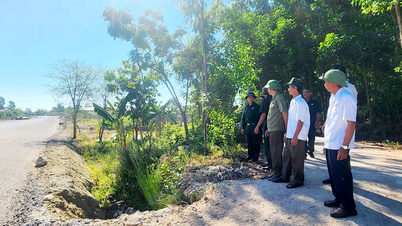
| Groundbreaking ceremony for emergency landslide prevention project in Khe Sanh commune on December 15, 2025 - Photo: Phan Khiem |
PV: Besides the achievements, the summary report also frankly points out shortcomings in leadership and public awareness. Could you elaborate on these lessons learned?
Comrade Le Van Bao: We seriously acknowledge that there are still shortcomings that need to be thoroughly addressed based on the experience of the past year. Firstly, there is the complacent attitude of some people, with many tragic deaths occurring due to people attempting to cross deep floodwaters or fishing and salvaging property while the natural disaster was unfolding. Regarding leadership and guidance, at certain times and in specific incidents, there was still a lack of coordination.
For example, during the initial phase of addressing the landslide in Khe Sanh commune, the advisory work of specialized agencies was not timely or decisive enough, leading to a delay in implementing solutions to ensure the safety of the people compared to practical requirements. This is a major lesson about the responsibility of leaders and the need for proactiveness in developing response scenarios for emergency situations.
 |
| Natural disasters cause severe damage, requiring a shift in risk management thinking - Photo: Phan Khiem |
PV: Based on those practical lessons, what strategic direction does Quang Tri province have to enhance its capacity to prevent and adapt to climate change in the coming time, Comrade?
Comrade Le Van Bao: The consistent viewpoint of the provincial leadership is to innovate thinking, shifting strongly from a passive response to a proactive approach in disaster risk prevention and management. To realize this goal, the province focuses on promoting the application of science and technology, with digital transformation as the core, through the completion of digital maps of natural disasters, the construction of risk databases, and the initial introduction of artificial intelligence to support forecasting. Along with that, priority is given to investing resources in key multi-purpose infrastructure.
In 2025, the province mobilized over 518 billion VND to implement urgent projects such as repairing the Vuc Tron reservoir, the Khe Doi dam, the second phase of the Nhat Le river embankment to prevent landslides, the North Gianh river boat mooring area, repairing the dike system (left bank of the Gianh river, Thuong My Trung dike, left bank of Kien Giang river dike, Bac Phuoc dike, etc.), and addressing landslides at Khe Sanh through the Quang Trung Campaign.
An equally important task is to strengthen the early warning system, ensuring that accurate information reaches people in remote areas in the shortest possible time to optimize response preparation time.
 |
| The landslide incident in residential area 3A, Khe Sanh commune on the afternoon of November 17, 2025 has been resolved - Photo: Phan Khiem |
PV: In the long-term strategy, how does the province position the human factor and the role of the community to ensure sustainability, Comrade?
Comrade Le Van Bao: We believe that the people are not only the beneficiaries of protection but must also be the subjects and the center of disaster prevention and control work. Any investment in technology or infrastructure will only truly be effective when the community has sufficient skills and awareness to strictly adhere to safety guidelines.
Therefore, in 2026, the province will focus on strengthening communication and training in response skills for residents in vulnerable areas, while improving the professional quality of grassroots emergency response forces. Building disaster-safe communities, where every citizen understands on-site response plans, will be a solid foundation for risk reduction.
On the occasion of the 80th anniversary of the Traditional Day of Disaster Prevention and Control, the message that the province wants to send to all levels of government and the people is to maintain a proactive and decisive spirit, and absolutely not be complacent. Quang Tri commits to closely linking this work with socio-economic development planning to protect the safety of people's lives and property and to move towards sustainable development in the face of all natural challenges.
PV: Thank you very much for this interview!
Phan Khiem ( compiled)
Source: https://baoquangtri.vn/moi-nong/202605/doi-moi-tu-duy-tu-ung-pho-sang-quan-tri-rui-ro-thien-tai-3165457/
















































































Comment (0)