

Preserving traditional weaving and musical instruments.
On a summer afternoon, as the sun sets behind the hills, the heat in the mountain town of Khe Sanh subsides. At the community center of Pa Nho village, hamlet 6, the Pa Nho Folk Culture Club begins its regular meeting. The gentle sound of the bamboo flute blends with the melodious Ta Lu string instrument and the resonant Bru-Van Kieu folk songs echoing through the mountain forest.
Throughout the session, artisan Ho Van Hoi quietly observed and adjusted each member's playing and singing, especially the younger members. He is currently the head of the Pa Nho Folk Culture Club and is considered the guardian of the "soul" of folk art and the Bru-Van Kieu cultural identity in the locality.
Over the years, as the pace of modern life has caused many traditional values to gradually fade away, Mr. Hoi has quietly traveled through many villages of the Bru-Van Kieu people to teach young people to play gongs, flutes, and the Nhi and Ta Lu stringed instruments; at the same time, he has collected and compiled ancient folk melodies.
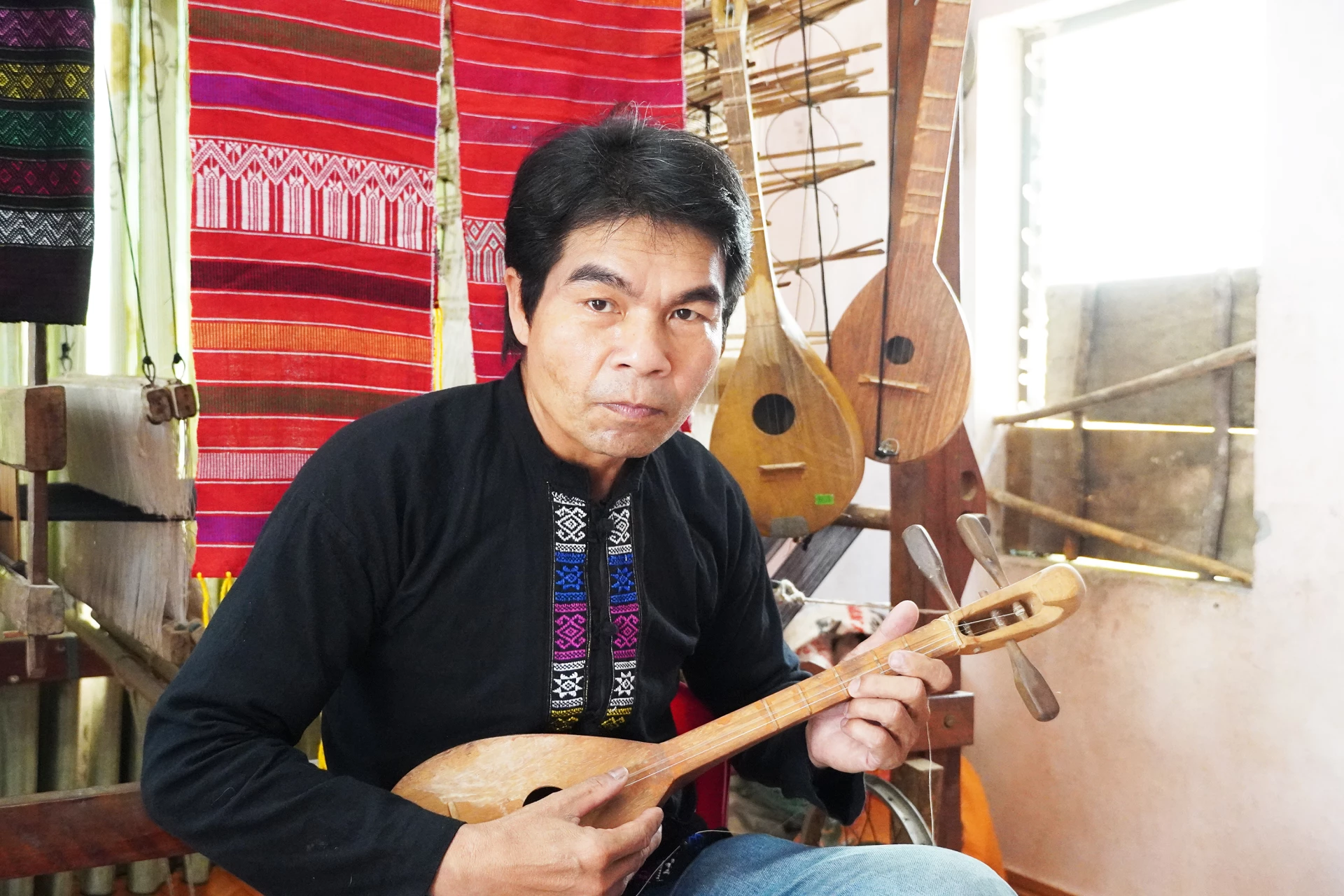 |
| Artisan Ho Van Hoi playing the Ta Lu instrument - Photo: PP |
Born into a Bru-Van Kieu family in the Vietnam-Laos border region, his childhood was filled with the sounds of gongs and drums, the Ta Lu lute, nights of folk singing by the fireplace, and traditional village festivals.
"In the past, almost everyone in the village knew how to play musical instruments and sing folk songs. But then life changed, and many young people are no longer interested. I fear that one day the sounds of our ethnic group's stringed instruments and flutes will disappear," Mr. Hoi shared.
That worry motivated the man, who was used to farming, to relearn traditional musical instruments. Since 2007, when he joined the Pa Nho gong ensemble (the predecessor of the Pa Nho Folk Club), he studied with elderly artisans, learning each gong rhythm, flute melody, string instrument technique, and folk song tune.
Without formal training, his only way of learning was to listen and practice on his own. "The elders would play once, and I'd listen, then practice again at night. If the instrument broke, I'd fix it myself; if I didn't know something, I'd keep asking," he recalled.
Thanks to his perseverance and love for national culture, he rose from an apprentice to a proficient player of many musical instruments such as gongs, bamboo flutes, flutes, Ta Lu lute, Nhi lute, mouth lute, etc.
Not only that, he also composed new lyrics for Bru-Van Kieu folk songs, praising his homeland, the Party and President Ho Chi Minh, and the solidarity of the village, and then taught them to the villagers.
"For culture to survive, it must keep pace with life today. We must preserve the old but also make it feel familiar and appealing to the younger generation," he said.
Besides preserving musical instruments and folk songs, Mr. Hoi is also one of the few artisans in Khe Sanh commune who maintains the traditional brocade weaving craft. When he's not busy, he sits by his loom, meticulously weaving brocade fabrics with patterns characteristic of the Bru-Van Kieu people.
He said that each pattern tells a story about the mountains, streams, fields, and the lives of the local people. Many locals and tourists come to order his products, helping his family earn extra income and contributing to the spread of traditional culture.
Skilled in weaving, he didn't keep his craft to himself but traveled to many places to teach it. In many villages of the Bru-Van Kieu people in Quang Tri and Hue City, he stayed for months at a time to guide the villagers in reviving the weaving craft. As a result, many abandoned looms were put back into use, and many women gained a livelihood from brocade weaving.
Passing on to the younger generation
Over the years, Mr. Hoi has almost never refused invitations from local communities when they needed someone to teach Bru-Van Kieu culture. From remote villages to schools, wherever there were training classes on folk songs, musical instruments, or brocade weaving, he would be there in traditional attire with his traditional musical instruments.
What worries him most is how to make young Bru-Van Kieu people love their ethnic culture. "Nowadays, there are too many phones and social media. Many young people prefer modern music. If we don't pass it on, in a few decades, who will still know how to play the gongs, sing folk songs, and play the Ta Lu instrument?" he confided.
Therefore, for many years, his house has become a free classroom for the youth in the village. After working in the fields, the children gather to learn to play the flute, gongs, and bamboo mouth organs, and sing folk songs. For many schools in the area, Mr. Hoi has also become a "teacher" in extracurricular classes on Bru-Van Kieu culture.
 |
| Artisan Ho Van Hoi teaches Bru-Van Kieu folk songs and traditional musical instruments to students - Photo: PP |
Ms. Ho Thi Tu, Principal of Khe Sanh Ethnic Boarding School, said that for many years, the school has regularly invited artisan Ho Van Hoi to teach folk arts and ethnic culture to students.
"Although I'm not a professional teacher, my approachable and easy-to-understand teaching style has made it very popular with students. This helps preserve and spread the Bru-Van Kieu cultural identity more widely," Ms. Tu said.
For Mr. Hoi, learning traditional musical instruments is not just about learning technique, but also about learning to understand his own national culture. Therefore, when teaching, he always teaches with great patience.
"Playing gongs, stringed instruments, or singing folk songs requires not only getting the rhythm and melody right, but also understanding how to use them in weddings, festivals, or celebrating the new rice harvest," he explained to the students.
“The most valuable thing about artisan Ho Van Hoi is not only his talent but also his voluntary spirit in preserving and promoting community culture. For decades, he has been farming, participating in the work of the Fatherland Front and the Farmers' Association in the locality, and dedicating his time to cultural activities almost without calculating the cost. He has made a significant contribution to preserving and promoting the ethnic cultural values of the locality, and has received many certificates of merit and commendations from various levels and sectors,” said Ms. Tran Thi Thuong, Vice Chairman of the People's Committee of Khe Sanh commune.
Ho Thi Kim Anh, a 6th-grade student from Khe Sanh Ethnic Boarding School, shared: “Learning folk songs and the culture of the Bru-Van Kieu ethnic group from Teacher Hoi has helped us understand and love our ethnic identity even more. We hope that our culture will spread even wider.”
For the Bru-Van Kieu people, Mr. Ho Van Hoi is not only an artisan but also a quiet guardian of the flame, keeping alive the traditional music and songs of his ethnic group, ensuring they continue to resonate amidst the Truong Son mountain range.
Phan Phuong
Source: https://baoquangtri.vn/van-hoa/202606/nguoi-truyen-lua-ban-sac-van-hoa-bru-van-kieu-d1972a1/








































































Comment (0)