

- Cai Nuoc Commune: Landslides cut off vital road connecting 5 hamlets.
- Urgent measures needed to address landslides and subsidence.
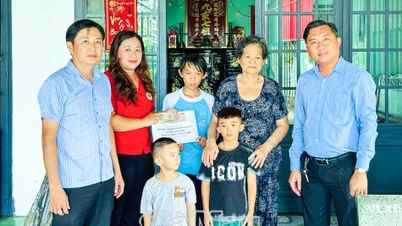
- Providing assistance to people affected by the landslide.
There are small villages formed from a few posts driven into the alluvial plain. There are generations who grew up listening to the sound of boat engines. People living along the river are accustomed to reading the water levels to determine the seasons, and using the silt to assess the land.
But in recent years, the river has not been as gentle as before. Landslides have occurred more frequently. Long cracks running along the riverbanks are like harbingers of a separation. Land is being lost in chunks. Houses are being swept away by the water. And many peaceful rural areas in Ca Mau are having to learn to live with constant anxiety on nights when the river "swallows" the land.
In the early morning of the last day of April, along the Dam Doi River, specifically the section passing through Duong Thi Cam Van Street in Hamlet 1, Dam Doi Commune, the ground suddenly began to shift.
No heavy rain. No thunderstorms. Only a "crack... crack..." sound coming from underground in the darkness.
 In just a few minutes, Mrs. Hien's house and the road leading to it were swallowed up by the river.
Mr. Nguyen Minh Trang (Hamlet 1) remembers that moment very clearly: “It was around 3 a.m. I was lying down when I heard a cracking sound under the floor. At first, I thought it was a truck driving on the road. But the sound was very different, like something underground was breaking…”
As the whole family ran outside, the river in front of them was slowly pulling a section of the road underwater.
It wasn't an instantaneous collapse. It was a slow, terrifying one.
Mr. Trạng stood frozen, watching as the more than 40-meter-long concrete embankment began to tilt. The surface cracked open. Blocks of concrete separated like crumbling biscuits. Then, they all slid down into the river.
"Everything happened very slowly, extremely slowly. So slowly that I could see everything but couldn't do anything to save it."
The scholar was still in shock as he recounted the story.
The landslide, approximately 70 meters long, dragged a 4-meter-wide section of concrete road, a sturdy embankment, a house, and a cargo dock down into the river.
Assets worth over 3 billion VND were lost in just a few minutes.
But what haunted Mr. Trang the most wasn't money, but the helplessness in the face of natural disasters. "I've lived here for decades. With a structure this sturdy, it should have lasted more than 50 years," Mr. Trang asserted confidently.
The Dam Doi River is famous for its "eroding bank on one side and depositing sediment on the other." Knowing they were located on the eroding bank, more than ten years ago, Mr. Trang's family, along with Mrs. Nguyen My Hien's family (from the same hamlet), decided to invest nearly 3 billion VND to build an embankment to prevent erosion.
Large piles were driven deep into the ground. Thick concrete was poured. The embankment was wide enough for trucks to pass through. "When they were building it, everyone said it would be very sturdy, probably last for several decades," Mrs. Hien recalled.
But natural disasters don't follow the lifespan of the structures. In recent years, the river's course has begun to change. The currents are stronger, more troughs are appearing, and the erosion is deeper. Some sections that were reinforced just a few rainy seasons have already cracked again. We thought we could hold onto the land, but it turned out we couldn't!
Then, on the last night of April, the entire stretch of embankment that they had once believed would protect their land finally disappeared.
Mrs. Hien recounted: "Back then, it was incredibly difficult to build this house. Now that I'm older, I have to rebuild it from scratch. I'm just worried about whether my children and grandchildren will still be able to live here in the future..."
As she said that, she looked out at the riverbank, which had been gouged into a sheer cliff. At the foot of the bank, the water was still swirling and murky.
Not only residential houses, but even the most sacred places in this land are being pushed aside by landslides. In Thanh Tung commune, the Thuy Long Goddess Temple has existed for nearly 200 years. People in this riverside region believe that the Thuy Long Goddess is the guardian deity of boats and ships, protecting those who pioneered the land.
Mr. Nguyen Thanh Phong, Head of the Management Board of Ba Temple, recounts that in the old days, the first settlers who came to this area often prayed: "Wherever the snakehead fish jump up, plant a stake and stay." From that belief, the temple was born and has existed for many generations.
But over the past nearly three decades, the temple has had to be relocated at least five times due to landslides. Each time it was rebuilt, the temple was pushed further inland.
Mr. Le Thanh Liem, former Party Secretary and Chairman of Thanh Tung commune (old), pointed towards the riverbank: "Back in the 1980s, this area was over 8,000 m² . Now it's only about 3,500 m² ."
In early 2025, local people contributed money to rebuild the Lady's Temple in a more spacious and modern style, costing nearly 2 billion VND. Hundreds of millions of VND were also invested in the embankment protecting the temple grounds. Yet, just a few months later, a section of the temple courtyard collapsed into the river.
Ms. Pham Thi Tai, the caretaker of the shrine, is still shaken when she recalls that moment: "I heard a loud crash. When I ran out, the small shrine next to the Lady's Shrine was gone..."
Where she pointed, there was now only swirling, muddy water. The shrine had been rebuilt. But the old land was gone. And so, each time the shrine was rebuilt, it moved further and further inland.
 What used to be a spacious courtyard where locals gathered to worship the Goddess, hold ceremonies, and meet on her birthday has now been swept away by the water, leaving only a jagged riverbank after the recent landslide.
People in the Mekong Delta often build their houses facing the river. Because the river is their lifeline. In the morning, they open the door to watch the tide rise and fall; in the afternoon, they paddle their boats out to set traps and cast their lines. Children grow up familiar with the sound of boat engines. The elderly sit on the porch watching the water flow through their lives.
Therefore, losing a home in a riverside area is not just about losing property, but also about losing a part of one's memories.
After each landslide, some people move elsewhere. Some build new houses further inland. Some abandon their livelihoods because they no longer have land to cultivate. The riverside villages are silently changing day by day. Some docks no longer have moored boats. Some roads that were used by people one day have become part of the riverbed the next.
Many afternoons, people stand for a long time at the water's edge. Not to look at the river, but to look at what used to be their homes. As Mrs. Hien said: "Before the landslide, we never thought it would swallow up our house!"
In recent years, landslides in Ca Mau are no longer just small, isolated fault lines along the riverbanks.
According to statistics from relevant authorities, many sections of riverbanks and coastlines in Ca Mau are being eroded by 30-80 meters per year, with some areas losing over 100 meters of land. Each year, approximately 250-300 hectares of protective forest continue to disappear due to the impact of sea waves and currents. Currently, more than 56 km of riverbanks and coastlines throughout the province are in a state of dangerous erosion, directly threatening houses, transportation infrastructure, and many coastal residential areas.
In those places, people don't know how long the land they stand on today will remain. Climate change, rising sea levels, altered currents, and human impact are making the rivers of the Mekong Delta more unpredictable than ever. People are still fighting with everything they have. They drive stakes, reinforce embankments, plant trees to protect against waves... But some shifts are beyond human control.
Mr. Le Thanh Liem said very softly, "Our ancestors cleared this land from the alluvial plain. Now the water is reclaiming it..." Then he fell silent, looking at the river in front of him. The water still flows as it has for hundreds of years. Only the land that remains is dwindling. And beneath the riverbed, there are not only concrete, houses, and stretches of road that have been swept away, but also the memories of an entire rural area.
As evening fell on the Dam Doi River, the water level began to rise. At night, Mr. Nguyen Minh Trang walked along the riverbank with his flashlight, shining it on the cracks that had appeared after the first rains of the season.
He said that many households along this route don't dare sleep soundly at night, always keeping papers, clothes, and a few essentials ready in their homes in case of an emergency.
"If you hear the ground crack, you have to run immediately!" Mr. Trang shared anxiously!
Behind him, Mrs. Nguyen My Hien's house, which was being rebuilt, still faced the stream. Everyone understood that one day, that stream might carry away even more land...
In this struggle, the story is no longer just about dealing with individual landslides, but requires a more fundamental approach: replanning riverside settlements, proactively relocating households in dangerous areas, investing in targeted landslide prevention embankments, and restoring protective forests to reduce pressure on the river flow.
But whatever solution is proposed, what people in these "hot spots" need most is a level of safety that prevents them from being woken up in the middle of the night by a "crack" sound from the riverbank.
Diamond - Ha Giang
Source: https://baocamau.vn/dem-nghe-dat-nut-a129003.html


























































































Comment (0)