

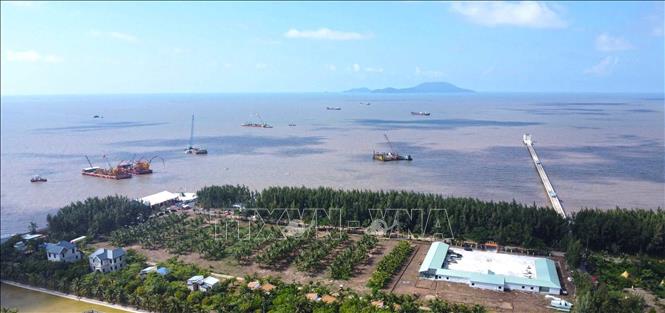
Ca Mau, the southernmost province of Vietnam, holds a particularly important strategic position with three sides bordering the sea, a coastline of 310 km, and an exploitable and exploration area of approximately 120,000 km². Along with one of the largest mangrove ecosystems in the country, the Hon Khoai island cluster, situated on an international shipping route, presents numerous opportunities for the province to develop its marine economy while ensuring national defense and security.
Growth drivers from the sea
According to Mr. Pham Van Muoi, Deputy Director of the Department of Agriculture and Environment of Ca Mau province, in recent years, the marine economy has continued to make an important contribution to the overall growth of the locality, with fisheries playing a pivotal role.
The province's total aquatic product output reached over 1.26 million tons; the shrimp farming area reached over 435,000 hectares, further affirming its position as a major shrimp production center in the country. The seafood processing industry has developed steadily with 89 factories, totaling over 500,000 tons per year. During the 2021-2025 period, processing output is expected to reach over 1.49 million tons, with export turnover exceeding US$10.4 billion. In 2025 alone, seafood exports are projected to exceed US$2.4 billion, making a significant contribution to economic growth and job creation.
Besides fisheries, the province is developing new growth drivers from marine tourism and renewable energy. Between 2018 and 2025, Ca Mau is expected to welcome approximately 40.3 million visitors, with the coastal area attracting nearly 4.7 million; marine tourism revenue is projected to reach approximately 4,557 billion VND.
The province has also attracted 26 wind power projects and one gas power project with a total capacity of approximately 4,650 MW and a total registered capital of over 170,000 billion VND. The transportation infrastructure system continues to receive investment with over 1,800 km of commune roads and over 16,000 km of rural roads, contributing to expanding development space and strengthening regional connectivity.
Alongside economic development, the province has focused on resource management, marine environmental protection, and climate change adaptation. It effectively maintains a marine protected area of approximately 27,000 hectares; strengthens environmental monitoring, pollution control, mangrove forest protection, and implements solutions to combat coastal erosion.
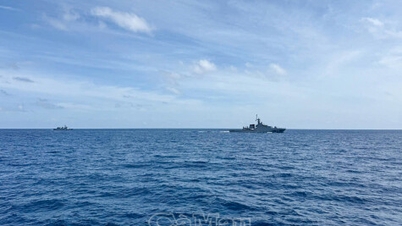
People's lives have gradually improved, with per capita income increasing from 34.36 million VND in 2018 to 65.4 million VND in 2025. National defense and security at sea have been maintained; the management of fishing vessels and the fight against IUU fishing have been strengthened.
According to Mr. Pham Van Muoi, "looking at Ca Mau means seeing the image of a locality rising from the sea and developing strongly thanks to the marine economy."
Towards sustainable development

Based on an assessment of its potential and current situation, Ca Mau province has identified the development of the marine economy as a strategic, central, and long-term task. The province aims for an average GRDP growth rate of 10% or higher during the 2026-2030 period by 2030; marine economic sectors contributing approximately 40-45% of total budget revenue; and a GRDP per capita exceeding US$6,000. By 2045, Ca Mau aspires to become a province with a strong marine economy, developing in a modern, green, and sustainable direction.
According to Le Van Su, Vice Chairman of the People's Committee of Ca Mau province, along with developing the marine economy, the province pays special attention to the task of ensuring national defense and security. Many strategic infrastructure projects are being invested in by the central government, such as the Ca Mau - Dat Mui expressway, the sea-crossing road connecting Ca Mau Cape with the Hon Khoai island cluster, and the Hon Khoai dual-use port. These are considered strategically significant projects, not only opening up trade opportunities for the Mekong Delta region but also contributing to strengthening national defense and security in the southwestern sea area.
In implementing Resolution No. 36-NQ/TW on the Strategy for Sustainable Development of Vietnam's Marine Economy, Ca Mau has planned its development with the marine economy as the pillar of growth, linking marine exploitation with aquaculture and protecting national sovereignty.
The leaders of the Ca Mau Provincial People's Committee believe that, in order to achieve a breakthrough in the marine economy, the locality needs to shift strongly from "training based on existing capabilities" to "training based on strategic development needs," taking a proactive approach to meet future development requirements. Ca Mau also recognizes that it cannot develop according to a model of "sacrificing the environment for growth," but must choose a sustainable path, adapting to climate change and developing a circular economy.
At the provincial workshop on developing the marine economy, Associate Professor, Dr. Tran Dinh Thien emphasized that Ca Mau holds a particularly important position in the national marine economic strategy, with many advantages for developing renewable energy, seaports, marine tourism, marine industries, and coastal urban areas. For sustainable development, Ca Mau needs to prioritize marine economic sectors with high added value, applying modern technology and effectively managing the marine environment.
Meanwhile, Associate Professor, Dr. Nguyen Ba Hoang, Rector of Ba Ria - Vung Tau University, believes that transportation and logistics infrastructure will be the key to unlocking new growth potential for Ca Mau and the entire Southwest region.
According to the development plan for the period 2026-2040, the province needs to focus on developing multimodal transport infrastructure including seaports, inland waterways, roads, air and rail; in which Hon Khoai deep-water port and strategic connecting routes play a driving role in promoting the marine economy and logistics.
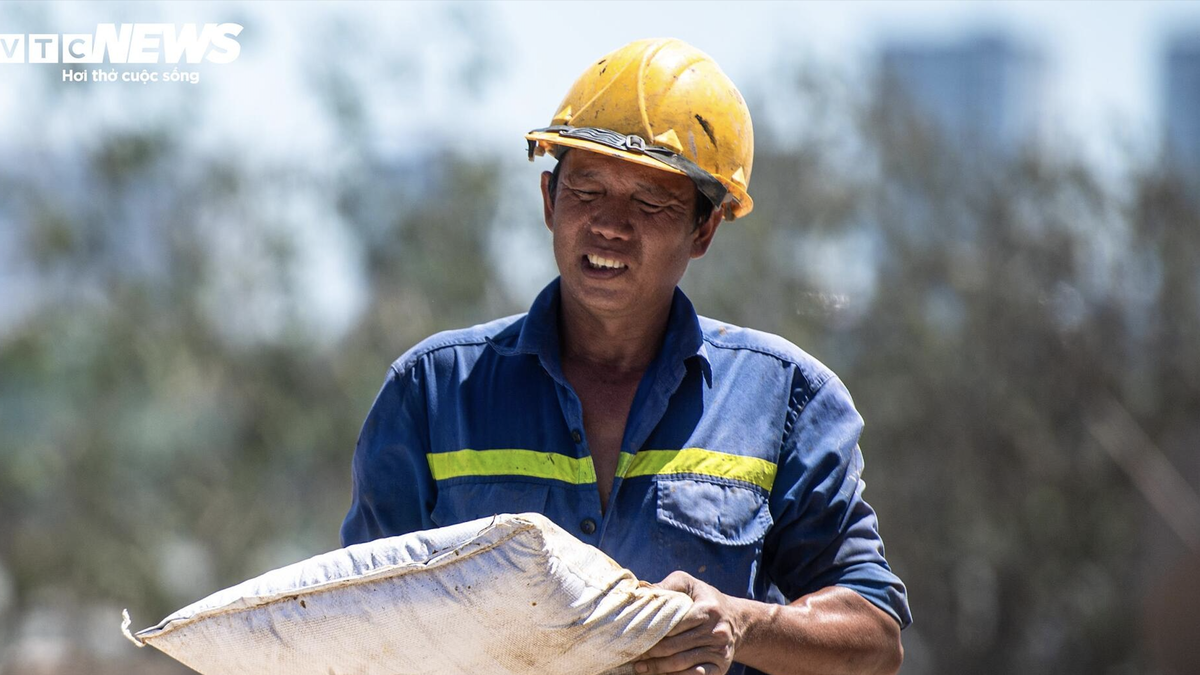
Along with infrastructure investment, the province needs to quickly develop a strategy for training high-quality human resources in the fields of logistics, maritime economy, infrastructure construction, and supply chain management, to meet the development requirements of the new phase.
Source: https://baotintuc.vn/kinh-te-bien-dao/kinh-te-bien-mo-duong-cho-ca-mau-tang-truong-20260522094404606.htm

![[Image] Close-up view of the interchange connecting the two expressways and Long Thanh Airport.](https://vphoto.vietnam.vn/thumb/1200x675/vietnam/resource/IMAGE/2026/05/25/1779703378210_ndo_br_z7863716673926-224453a31600126cce10622af6290afd-4549-jpg.webp)
![[Image] Hanoi's urban life under the challenge of a "scorching hot" environment](https://vphoto.vietnam.vn/thumb/1200x675/vietnam/resource/IMAGE/2026/05/25/1779706979265_nang-nong-t5-2026-minh-duy-7-4636-jpg.webp)




































































Comment (0)